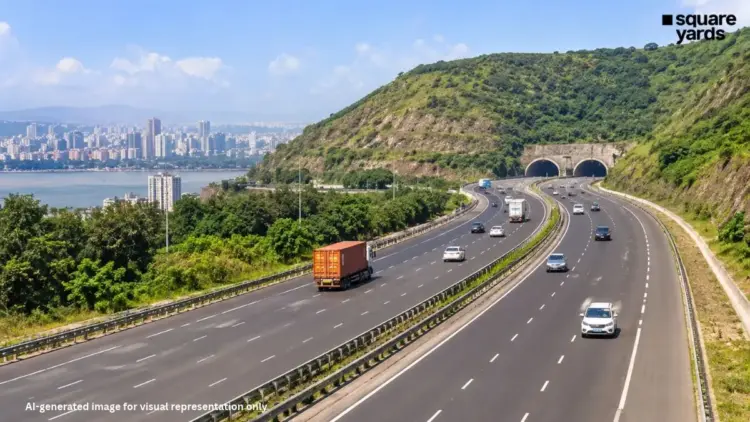
NAVI MUMBAI/PUNE – In a move set to redefine the logistics and commuter landscape of Western India, the National Highways Authority of India (NHAI) has officially moved the first package of the proposed Rs 15,000-crore Mumbai-Pune Greenfield Expressway into the tender process. This ambitious 130-km project aims to provide a high-capacity, eight-lane alternative to the existing saturated corridors, effectively cutting the travel time between the two metropolitan giants to just 90 minutes.
The initiation of the tender for the first 29.2-km stretch marks a significant milestone in India’s infrastructure roadmap, promising to link the burgeoning Navi Mumbai region—specifically the Jawaharlal Nehru Port Authority (JNPA) area—directly with the industrial and IT hubs of Pune.
1. Main Facts: The Blueprint of a Modern Corridor
The Mumbai-Pune Greenfield Expressway is not merely an expansion of existing roads but a completely new alignment designed to handle the projected traffic growth of the next three decades. As the Mumbai Metropolitan Region (MMR) expands southward and eastward, the demand for a dedicated freight and passenger corridor has become critical.
The First Phase: Pagote to Chowk
The NHAI has prioritized a 29.2-km section starting near Pagote (at the junction with NH-348) and concluding at Chowk, where it intersects with NH-48. This specific package is estimated to cost approximately Rs 3,653 crore. Unlike the wider 130-km project, which is envisioned as an eight-lane expressway, this initial segment is planned as a six-lane greenfield highway developed under the Build-Operate-Transfer (BOT) Toll model.
Technical Specifications and Engineering Feats
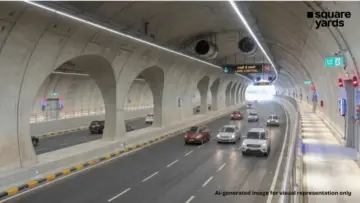
The most striking feature of the first package is the inclusion of two major tunnels through the Sahyadri mountain range. These tunnels are engineered to bypass the treacherous gradients of the Western Ghats, ensuring a flatter, faster, and safer alignment. The project also includes:
- Total Project Length: Approximately 130 km.
- Configuration: 8 lanes for the main corridor; 6 lanes for the first package.
- Total Estimated Cost: Rs 15,000 crore.
- Target Travel Time: 90 minutes from end-to-end.
- Implementation Agency: National Highways Authority of India (NHAI).
2. Chronology: From Conception to Tender
The journey of the Mumbai-Pune Greenfield Expressway reflects the evolving infrastructure needs of Maharashtra. While the existing Mumbai-Pune Expressway (opened in 2002) was a revolutionary project for its time, it has increasingly faced congestion issues, particularly at the "Ghat" sections and the entry points of both cities.
- Pre-2023: Planning and Feasibility: The NHAI and the Ministry of Road Transport and Highways (MoRTH) identified the need for a "Greenfield" (new land) alignment to complement the existing "Brownfield" (upgraded) roads.
- Early 2024: DPR Finalization: Detailed Project Reports (DPR) for the initial segments were finalized, focusing on the connectivity between the Atal Setu (MTHL) and the Pune Ring Road.
- Late 2024: Tender Issuance: The NHAI officially listed the e-procurement notice for the Pagote-Chowk stretch.
- Current Status: The tender schedule has undergone revisions through subsequent corrigenda to ensure competitive bidding and technical compliance.
- Key Milestone: The NHAI e-procurement schedule has set December 24, 2026, as the bid opening date.
- Construction Timeline: Once awarded, the first package has a specified construction period of 910 days (approximately 2.5 years).
The remaining 100-km stretch extending toward Pune remains in the advanced stages of planning and DPR finalization, with land acquisition processes expected to follow the successful tendering of the first phase.
3. Supporting Data: Economic and Geographic Integration
The expressway is strategically designed to act as a "logistics spine" for the region. By connecting the JNPA—India’s premier container port—to the hinterlands of Pune and beyond, the project addresses a long-standing bottleneck in the nation’s supply chain.
Connectivity Matrix
| Connection Point | Significance |
|---|---|
| Pagote (NH-348) | Direct access to JNPA and the Navi Mumbai International Airport (NMIA) influence zone. |
| Atal Setu (MTHL) | Enables seamless travel from South Mumbai to Pune via the new expressway. |
| Chowk (NH-48) | Interconnects with the existing national highway network. |
| Shivare (Bhor) | The planned terminus near Pune, linking with the proposed Pune Ring Road. |
Real Estate Valuation Trends
The announcement of the expressway has already begun influencing property sentiment in the peripheral markets of Navi Mumbai and Pune. According to data from Square Yards, asking prices in these regions reflect their growth potential:
- Navi Mumbai Hubs:
- Ulwe: Rs 17,700 psf (Positioned as a premium node near the airport and MTHL).
- Panvel: Rs 15,450 psf (The primary transit hub for the new corridor).
- Kharghar: Rs 19,150 psf (An established residential market with high social infrastructure).
- Taloja: Rs 11,400 psf (An affordable entry point for industrial and residential buyers).
- Pune Hubs:
- Wakad: Rs 12,700 psf (A preferred residential choice for IT professionals).
- Hinjewadi: Rs 11,400 psf (The heart of Pune’s tech industry, set to benefit from reduced transit times to Mumbai).
4. Official Responses and Implementation Strategy
NHAI officials have emphasized that the Greenfield Expressway is distinct from the MSRDC’s "Missing Link" project, which is currently under construction on the existing expressway. While the "Missing Link" aims to widen the current road, the NHAI’s Greenfield project creates an entirely new route to decentralize traffic.
The BOT (Toll) Model
The selection of the Build-Operate-Transfer (BOT) model for the first package indicates a strategic move to leverage private sector efficiency and capital. Under this model, the private developer will bear the cost of construction and maintenance, recovering the investment through toll collection over a pre-determined period. This shift marks a return to the BOT model, which the government has been revitalizing to reduce the fiscal burden on the exchequer.
Environmental and Engineering Focus
Officials have noted that the Sahyadri tunnels are being designed using modern tunneling methods (possibly NATM or TBM, depending on final geological surveys) to minimize the impact on the ecologically sensitive Western Ghats. By opting for tunnels over deep mountain cuts, the NHAI aims to preserve the local flora and fauna while ensuring an all-weather, landslide-resistant route.
5. Implications: Beyond the Commute
The ripple effects of the Mumbai-Pune Greenfield Expressway extend far beyond a shorter travel time. The project is poised to trigger a socio-economic transformation in the Raigad and Pune districts.
Logistics and Industrial Catalyst
For the manufacturing sectors in Chakan, Talegaon, and Pimpri-Chinchwad, this expressway is a game-changer. Reduced transit times to the JNPA mean lower logistics costs and faster turnaround times for export-oriented units. The corridor is expected to host a series of "Multi-Modal Logistics Parks" (MMLPs) and specialized warehousing zones along its route, particularly near the intersections at Chowk and the Pune Ring Road.
Real Estate and Urban Sprawl
As seen with the Samruddhi Mahamarg and the Delhi-Mumbai Expressway, large-scale road projects lead to "rurbanization"—the development of urban pockets in previously rural areas. The Pagote-Chowk stretch will likely see a surge in demand for industrial plots and worker housing. In Navi Mumbai, nodes like Panvel and Ulwe will evolve from "commuter towns" into integrated logistics hubs.
The "90-Minute" Reality Check
While the 90-minute travel target is a powerful headline, experts suggest that the actual benefit will depend on "last-mile" connectivity. The success of the expressway hinges on how efficiently it integrates with local road networks in Navi Mumbai and the Pune Ring Road. If these connecting arteries are not upgraded simultaneously, the time saved on the expressway could be lost in city traffic.
Conclusion: A Vision for 2030
The NHAI’s move to tender the first package of the Mumbai-Pune Greenfield Expressway is a bold step toward modernizing India’s most vital economic artery. By investing Rs 15,000 crore into an eight-lane corridor, the government is not just building a road; it is constructing a foundation for the next phase of Maharashtra’s industrial and residential growth. As the bid opening date of December 2026 approaches, the eyes of the nation’s infrastructure and real estate sectors will remain firmly fixed on this transformative corridor.
Note: The property rates mentioned are indicative asking prices based on market listings and may vary based on specific project locations, amenities, and market conditions. The project timelines and costs are subject to change based on NHAI’s official corrigenda and administrative decisions.