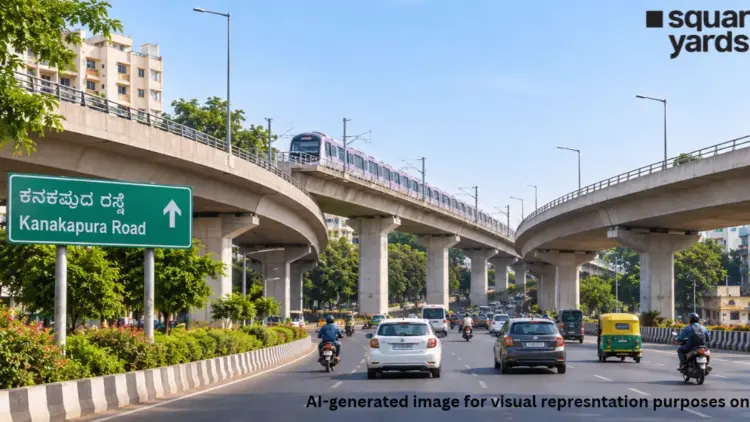
BENGALURU – In a decisive move to address the chronic gridlock plaguing South Bengaluru, the Karnataka state government and city civic authorities have greenlit a major infrastructure overhaul centered around the Konanakunte Cross. The project, estimated at a cost of ₹291 crore, involves the construction of two unidirectional elevated flyovers designed to flank the existing Namma Metro Green Line.
As the city continues to grapple with its reputation as one of the world’s most congested urban centers, this specific intervention on Kanakapura Road represents a sophisticated engineering approach to multi-modal transport integration. By elevating road traffic alongside the metro corridor, the project seeks to resolve a bottleneck that currently handles more than a quarter-million vehicles daily.
1. Main Facts: The Blueprint for a Multi-Tiered Corridor
The core of the proposal lies in the creation of a grade-separated bypass for one of the most troubled stretches of Kanakapura Road. The project targets two critical intersections: the Kanakapura Road-Vasanthapura Road junction and the Konanakunte Cross junction. These two nodes, separated by a mere 125 meters, have become synonymous with "bumper-to-bumper" traffic for residents of South Bengaluru.
Project Specifications and Design
The proposed flyovers are not a single traditional structure but a pair of "twin" elevated roads. According to the Detailed Project Report (DPR), these structures will be:
- Unidirectional: Each flyover will cater to traffic moving in one direction, ensuring a smoother flow without the risk of head-on congestion.
- Parallel Alignment: The flyovers will be built on either side of the existing Namma Metro Green Line piers. This "sandwich" design allows the metro to remain the central spine of the corridor while road traffic is elevated on its flanks.
- Dimensions: Each structure will feature a 7.5-meter carriageway, supplemented by kerbs and crash barriers, bringing the total width of each flyover to approximately 8.5 meters.
- Purpose: The primary goal is to allow "through traffic"—those traveling between Banashankari and the farther reaches of Kanakapura—to bypass the signalized junctions at Vasanthapura Road and Konanakunte Cross.
Financial Breakdown
The ₹291-crore price tag reflects the complexity of working within a high-density urban environment. A significant portion of this budget—approximately ₹191.3 crore—is earmarked specifically for land and structure acquisition. The remaining ₹100 crore will cover the actual construction costs, engineering, and utility shifting.
2. Chronology: The Evolution of Kanakapura Road
To understand the necessity of this project, one must look at the rapid transformation of South Bengaluru over the last two decades.
- 2000s – The Residential Boom: Once considered the outskirts of the city, Kanakapura Road saw a massive influx of residential townships and apartment complexes. The area’s greenery and proximity to the Art of Living International Center made it a preferred choice for retirees and young families alike.
- 2011–2021 – The Metro Era: The expansion of the Namma Metro Green Line from Yelachenahalli to Silk Institute fundamentally changed the corridor. While it provided a reliable mass transit option, the ground-level road infrastructure failed to keep pace with the increasing number of private vehicles and feeder buses.
- 2022–2023 – The Breaking Point: Post-pandemic traffic volumes surged. The Konanakunte Cross junction, which serves as the primary gateway to massive retail hubs like the Forum South Western Mall and several large-scale housing projects, became a permanent choke point.
- 2024 (Current Status) – The Solution Phase: Recognizing that the Metro alone could not solve the congestion for those traveling to areas not directly served by rail, the Bruhat Bengaluru Mahanagara Palike (BBMP) and the state government proposed the twin flyovers as a complementary "road-over-road" solution.
3. Supporting Data: Traffic Density and Land Logistics
The justification for a ₹291-crore investment is rooted in the staggering data collected during feasibility studies.
Traffic Volume Analysis
The stretch between Vasanthapura Road and Konanakunte Cross is one of the highest-density corridors in the city.
- Daily Vehicle Count: Over 2.7 lakh vehicles traverse these two junctions every 24 hours.
- Peak Hour Pressure: During morning and evening peaks, the Passenger Car Unit (PCU) count far exceeds the designed capacity of the existing six-lane ground-level road.
- The 125-Meter Trap: Because the two junctions are located only 125 meters apart, the tailback from one signal frequently spills into the other, creating a "deadlock" scenario where vehicles cannot move even when the light is green.
Land Acquisition and the TDR Mechanism
Building in a developed area like Konanakunte presents immense logistical hurdles. The project requires the acquisition of approximately 6,848 square meters of private land.
- Land Use: The land to be acquired consists of both high-value commercial frontage and residential plots.
- TDR (Transferable Development Rights): To mitigate the high cost of cash compensation and speed up the process, the government intends to utilize the TDR mechanism. This allows property owners to relinquish their land in exchange for additional building rights elsewhere or to sell those rights to developers, a move intended to reduce the immediate financial burden on the exchequer.
4. Official Planning: Integration with the Broader Network
This project is not an isolated intervention; it is a cog in a much larger machine designed to overhaul South Bengaluru’s connectivity.
The Ragigudda-Kanakapura Link
One of the most ambitious projects in the vicinity is the proposed 18.5-km elevated toll corridor. Starting at Ragigudda Junction (near Marenahalli Main Road), this corridor will follow the BWSSB pipeline alignment to connect directly with Kanakapura Main Road.
- Synergy: The Konanakunte Cross flyovers will act as a "feeder" or a continuation of this high-speed network.
- The "Double-Decker" Philosophy: While not a true double-decker structure (like the Silk Board-Electronic City stretch), the Konanakunte project follows the same philosophy of stacking transit modes to maximize the utility of limited "Right of Way" (RoW).
Metro-Road Coexistence
A key challenge for the engineers is the Namma Metro Green Line. The metro stations at Konanakunte Cross and Doddakallasandra are vital transit hubs. The flyovers must be designed to ensure that:
- Station Access is Not Hampered: Pedestrian access to metro stations must remain seamless.
- Structural Integrity: Construction must take place without disrupting the metro’s high-tension lines or the stability of the existing piers.
- Future-Proofing: The design must account for potential future expansions of both the road and rail networks.
5. Implications: Real Estate, Economy, and Quality of Life
The ripple effects of this project extend far beyond the asphalt and concrete of the flyovers themselves.
Real Estate: From "Investment" to "End-User" Goldmine
The real estate market along Kanakapura Road has historically been robust, but traffic woes have occasionally deterred high-end buyers.
- Appreciation Potential: Industry experts suggest that the completion of the flyovers could lead to a 10-15% appreciation in property values in Konanakunte, Vasanthapura, and Doddakallasandra.
- Shift in Demand: Improved connectivity often shifts a neighborhood from an "investment destination" to a "preferred residential hub." With the commute to Banashankari and Jayanagar becoming more predictable, the demand for "ready-to-move-in" homes is expected to spike.
- Commercial Growth: Better road access typically invites more organized retail and Grade-A office spaces. The ease of access for 2.7 lakh daily commuters makes the area a prime target for commercial developers.
Socio-Economic Impact
For the average commuter, the flyover represents the gift of time. By bypassing two of the most congested signals in the city, daily travel time could be reduced by 15 to 20 minutes during peak hours. In a city where the average commuter spends hundreds of hours a year in traffic, this is a significant improvement in the quality of life.
Environmental Considerations
While flyovers encourage private vehicle use—which is often criticized by urban planners—the reduction in "idling time" at signals will lead to a localized decrease in vehicular emissions. However, the long-term success of the corridor depends on how well these flyovers integrate with the Metro, encouraging a "Park and Ride" culture.
Conclusion: A Multi-Modal Future
The ₹291-crore Konanakunte Cross flyover project is a testament to the complexities of modernizing an aging city. By choosing to build around the Namma Metro Green Line rather than competing with it, Bengaluru is embracing a multi-layered approach to urban mobility.
While the road ahead involves the difficult task of land acquisition and the inevitable disruptions of construction, the long-term vision is clear: a South Bengaluru where the metro and the road work in tandem to keep the city moving. For the residents of Konanakunte and the thousands who traverse Kanakapura Road daily, these flyovers are not just structures of steel and concrete—they are a much-needed bridge to a more mobile and less congested future.