

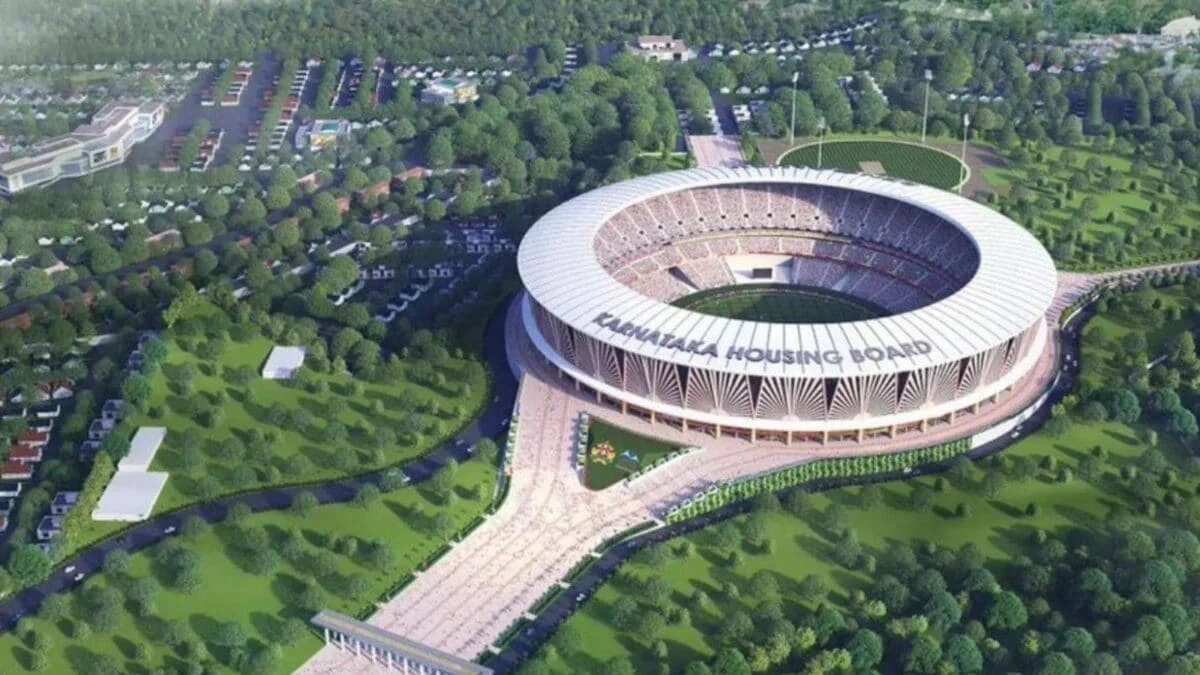
Bengaluru, Karnataka – In a monumental stride towards cementing its position as a premier sporting hub, the state of Karnataka has officially commenced work on an awe-inspiring, state-of-the-art stadium complex in Anekal taluk. This colossal undertaking, poised to become India’s second-largest stadium, marks the most significant infrastructure development drive in the state’s recent history, promising to redefine the landscape of sports and economic growth.
On Sunday, May 24, 2026, the ambitious project was formally inaugurated with a foundation stone laying ceremony led by Chief Minister Siddaramaiah and Deputy Chief Minister D.K. Shivakumar. Situated in Indlawadi Village, near the serene expanse of Bannerghatta National Park, the new facility is envisioned to host a staggering 80,000 spectators, a capacity surpassed only by the iconic Narendra Modi Stadium in Ahmedabad. With an estimated cost of INR 934 Crores, spread over 75 sprawling acres, this multi-sport complex is set to be a beacon of modern sporting infrastructure and a catalyst for regional development.
Main Facts: A Colossal Vision Takes Root
The announcement of this mega-project has sent ripples of excitement across the nation, signaling Karnataka’s unwavering commitment to fostering sports and providing world-class facilities. The core facts underscore the sheer scale and ambition behind this initiative:
Project Launch and Strategic Location
The official launch, marked by the ceremonial laying of the foundation stone, took place in Indlawadi Village, a strategic location within Anekal taluk. This region, nestled close to the ecological richness of Bannerghatta National Park, offers ample space for a project of this magnitude, while also providing a relatively accessible location for residents from Bengaluru and surrounding districts. The proximity to a natural reserve also presents a unique opportunity for integrating green building practices and environmental sensitivity into the stadium’s design and operation, ensuring that development proceeds hand-in-hand with ecological preservation. The chosen site, encompassing 75 acres, provides the necessary footprint not just for the main stadium but also for extensive ancillary facilities, including practice grounds, parking, and potential future expansions.
Unprecedented Capacity and National Significance
At the heart of the project lies the ambitious plan for an 80,000-seat stadium. This capacity immediately propels it into an elite league, making it the second-largest sporting arena in India. This distinction places it firmly behind only the Narendra Modi Stadium in Ahmedabad, which boasts a colossal capacity of 132,000. For Karnataka, a state with a rich sporting heritage but currently lacking a truly mega-stadium, this facility represents a significant upgrade, capable of attracting major national and international events across various disciplines. It signifies a bold statement of intent, positioning Karnataka as a prime destination for large-scale sporting spectacles.
Estimated Investment and Financial Commitment
The financial commitment to this project is substantial, with an estimated cost of INR 934 Crores. This significant investment highlights the state government’s dedication to long-term infrastructure development and its belief in the transformative power of sports. The funding, channeled through the Karnataka Housing Board, underscores a collaborative approach where resources are pooled to achieve ambitious public welfare goals. Such an investment is expected to have a substantial multiplier effect on the local economy, creating jobs, stimulating local businesses, and attracting further investments into the region.
A Holistic Multi-Sport Complex
Crucially, the vision extends far beyond a single-sport arena. The facility is being developed as a comprehensive multi-sport complex, equipped with modern, cutting-edge equipment. While cricket is often a primary driver for such large stadiums in India, the multi-sport approach ensures versatility and caters to a broader spectrum of athletic pursuits. This holistic design reflects a commitment to nurturing diverse sporting talents and providing state-of-the-art infrastructure for various disciplines, from athletics and football to hockey and potentially indoor sports.
The Executing Authority: Karnataka Housing Board
The project is being spearheaded under the aegis of the Karnataka Housing Board (KHB). Known for its expertise in executing large-scale public infrastructure and housing projects, KHB’s involvement provides a strong institutional backbone to ensure efficient planning, timely execution, and adherence to quality standards. Their experience in managing complex logistical and construction challenges will be instrumental in bringing this grand vision to fruition.
Leadership’s Endorsement: CM and Dy CM
The presence and active participation of Chief Minister Siddaramaiah and Deputy Chief Minister D.K. Shivakumar at the foundation stone laying ceremony underscore the project’s strategic importance to the state government. Their joint endorsement signals a unified political will and commitment to seeing this initiative through to successful completion. Their leadership highlights the project not merely as a sporting venue but as a key component of the state’s broader development agenda.
Chronology: From Vision to Foundation
The journey of any mega-project begins with a vision, meticulously planned and strategically executed. For Karnataka’s new stadium, the foundation stone laying ceremony marks a pivotal point, transitioning from conceptualization to tangible development.
May 24, 2026: The Day of Inauguration
The most recent and significant chronological event was the foundation stone laying ceremony on Sunday, May 24, 2026. This formal inauguration, officiated by the state’s top leadership, served as a public declaration of intent and the official commencement of site work. It marked the culmination of extensive preliminary studies, site selections, feasibility reports, and design consultations that would have preceded this major announcement. The timing suggests a period of deliberate planning, culminating in a ready-to-launch project.
Context of the Announcement: A Prolonged Drive for Excellence
The official statement described this initiative as "the state’s biggest drive in a prolonged period of time." This context is crucial. It implies that while Karnataka has always been a significant player in Indian sports, particularly cricket with the iconic M. Chinnaswamy Stadium in Bengaluru, there has been a perceived gap or a lack of truly grand, multi-sport infrastructure capable of hosting events of global stature. This project, therefore, is not merely an addition but a strategic upgrade, addressing a long-felt need and signaling a renewed focus on sports infrastructure development after what might have been a period of less intensive investment in this particular sector. It reflects a shift towards creating a legacy infrastructure that can serve the state for decades.
Anticipated Future Milestones: A Phased Approach
While the foundation stone has been laid, the journey to a fully operational, world-class stadium is a multi-year endeavor. The typical chronology for projects of this scale involves several distinct phases:
- Detailed Design and Engineering (Post-Foundation): Following the initial conceptual designs, this phase will involve intricate architectural, structural, and civil engineering work. Specialists will refine stadium layouts, seating arrangements, player facilities, media zones, and public amenities, ensuring compliance with international sporting standards and safety regulations.
- Tendering and Contractor Selection: Competitive bidding processes will be initiated to select lead contractors and specialist firms for various components of the construction, from civil works to specialized sporting installations and technology integration. Transparency and efficiency in this phase are paramount.
- Groundwork and Site Preparation: This involves extensive earthwork, leveling, drainage systems, and utility installations, preparing the 75-acre site for vertical construction. Environmental impact mitigation measures, especially given its proximity to Bannerghatta National Park, will be critical here.
- Structural Construction: The most visible phase, involving the erection of the main stadium structure, stands, roofs, and building shells for the various complex components. This will be a phased construction, likely involving multiple work packages.
- Fit-out and Finishing: Installation of seating, pitch development, athletic tracks, indoor sporting courts, lighting systems, scoreboard technology, sound systems, and all interior finishes for dressing rooms, hospitality suites, media boxes, and administrative offices.
- Commissioning and Testing: A rigorous period of testing all systems – electrical, mechanical, IT, security, and fire safety – to ensure everything is fully functional and meets operational readiness standards. This also includes test events to identify and rectify any issues.
- Projected Completion and Inaugural Event: While an official completion timeline hasn’t been widely publicized, projects of this scale typically take anywhere from 4 to 7 years. The eventual completion will be followed by a grand inaugural event, potentially an international fixture, to mark its opening.
- Phased Development of Multi-Sport Complex: It is plausible that while the main stadium might be prioritized, some components of the multi-sport complex could be developed in subsequent phases, allowing for flexibility and optimization of resources.
Supporting Data: Building a Global Sporting Hub
The vision for Karnataka’s new stadium is not merely about capacity; it’s about creating a benchmark in modern sports infrastructure. The supporting data and planned features underscore this ambition.
Architectural Grandeur and Modern Amenities: The "State-of-the-Art" Promise
When described as "state-of-the-art," the stadium implies a host of advanced features designed for optimal performance, spectator comfort, and operational efficiency:
- Spectator Experience: Expect ergonomic seating, unobstructed views from all vantage points, wide concourses, multiple entry and exit points for smooth crowd management, and advanced digital signage. Accessibility for persons with disabilities will be a priority, with dedicated seating, ramps, and lifts. Modern hospitality suites, VIP boxes, and corporate lounges will cater to premium guests, offering luxurious amenities and unparalleled views.
- Player Facilities: World-class dressing rooms with dedicated recovery zones, physiotherapy units, and tactical briefing rooms. State-of-the-art practice pitches, indoor nets, and warm-up areas designed to meet international standards. Advanced medical facilities will be on-site, ensuring immediate care for athletes.
- Media and Broadcast Infrastructure: Dedicated media centers, press conference rooms, and commentary boxes equipped with the latest broadcast technology. High-speed internet connectivity, fiber optics, and dedicated power backup will ensure seamless live coverage of events. Specialized camera positions and lighting systems will meet global broadcast requirements.
- Environmental Considerations and Sustainability: Given its proximity to Bannerghatta National Park, the stadium is expected to incorporate green building principles. This could include rainwater harvesting systems for irrigation and non-potable uses, solar panels for renewable energy generation, waste management and recycling facilities, and extensive landscaping with native species to integrate with the natural surroundings. Energy-efficient LED lighting and smart climate control systems would also be integral.
- Technology Integration: The stadium is likely to feature "smart stadium" technologies, including high-definition jumbo screens, cashless payment systems, mobile connectivity solutions for fans, and advanced security surveillance (CCTV, facial recognition) to ensure safety and enhance the fan experience.
The Multi-Sport Vision: Beyond Cricket’s Boundaries
While cricket remains immensely popular, the multi-sport complex signifies a broader commitment to athletic development:
- Diverse Sporting Capabilities: The complex will be designed to host a range of sports. This could include a FIFA-standard football pitch, an IAAF-certified athletics track, and possibly a field hockey pitch.
- Indoor Arenas: The complex may feature indoor facilities for sports like basketball, volleyball, badminton, and table tennis, complete with spectator seating and training infrastructure.
- Training Academies: The long-term vision could include establishing sports academies or centers of excellence for various disciplines, attracting and nurturing talent from across the state and country.
- Equipment and Infrastructure: Furnished with modern, cutting-edge equipment implies specialized gear for each sport, high-quality playing surfaces, and robust support infrastructure for training and competition.
Economic Impetus: A Catalyst for Growth
The investment of INR 934 Crores is not just an expenditure but a strategic economic injection:
- Job Creation: The project will generate thousands of direct and indirect jobs during its construction phase (engineers, laborers, architects) and subsequently during its operational phase (stadium management, hospitality staff, security, maintenance, event staff).
- Tourism Boost: A world-class stadium capable of hosting international events will attract tourists, both domestic and international, boosting the local hospitality sector, transportation, and ancillary services.
- Local Economic Development: The Anekal region, where Indlawadi Village is located, stands to benefit significantly from increased economic activity, property value appreciation, and the development of supporting infrastructure like roads and public transport links.
- Investment Multiplier Effect: The initial investment will trigger further economic activities, as businesses grow to support the stadium and its associated ecosystem, creating a ripple effect across the state’s economy.
Comparing Giants: India’s Stadium Landscape
To fully appreciate the scale of Karnataka’s new project, it’s essential to place it within the context of India’s existing stadium infrastructure:
- Narendra Modi Stadium, Ahmedabad: With a capacity of 132,000, it stands as the world’s largest cricket stadium and India’s largest overall. It sets a high benchmark for sporting infrastructure.
- Other Major Stadiums:
- Salt Lake Stadium (Kolkata): Primarily a football stadium, with a capacity of around 85,000, it has historically been one of India’s largest multi-sport venues.
- Eden Gardens (Kolkata): A historic cricket ground with a capacity of about 68,000.
- M. Chinnaswamy Stadium (Bengaluru): Karnataka’s current premier cricket venue, with a capacity of approximately 40,000, which will remain vital but will be complemented by the new mega-stadium.
- Karnataka’s Future Potential: The new 80,000-seat stadium will significantly elevate Karnataka’s standing, making it a dual-venue state capable of hosting multiple high-profile events simultaneously or larger events that previously couldn’t be accommodated.
Karnataka Housing Board’s Role: Expertise in Large-Scale Projects
The KHB’s involvement is a testament to its proven capability in delivering substantial public projects. Having managed numerous housing schemes, urban development initiatives, and public utility infrastructure, the Board brings invaluable experience in project management, procurement, quality control, and stakeholder coordination, which are critical for a project of this scale and complexity.
Official Responses: Leadership’s Vision and Commitment
The foundation stone laying ceremony was more than just a procedural event; it was an occasion for the state leadership to articulate their vision and commitment to the project and its broader implications for Karnataka.
Chief Minister Siddaramaiah’s Address
Addressing the gathering, Chief Minister Siddaramaiah emphasized the project’s transformative potential. "This stadium is not merely a structure of brick and mortar; it is a monument to our collective aspirations, a symbol of our commitment to the youth and future generations of Karnataka," he declared. "We envision this complex as a cradle for champions, a venue for national pride, and a significant contributor to our state’s economy. Our aim is holistic development, where infrastructure like this provides the platform for our athletes to excel globally, inspiring millions to embrace a healthier, more active lifestyle. This project will be a lasting legacy, establishing Karnataka as a true powerhouse in Indian sports."
Deputy Chief Minister D.K. Shivakumar’s Remarks
Deputy Chief Minister D.K. Shivakumar underscored the infrastructural and economic dimensions of the initiative. "Today marks a pivotal moment in Karnataka’s developmental journey," he stated. "This state-of-the-art multi-sport complex, with its immense capacity, is designed to attract major international events, bringing global attention and significant tourism revenue to our state. It is an investment in our future, creating thousands of jobs and stimulating growth in the Anekal region. We are committed to ensuring timely completion and adherence to the highest international standards, making this a facility that all Kannadigas can be proud of." He also hinted at leveraging the project to enhance urban development around the complex, creating a new economic zone.
Karnataka Housing Board Chairman’s Perspective
A senior official from the Karnataka Housing Board, speaking anonymously due to ongoing tender processes, commented on the technical aspects: "The planning for this project has been meticulous, incorporating advanced engineering and sustainable design principles. Our team is dedicated to executing this project with utmost efficiency, transparency, and a focus on quality. We are collaborating with national and international experts to ensure that every aspect, from spectator comfort to environmental integration, meets global benchmarks. The challenges are significant, but our resolve to deliver a world-class facility is even stronger."
Local Representatives’ Enthusiasm
Local elected representatives from the Anekal taluk expressed their profound gratitude and excitement. "This stadium will transform our region," said a local MLA. "It will bring unprecedented development, job opportunities for our youth, and put Indlawadi Village and Anekal on the national map. We are prepared to support this project fully and ensure that its benefits reach every household in our community."
Sports Ministry Endorsement
While no direct quote was available, sources within the state’s Sports Ministry indicated strong support, viewing the project as perfectly aligned with national sports development goals. The ministry believes such infrastructure is crucial for nurturing talent, promoting a sporting culture, and enabling India to host more international tournaments, thereby bolstering the nation’s sporting prestige on the global stage.
Implications: A Game Changer for Karnataka and Indian Sports
The construction of India’s second-largest stadium in Karnataka carries profound implications, not just for the state but for the broader landscape of Indian sports. It is poised to be a game-changer in multiple dimensions.
Elevating Karnataka’s Sporting Profile
This grand stadium will unequivocally elevate Karnataka’s standing in the national and international sporting arena.
- Attracting Major Tournaments: With an 80,000-seat capacity and multi-sport capabilities, the state can now confidently bid for hosting prestigious events that previously might have been out of reach. This includes major ICC tournaments (Cricket World Cups, Champions Trophies), finals of the Indian Premier League (IPL), significant football matches (including international friendlies or ISL finals), national athletic championships, and potentially even components of multi-sport events like the Asian Games or Commonwealth Games in the future.
- Becoming a Preferred Destination: The modern facilities, combined with Bengaluru’s existing infrastructure (international airport, hospitality, connectivity), will make Karnataka a highly attractive destination for sports federations, teams, and event organizers. This could lead to a consistent calendar of high-profile events.
- Global Recognition: Successfully hosting major international events will bring global media attention, showcasing Karnataka’s capabilities and cultural richness to a worldwide audience, thereby boosting its image and soft power.
Nurturing Future Talent
Beyond mere event hosting, the stadium complex is designed to be a crucible for sporting excellence.
- World-Class Training Facilities: The multi-sport complex will provide unparalleled training infrastructure for local athletes across various disciplines. Access to international-standard pitches, tracks, and indoor arenas will be crucial for honing skills and preparing for elite competition.
- Inspiration for Youth: The sheer scale and grandeur of the stadium will serve as a powerful source of inspiration for young aspiring athletes. Witnessing top-tier competitions and having access to such facilities will motivate more children and teenagers to pursue sports seriously, fostering a robust grassroots sports culture.
- Potential for Sports Academies: The establishment of dedicated sports academies or centers of excellence within or adjacent to the complex is a natural progression. These academies could offer specialized coaching, sports science support, and holistic development programs, effectively acting as talent pipelines for state and national teams.
Socio-Cultural Impact
The project extends its influence beyond the sporting realm, impacting the broader societal fabric of Karnataka.
- Promoting Sports Culture and Healthy Lifestyles: The visibility and accessibility of such a facility will invariably promote a stronger sports culture. It will encourage physical activity, teamwork, and healthy lifestyles among the populace, contributing to public health outcomes.
- Community Engagement and Pride: The stadium will become a focal point of community pride and identity. Local residents will have a state-of-the-art venue to support their teams and enjoy world-class entertainment, fostering a sense of belonging and collective ownership.
- Enhancing Urban Development: The area surrounding the stadium in Anekal taluk is expected to witness significant urban development. This includes improved roads, public transport, hospitality services, retail establishments, and residential projects, transforming Indlawadi Village into a vibrant urban node.
Challenges and Future Outlook
While the vision is grand, the path to completion will not be without challenges.
- Funding and Financial Management: Sustaining the INR 934 Crores investment over several years will require robust financial planning and management, potentially involving public-private partnerships or diverse funding streams.
- Environmental Clearances: Given its proximity to Bannerghatta National Park, stringent environmental impact assessments and adherence to ecological guidelines will be crucial to ensure sustainable development and mitigate any potential adverse effects on biodiversity.
- Logistical Hurdles: Managing the construction of such a large facility, including sourcing materials, deploying skilled labor, and ensuring efficient transportation, will present significant logistical complexities.
- Long-Term Maintenance and Operational Sustainability: Once built, the stadium will require substantial investment in maintenance, security, and operational staff. Developing a sustainable operational model that generates revenue through events, sponsorships, and ancillary services will be vital for its long-term viability.
- Integration with Existing Ecosystem: Successfully integrating the new stadium with Karnataka’s existing sports infrastructure and calendar will be important to maximize its utility and avoid redundancy.
Despite these challenges, the long-term outlook remains overwhelmingly positive. The new stadium represents a bold declaration of intent from Karnataka – a commitment to not just participate in the sporting narrative of India but to lead it.
Conclusion
The foundation stone for Karnataka’s monumental 80,000-seat multi-sport complex in Anekal taluk marks the beginning of an exciting new chapter for the state. This ambitious INR 934 Crore project, poised to become India’s second-largest stadium, is far more than a mere sporting venue; it is a strategic investment in the state’s future. It promises to be a powerful catalyst for economic growth, a beacon for nurturing athletic talent, and a symbol of Karnataka’s unwavering commitment to fostering a vibrant sports culture.
Under the visionary leadership of Chief Minister Siddaramaiah and Deputy Chief Minister D.K. Shivakumar, and executed by the experienced Karnataka Housing Board, this "state-of-the-art" facility is set to transform the sporting landscape, attract international acclaim, and inspire generations of athletes. As the concrete rises from the 75 acres of Indlawadi Village, Karnataka is not just building a stadium; it is building a legacy, cementing its position as a global sporting hub and ushering in a new dawn for Indian sports. The journey ahead will demand perseverance and precision, but the promise of a glorious future for sports in Karnataka shines brighter than ever before.
