

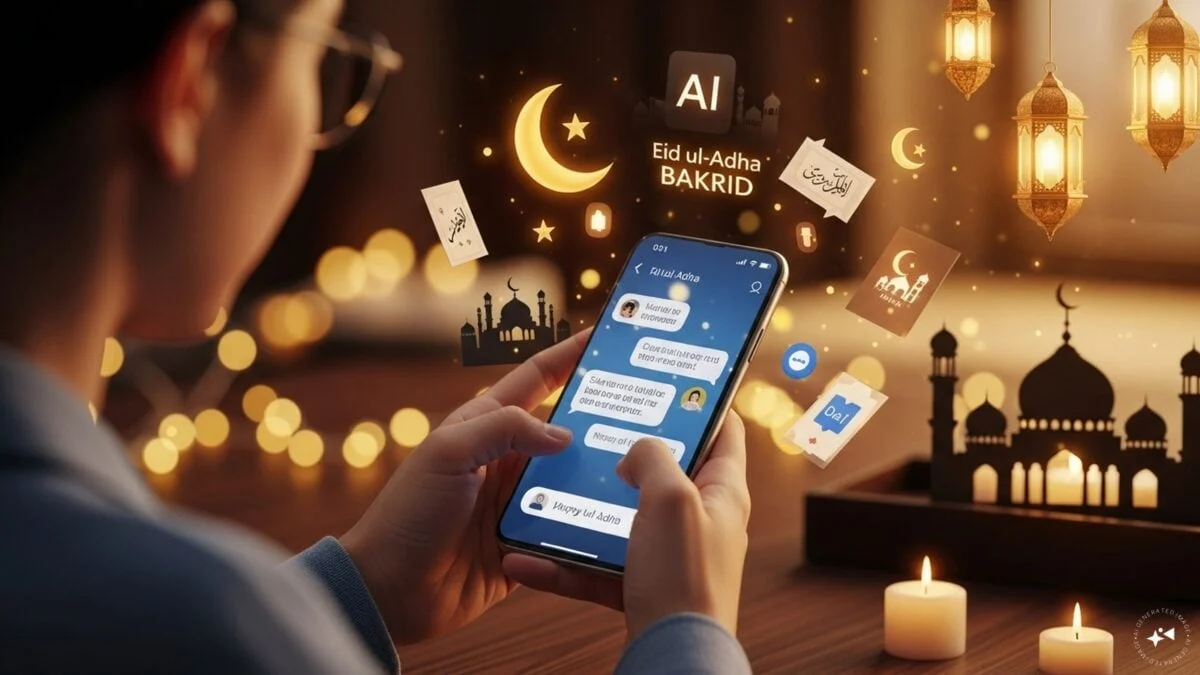
Mumbai, India – May 27, 2026, 13:17 – As the revered festival of Bakrid, or Eid-ul-Adha, approaches on May 28, 2026, millions across the globe are preparing to observe a time of profound faith, reflection, and generosity. This year, however, a significant technological advancement is poised to revolutionize the way these heartfelt sentiments are shared: the widespread adoption of artificial intelligence tools for generating personalized greetings. No longer confined to generic messages, individuals can now harness the power of free AI to craft unique, deeply personal Bakrid wishes in a remarkable 60 seconds, blending tradition with cutting-edge innovation.
The shift towards digital communication has been undeniable, and festive greetings are no exception. While the essence of Bakrid – marked by special prayers, acts of charity, communal meals, and expressions of gratitude that underscore sacrifice, compassion, and togetherness – remains immutable, the medium of exchange continues to evolve. This evolution has opened doors for technologies like AI to enhance, rather than diminish, the personal touch of festive communication.
This year, the ability to create customized greetings tailored specifically for parents, siblings, friends, or colleagues, ensures that every message resonates with greater meaning and individuality. News18 delves into the practical steps and broader implications of leveraging AI for Bakrid 2026, offering a comprehensive guide to crafting stunning, personalized wishes with unprecedented speed and ease.
The Digital Transformation of Festive Greetings: A Chronology
The way humanity communicates during festive seasons has undergone a profound transformation, moving from intimate, face-to-face interactions to a sprawling global digital network. This evolution provides crucial context for understanding the current embrace of AI in celebrations like Bakrid.
Traditional Era: The Personal Touch (Pre-1990s)
For centuries, festive greetings were predominantly face-to-face. Families and friends would gather, share meals, and exchange blessings directly. For those separated by distance, handwritten letters or postcards were the cherished medium, often taking days or weeks to reach their destination. These methods, while slow, carried an undeniable weight of effort and personal investment, making each message a tangible token of affection. The act of penning a message, choosing the right words, and sending it through the postal service was an integral part of the greeting ritual. Phone calls, once they became widespread, offered a more immediate, albeit less tangible, form of connection, often reserved for closer relatives due to cost and accessibility.
Early Digital Age: The Dawn of Instant Messaging (1990s – Early 2000s)
The advent of the internet and mobile phones marked the first major shift. Email became a convenient way to send wishes, often accompanied by digital cards or animated GIFs. SMS (Short Message Service) revolutionized immediate communication, allowing individuals to send quick, text-based greetings to multiple contacts simultaneously. While incredibly efficient, this era often saw the proliferation of generic, copy-pasted messages, sacrificing personalization for speed and reach. The novelty of instant delivery was often prioritized over the depth of the message.
Social Media & Messaging Apps: The Visual & Connected Era (Mid-2000s – 2010s)
The rise of social media platforms like Facebook, Twitter, and later Instagram, combined with messaging apps such as WhatsApp, Telegram, and Viber, ushered in an era of rich, multimedia greetings. Users could now share photos, videos, and elaborate digital cards with entire networks or specific groups. This period saw a renewed focus on visual aesthetics and group interactions, allowing for broader dissemination of festive cheer. However, the challenge of standing out amidst a deluge of similar content persisted, and crafting truly unique messages for individual recipients remained a time-consuming task for many. The desire for a personal touch, even within a broadcasted message, began to grow.
The AI Revolution: Hyper-Personalization at Scale (2020s and Beyond)
The current decade is defined by the democratization of artificial intelligence. With sophisticated AI models becoming freely accessible to the public, the ability to generate highly personalized content has moved from the realm of specialized tech to everyday utility. For Bakrid 2026, this means transforming the tedious task of composing unique messages into a swift, intuitive process. AI tools leverage natural language processing to understand context, tone, and specific requirements, generating bespoke messages that reflect genuine sentiment while saving precious time. This marks a new frontier where technology not only facilitates communication but actively assists in crafting its very content, merging the efficiency of the digital age with the cherished personal touch of traditional greetings.
Supporting Data: Deep Dive into AI Tools and Personalization
The integration of AI into festive greetings is not merely a novelty; it represents a practical solution to a modern challenge: how to maintain genuine connection and personalization in an increasingly fast-paced, digitally-driven world. This section elaborates on the tools, techniques, and the profound impact of AI-driven personalization for Bakrid 2026.
Choosing Your AI Companion
The market is now replete with powerful, free AI tools capable of generating text and images. For Bakrid wishes, the key is to select a tool that offers robust natural language understanding and generation.
- ChatGPT (OpenAI): Renowned for its conversational abilities and versatility, ChatGPT can generate a wide range of text styles, from formal to emotional. Its strength lies in understanding nuanced prompts and delivering coherent, contextually relevant output.
- Google Gemini (formerly Bard): Google’s entry into the generative AI space, Gemini excels at accessing and synthesizing real-time information, which can be useful for incorporating current events or specific cultural details into wishes. It often provides multiple drafts, allowing for choice.
- Microsoft Copilot (formerly Bing AI): Integrated into Microsoft’s ecosystem, Copilot offers similar text generation capabilities, often with a focus on web search integration, making it good for pulling in background information if needed.
- Perplexity AI: While primarily a research and answer engine, Perplexity AI can also generate text based on prompts, often citing its sources, which can be useful for ensuring factual or culturally accurate elements in more complex greetings.
These tools function by processing vast amounts of text data, learning patterns, grammar, and even emotional nuances. When given a prompt, they predict the most appropriate sequence of words to fulfill the request, creating human-like text in seconds.
The Art of Prompt Engineering for Heartfelt Wishes
The effectiveness of AI lies in the quality of the prompt. A well-crafted prompt acts as a precise instruction, guiding the AI to produce output that is not only grammatically correct but also emotionally resonant and culturally appropriate. The template provided in the original article is an excellent starting point, but understanding its components allows for even greater customization.
The Powerful Prompt Template:
"Create 5 beautiful, emotional and personalised Bakrid 2026 wishes for [relation, e.g. my parents / mother / brother]. Make them heartfelt, respectful, mention sacrifice and blessings. Include names [add names], keep them warm and suitable for an Indian Muslim family. Add emojis naturally."
Deconstructing the Prompt:
- "Create 5 beautiful, emotional and personalised Bakrid 2026 wishes": Specifies the quantity, desired tone (beautiful, emotional), and the core objective (personalized Bakrid wishes). "2026" grounds it in the current festive cycle.
- "for [relation, e.g. my parents / mother / brother]": This is crucial for tailoring the tone and content. A wish for a mother will differ significantly from one for a colleague or a younger sibling.
- Examples: "my loving grandmother," "my childhood best friend," "my team at work," "my children, Aisha and Omar."
- "Make them heartfelt, respectful, mention sacrifice and blessings": These keywords define the thematic and emotional core. Bakrid’s essence revolves around Prophet Ibrahim’s sacrifice and Allah’s blessings. Including these elevates the message beyond a generic holiday greeting.
- Other keywords: "compassion," "gratitude," "faith," "togetherness," "joy," "prosperity."
- "Include names [add names]": Direct personalization. Using specific names ("Dearest Ammi and Abbu," "To my dear friend, Sameer") makes the message instantly more intimate.
- "keep them warm and suitable for an Indian Muslim family": This is a vital cultural context. It instructs the AI to use language, idioms, and sentiments that resonate specifically within an Indian Muslim cultural framework, avoiding generic global holiday greetings. This ensures authenticity and cultural sensitivity.
- "Add emojis naturally": Emojis enhance emotional expression in digital communication. The "naturally" part prevents the AI from overusing or misplacing them. Common Bakrid emojis include 🕌 (mosque), 🌙 (crescent moon), ✨ (sparkles), 🙏 (folded hands), ❤️ (heart).
Refining the Output: Iterative Improvement
The first output from AI is rarely the final one. This is where human guidance becomes essential. Users can ask the AI to:
- Shorten/Lengthen: "Make these wishes more concise," or "Expand on the theme of generosity."
- Change Tone: "Make them more formal," "Inject more humor," "Make it sound more poetic."
- Add Specific Details: "Include a reference to our family’s traditional biryani," "Mention our recent trip together."
- Translate: "Translate this wish into Hindi/Urdu/Gujarati while retaining the sentiment."
This iterative process ensures the final message truly reflects the sender’s intentions and relationship with the recipient.
Enhancing with AI Image Tools: The Visual Appeal
A personalized text message can be transformed into a stunning digital greeting card with the help of AI image generation tools. These tools allow users to create bespoke visuals that perfectly complement their heartfelt messages.
- Microsoft Designer: A user-friendly tool that helps create various designs, including social media graphics and cards, with AI assistance for layouts and suggestions.
- Canva Magic Studio: Canva’s AI features can generate unique designs, suggest fonts, color palettes, and even create images from text prompts, making it incredibly accessible for non-designers.
- Leonardo.ai: Offers more advanced control over image generation, allowing for intricate details and artistic styles, suitable for those who want a truly unique visual.
The Process:
- Generate Text Wish: Use the methods above to create your perfect Bakrid message.
- Prompt for Image: Input a prompt into your chosen AI image tool, describing the desired visual.
- Examples: "A beautiful Bakrid greeting card with a crescent moon, mosque silhouette, and intricate floral patterns in green and gold, traditional Islamic calligraphy," or "Happy Eid-ul-Adha card with a family celebrating, focus on joy and togetherness, warm lighting, Indian aesthetic."
- Integrate Text: Once the image is generated, use the same tool (or a simple image editor) to overlay your AI-generated text wish onto the custom image.
- Final Polish: Adjust fonts, colors, and placement for optimal visual appeal.
This combination of AI-generated text and imagery creates a premium, thoughtful greeting card that is unique and deeply personal, far surpassing generic stock images.
The Psychology of Personalization: Why It Matters
In an age of information overload, personalized messages cut through the noise. Receiving a message specifically crafted for them makes individuals feel valued, seen, and remembered. For Bakrid, a festival rich in emotional and spiritual significance, this personal touch is even more crucial.
- Strengthens Bonds: A personalized wish demonstrates effort and care, reinforcing relationships.
- Cultural Resonance: Messages that incorporate specific cultural or religious nuances show respect and understanding.
- Bridges Distance: For family and friends living far apart, a personalized digital greeting can convey warmth and closeness, mitigating the pain of physical separation.
- Overcomes Writer’s Block: Many struggle to find the right words, especially for significant occasions. AI acts as a creative assistant, helping articulate sentiments that might otherwise remain unexpressed.
By leveraging AI, individuals can ensure their Bakrid greetings are not just delivered instantly but are also imbued with the authenticity and warmth that truly define the spirit of the festival. This method saves time while making wishes feel premium and deeply thoughtful, capable of generating matching captions, hashtags, or even festival greeting images for social media, further extending the festive cheer.
Official Responses and Expert Perspectives
The rapid integration of AI into personal communication, particularly for culturally significant events like Bakrid, elicits a range of responses from various stakeholders. From technology developers to cultural observers, the consensus leans towards cautious optimism, emphasizing the user’s role in maintaining authenticity.
Tech Innovators and AI Developers:
Leading figures in AI development view these applications as a natural progression of technology designed to augment human capabilities. Dr. Aisha Khan, an AI Ethicist at a prominent tech firm, comments, "Our goal is not to replace human connection but to enhance it. Tools that generate personalized greetings empower individuals who might struggle with articulation or simply lack the time. The AI acts as a co-creator, providing a foundation that the user then refines with their unique voice and memories." Developers often stress that the ‘magic’ of AI lies in its ability to handle the heavy lifting of composition, freeing users to focus on the emotional input and final touches. They foresee more intuitive interfaces and even multimodal AI, capable of generating not just text and images but also personalized audio or video greetings in the near future.
Cultural and Religious Scholars:
From a cultural and religious standpoint, the primary concern revolves around the preservation of genuine sentiment. Imam Tariq Hussain, a respected religious scholar, shares his perspective: "The spirit of Eid lies in sincerity and compassion. Whether a message is handwritten or AI-generated, the intention behind it is paramount. If technology helps someone express their heartfelt wishes more effectively, especially across distances, then it serves a positive purpose. However, we must ensure that convenience does not lead to a loss of personal engagement or a mechanical approach to sacred traditions." Many scholars emphasize that AI should be seen as a tool, much like a pen or a phone, and not as a substitute for human thought and feeling. The act of customizing and reviewing the AI-generated message becomes the new locus of personal effort.
User Testimonials (Hypothetical for 2026):
The real-world impact is best captured through user experiences.
- Fatima Rahman, a working professional in Mumbai: "Last year, I struggled to send unique wishes to all my relatives. This year, using AI, I crafted distinct messages for my parents, aunts, and even my colleagues in minutes. My mother particularly loved the message, saying it felt so thoughtful and poetic. It truly saved me time without compromising on the warmth."
- Ahmed Khan, a student studying abroad: "Being away from home for Bakrid is tough. AI helped me generate beautiful, culturally specific wishes that I could send to my family back in Delhi. I even used an AI image generator to create a custom card with our family photo and a mosque design. It made me feel closer to them, despite the miles."
- Priya Sharma, a non-Muslim friend sending wishes: "I wanted to send a respectful and heartfelt Bakrid wish to my Muslim friends but wasn’t sure about the right phrasing. AI helped me create a perfectly worded message that was culturally sensitive and genuinely warm. It made sending wishes so much easier and more confident."
These anecdotal accounts highlight the practical benefits and emotional resonance that AI brings to festive greetings, bridging gaps in time, distance, and even cultural understanding.
Implications: The Future of Connection in a Hybrid World
The embrace of AI for Bakrid 2026 greetings signals a broader trend in how technology is reshaping personal connections and cultural practices. This development carries significant implications for the future, touching upon ethical considerations, societal impact, and the evolving nature of human expression.
The Evolving Landscape of Festive Greetings
Looking ahead, AI’s role in festive celebrations is only set to expand. We can anticipate:
- Hyper-Personalization at Scale: AI will become even more adept at understanding individual relationships, preferences, and communication styles, generating wishes that feel uncannily personal.
- Multimodal Greetings: Beyond text and static images, AI could soon generate personalized video messages with avatars, custom voice recordings, or even augmented reality (AR) greetings that allow recipients to experience a virtual festive environment.
- Proactive Assistance: AI could remind users about upcoming festivals, suggest recipients, and even pre-draft personalized messages based on past interactions, offering a truly seamless experience.
- Language and Cultural Bridges: Advanced AI translation capabilities will further break down language barriers, allowing individuals to send culturally appropriate wishes in any language, fostering global understanding and celebration.
Ethical Considerations: Authenticity vs. Automation
The most prominent ethical debate surrounding AI-generated personal messages revolves around authenticity. If a machine crafts the words, is the sentiment truly genuine?
- The Sender’s Intent: Experts argue that the authenticity lies not in the origin of the words, but in the sender’s intent. If a user carefully selects, customizes, and approves an AI-generated message, it reflects their desire to communicate heartfelt wishes. The AI merely serves as an efficient scribe.
- Over-Reliance and Loss of Skill: A concern is that over-reliance on AI could diminish individuals’ own writing and expressive skills. It’s crucial for users to engage actively in the refinement process, adding their unique voice and memories rather than simply copy-pasting.
- Data Privacy: While generating greetings, users must be mindful of the data they input into free AI tools. Reputable platforms generally have privacy policies, but sharing sensitive personal details should always be approached with caution.
The key is to view AI as a tool for augmentation, not replacement. It helps articulate, but the emotion and the final decision remain human.
Broader Societal Impact: Bridging Gaps and Fostering Inclusion
Beyond individual greetings, the widespread use of AI in cultural communication has significant societal implications:
- Inclusivity: AI can help individuals with communication challenges, language barriers, or those feeling overwhelmed, participate more fully in festive exchanges.
- Preserving Tradition in Modernity: By making traditional greetings accessible and engaging through modern technology, AI helps younger generations connect with their cultural heritage in a way that resonates with their digital native experiences. It ensures that rituals of communication remain vibrant and relevant.
- Global Cultural Exchange: As AI facilitates cross-cultural communication, it can foster a greater appreciation for diverse traditions worldwide, turning moments like Bakrid into opportunities for global connection.
- Efficiency in a Demanding World: For busy professionals, expatriates, or individuals managing large networks, AI offers a crucial efficiency boost, allowing them to maintain important personal connections without sacrificing valuable time.
In conclusion, Bakrid 2026 stands as a testament to the evolving synergy between ancient traditions and modern technology. The ability to generate stunning, personalized wishes using free AI tools in mere seconds is not just a technological feat; it is a cultural bridge, enabling individuals to express profound sentiments with greater ease, reach, and personalization than ever before. As we move further into a hybrid world where digital and physical realities intertwine, AI promises to be an indispensable ally in preserving the warmth, sincerity, and communal spirit of our most cherished celebrations. The future of festive greetings is here, and it’s remarkably personal.
