

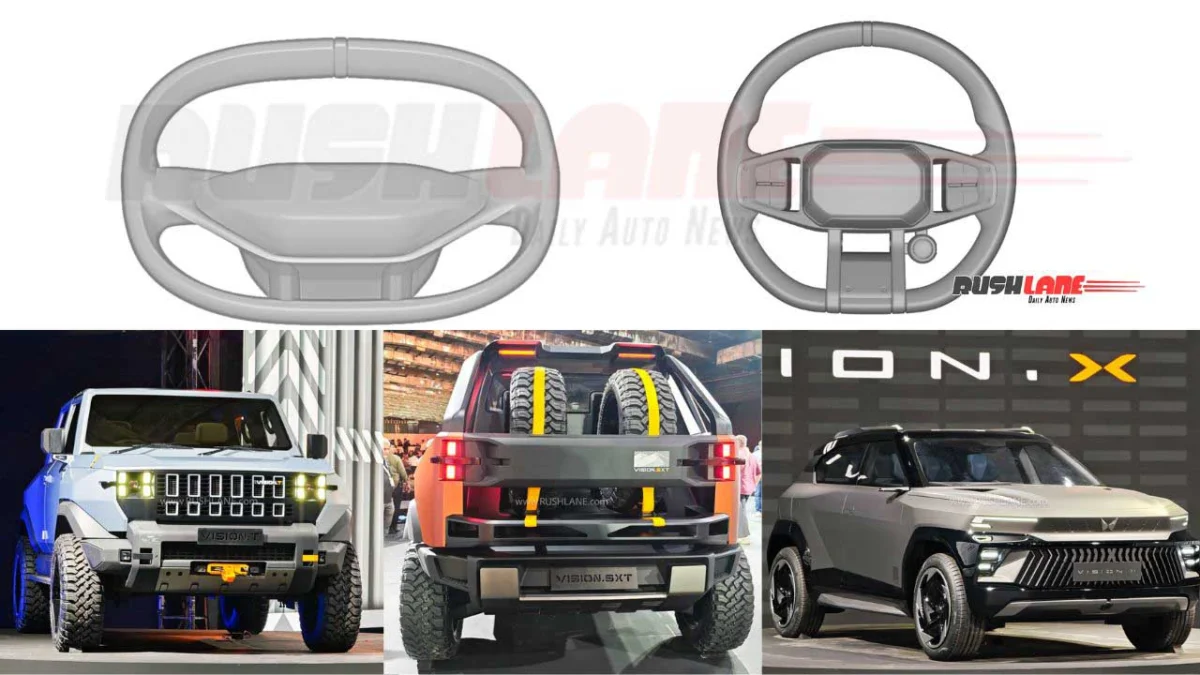
In the rapidly evolving landscape of the global automotive industry, few manufacturers have demonstrated a transformation as aggressive and design-led as Mahindra & Mahindra. Following the seismic impact of their "Freedom NU" event held in Mumbai on August 15, 2025, the Indian SUV specialist has moved from conceptual promise to intellectual property realization. Recent filings have revealed that Mahindra has officially patented two distinct, futuristic steering wheel designs intended for its upcoming "Vision" series of SUVs.
These patents serve as more than mere legal protections; they are a window into the cabin architecture of the next generation of Mahindra vehicles. By securing the designs for the Vision X, Vision T, and Vision SXT, Mahindra is signaling that the radical aesthetics showcased at their Mumbai gala are not merely "auto show fluff," but blueprints for production-bound global models.
Main Facts: The Intersection of Ergonomics and Digital Integration
The core of the recent news revolves around the patenting of two specific steering wheel units. These components represent a departure from the traditional circular forms that have dominated the automotive industry for over a century.

1. The Vision X "Tech-Rectangular" Unit
The first patent covers a steering wheel specifically designed for the Vision X, a sub-4-meter SUV aimed at a tech-savvy, urban demographic. This design moves away from the round silhouette, adopting a soft-rectangular, four-spoke geometry. This "squircle" or rectangular approach is often associated with modern electric vehicles (EVs) and high-end performance cars, as it allows for a clearer view of the digital instrument cluster while providing more thigh room for the driver.
2. The Shared Vision T and Vision SXT Command Center
The second patent describes a steering wheel shared by the larger, more rugged Vision T and the Vision SXT pickup concept. While maintaining a futuristic aesthetic, this unit is designed to balance the "macho" ethos of these larger vehicles with the ergonomic requirements of off-road and long-distance driving.
3. The NU_IQ Foundation
All vehicles associated with these patents are built upon Mahindra’s revolutionary NU_IQ platform. This modular architecture is a "born-flexible" chassis, capable of housing traditional internal combustion engines (Petrol and Diesel) as well as advanced Battery Electric Vehicle (BEV) drivetrains. The platform’s scalability allows Mahindra to apply these futuristic interiors across different segments, from compact city crossovers to heavy-duty lifestyle pickups.

Chronology: From "Freedom NU" to the Patent Office
The journey of these designs follows a meticulously planned timeline that highlights Mahindra’s intent to shorten the "concept-to-consumer" lifecycle.
- August 15, 2025: Mahindra hosts the "Freedom NU" event in Mumbai. The company unveils four concept vehicles: Vision X (urban sub-4m), Vision S (lifestyle sub-4m), Vision T (rugged 5-door SUV), and Vision SXT (lifestyle pickup). The event highlights the NU_IQ platform and a new design language focused on "sophisticated ruggedness."
- Late 2025: Industry observers spot production-spec mules of the Vision S undergoing rigorous road testing in India. This confirms that the Vision series is not a distant dream but a near-term reality.
- Early 2026: Mahindra & Mahindra files for design patents for the interior components of the Vision X, T, and SXT.
- May 2026: The patents are officially published, revealing the intricate details of the steering wheels and confirming the company’s commitment to the futuristic cabin layouts seen in the concept phase.
Supporting Data: Analyzing the "Vision" Segments
To understand the significance of these patents, one must look at the specific roles these vehicles play in Mahindra’s global portfolio.
Vision X: The Urban Sophisticate
Vision X is positioned as a tech-forward sub-4m SUV. Its design is characterized by aerodynamic, swooping lines that contrast with Mahindra’s historically boxy shapes.

- Interior Tech: Beyond the patented steering wheel, the cabin is designed to house dual 12.3-inch high-definition screens.
- Innovation: The dashboard features two unique trapezoidal screens dedicated specifically to dual-zone climate control, moving away from physical knobs or hidden sub-menus.
Vision T: The Electric Evolution of an Icon
Widely speculated to be the electric or next-generation evolution of the "Thar Roxx" lineage, the Vision T (the ‘T’ likely standing for Thar) is a butch, 5-door SUV.
- Design Philosophy: It retains the textbook SUV silhouette—upright pillars, flat hood, and a dominating front grille—but replaces traditional ruggedness with a digital-first approach.
Vision SXT: The Lifestyle Pickup
The Vision SXT is essentially the pickup truck variant of the Vision T. It features a short loading bay and a silhouette that pays homage to the cult-classic Bolero Invader.
- Market Positioning: While the Vision T takes a "sober" interior route with muted tones, the Vision SXT is expected to use "effervescent" colors and high-contrast materials to appeal to the "lifestyle adventurer" market.
Official Responses and Strategic Vision
While Mahindra’s executive team has maintained a standard of "no comment" regarding specific launch dates for the Vision X and T, their public statements during the Freedom NU event provide a clear framework for these patents.

Mahindra Auto’s design leadership has previously emphasized that the "NU_IQ" platform was engineered to "democratize high-end technology." By patenting these steering wheels now, the company is ensuring that the "command center" of their vehicles remains unique to the brand.
"Our goal with the Vision series is to create a global benchmark," a Mahindra design representative noted during the 2025 unveiling. "The interior is where the driver connects with the machine. We are moving away from the ‘utility-only’ mindset to a ‘utility-plus-experience’ philosophy. The steering wheel is the literal handle of that experience."
The company has also confirmed that these models are being developed with international markets in mind. Specifically, South Africa and Australia—markets where Mahindra has a growing foothold and where rugged, tech-heavy SUVs and pickups (utes) are in high demand—are primary targets for the production versions of the Vision T and SXT.

Implications: How Mahindra is Reshaping the SUV Landscape
The patenting of these futuristic steering wheels carries several significant implications for the automotive industry, both in India and abroad.
1. The Death of the "Basic" SUV
For decades, Mahindra was known for making "rugged but basic" vehicles. These patents prove that the company is now competing on the grounds of interior luxury and digital sophistication. By integrating rectangular steering wheels and multi-screen layouts into sub-4-meter segments, Mahindra is forcing competitors like Tata Motors, Hyundai, and Maruti Suzuki to rethink their interior design strategies.
2. Steer-by-Wire Potential
The rectangular shape of the Vision X steering wheel is often a precursor to "steer-by-wire" technology. In traditional systems, a circular wheel is necessary for the hand-over-hand motion required for large turns. However, with steer-by-wire, the steering ratio can be adjusted dynamically, meaning the driver never has to turn the wheel more than 90 or 180 degrees. This suggests that Mahindra may be preparing to introduce high-end chassis electronics in its mid-range SUVs.

3. Global Standardization
By patenting these designs, Mahindra is preparing for a unified global product line. Instead of offering "stripped-down" versions for emerging markets and "high-spec" versions for exports, the NU_IQ platform allows for a standardized, high-tech cabin that meets the expectations of Australian or European buyers while remaining cost-competitive for the Indian market.
4. Brand Identity through Touchpoints
As cars become more reliant on software, physical brand identity is increasingly found in touchpoints. A unique, patented steering wheel becomes a signature of the brand, much like the "i-Cockpit" is for Peugeot or the yoke was for Tesla. Mahindra is carving out a "Modern-Indian" design identity that is distinct from the European or Japanese schools of thought.
Conclusion: The Road to Production
The transition from the "Vision" concepts to the patent office suggests that the development of these SUVs is in an advanced stage. While the Vision S is already undergoing road trials, the patenting of components for the Vision X, T, and SXT indicates that a staggered launch schedule is likely to begin within the next 18 to 24 months.

For the consumer, these patents promise a future where the driver’s seat feels less like a utility cabin and more like a high-tech cockpit. As Mahindra continues to bridge the gap between rugged capability and digital luxury, the "Vision" series stands as a testament to the company’s ambition to not just participate in the global SUV market, but to lead it. The humble steering wheel, now a patented piece of futuristic art, is the first thing drivers will grab as they head into Mahindra’s new era.
