

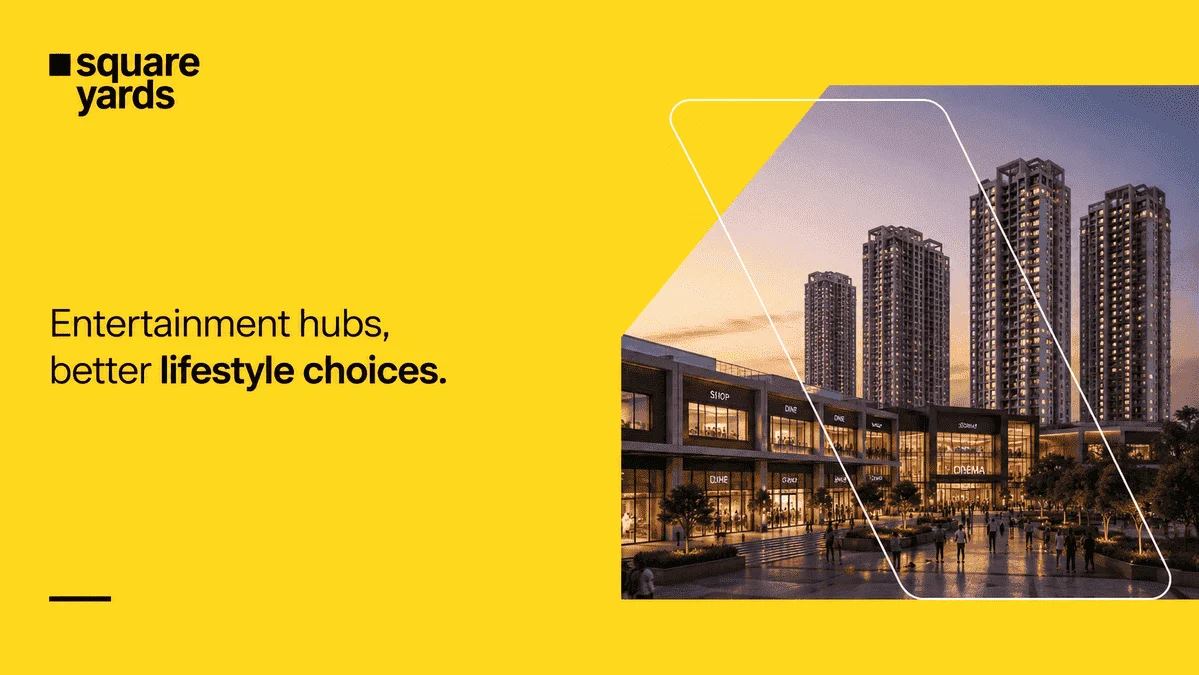
The traditional mantra of "location, location, location" is undergoing a radical transformation in the Indian real estate landscape. For decades, "location" simply meant proximity to a workplace or a railway station. However, as the Indian middle class expands and the post-pandemic emphasis on "quality of life" takes center stage, a new variable has emerged as a primary driver of property value: the entertainment and social infrastructure hub.
Main Facts: The Shift from Shelters to Ecosystems
Swati Desai, a 40-year-old homemaker and seasoned investor from Pune, vividly remembers the frustration of her first home-buying journey. Like many, she initially focused on the traditional metrics of square footage and price-per-square-foot. It was only after touring several "isolated suburbs"—areas characterized by high-rise clusters but lacking basic social amenities—that she realized the hidden costs of poor infrastructure.
"Buying a home was supposed to be a milestone of joy," Desai recalls. "But it quickly became overwhelming. I realized that a lower price point in a remote suburb meant a lifetime of ‘logistical debt.’ If you have to drive 45 minutes just to see a movie or buy high-quality groceries, you aren’t just spending money on fuel; you are losing your weekend and your sanity."
Desai’s experience reflects a broader national trend. In 2024 and 2025, the demand for "integrated living" has surged. Homebuyers are no longer looking for just an apartment; they are looking for an ecosystem. This shift has forced developers to move away from standalone projects toward "lifestyle enclaves" located within striking distance of vibrant retail corridors, multiplexes, and recreational zones.
The core realization for modern investors is that proximity to a vibrant entertainment hub impacts two critical areas:
- Daily Utility: The reduction of "commute fatigue" for non-work activities.
- Asset Premium: Properties near established social hubs tend to hold their value better during market downturns and appreciate faster during upturns.
Chronology: The Evolution of Urban Living in India
To understand why entertainment hubs have become so pivotal, one must look at the evolution of Indian urban planning over the last three decades.
The Era of "Bedroom Communities" (1990s–2005)
During the early liberalization phase, residential real estate was largely about "bedroom communities." People worked in central business districts and lived in far-flung suburbs where the only "entertainment" was a local park or a small corner shop.
The IT Boom and Mall Culture (2006–2015)
The rise of the IT sector brought global sensibilities to India. Malls began to sprout in cities like Bengaluru, Pune, and Gurgaon. However, residential development and retail development often happened in silos. A resident might live in a premium society but still face a grueling commute to reach the nearest "hub."
The Integrated Era (2016–Present)
Post-RERA (Real Estate Regulatory Authority) and post-pandemic, the market has matured. The "15-minute city" concept—where work, shopping, and leisure are all within a 15-minute radius—has become the gold standard. Today, the presence of a "lifestyle anchor" (a major mall, a high-street retail strip, or a sports complex) is often the first thing an investor looks for before checking the floor plan.
Supporting Data: The Economics of Proximity
The influence of retail and entertainment hubs on property strategy is backed by compelling market data from the 2024-2025 fiscal period. Across India’s top seven cities (NCR, Mumbai, Bengaluru, Pune, Hyderabad, Chennai, and Kolkata), a distinct "proximity premium" has emerged.
Appreciation and Yields
Data indicates that residential projects located within a 2-to-3-kilometer radius of a functional entertainment hub appreciate at a rate 12-18% higher than those in purely residential zones.
- Rental Demand: Properties near social hubs see 20% lower vacancy rates. Young professionals and nuclear families prioritize these areas, ensuring a steady stream of tenants.
- Micro-market Resilience: During the mid-2024 market cooling, properties adjacent to high-street retail corridors in cities like Hyderabad and Pune maintained their price points, while isolated projects saw price corrections of up to 5-7%.
The "Multiplex Effect"
A study of pedestrian traffic and commercial occupancy shows that the presence of a premium multiplex (like PVR-INOX) within a 10-minute drive acts as a "confidence anchor" for homebuyers. It signals to the buyer that the area has achieved a certain level of "upmarket" status, which in turn attracts further investment in cafes, hospitals, and schools.
A Practical Framework for Decision-Making
For buyers like Swati Desai, the challenge is moving from "feeling overwhelmed" to "making a data-driven decision." The following framework is designed to help investors evaluate social infrastructure with surgical precision.
Step 1: Establishing the Baseline
Before scanning the market, define your "non-negotiables." This involves a realistic assessment of your budget ceiling versus your lifestyle requirements.
- The 10-Minute Rule: For a property to truly benefit from an entertainment hub, the hub must be accessible within 10 minutes during peak hours.
- The Risk Range: Are you buying into an existing hub or a proposed one? The former offers safety; the latter offers higher growth potential but comes with execution risk.
Step 2: Mapping the Micro-Market Context
National trends are often "noise" for the individual buyer. What matters is the micro-market.
- Commercial Master Plans: Review the city’s development plan (DP). Is the nearby vacant land slated for a park, a mall, or a factory?
- Leverage in Negotiation: Use the lack of social infrastructure as a bargaining chip if you are looking at a project in a developing area. Conversely, expect to pay a premium for "plug-and-play" neighborhoods.
Step 3: Validation Through Triangulation
Never take a developer’s brochure at face value.
- Occupancy Checks: Visit the local shopping centers on a Tuesday morning and a Saturday evening. High footfall on weekdays indicates a sustainable local economy, not just weekend "tourism" from other parts of the city.
- Online Property Valuation: Use tools like Square Yards’ online property valuation to benchmark the asking price against real-time market data. If the "lifestyle premium" is more than 25% higher than the area average, you may be overpaying for the "hype."
Common Pitfalls and Official Perspectives
Industry experts and urban planners warn against several common mistakes that buyers make when chasing the "lifestyle dream."
- The "Phantom Mall" Trap: Many projects are marketed based on a "proposed" mall nearby. Official responses from municipal corporations often reveal that these projects lack environmental clearances or funding. Always prioritize "functional" infrastructure over "proposed" promises.
- The Noise-Congestion Paradox: While proximity to an entertainment hub is good, being too close can be a liability. Properties sharing a wall with a massive mall often suffer from noise pollution, traffic bottlenecks, and security concerns, which can actually lower their long-term resale value.
- Prioritizing the Familiar over the Accurate: Buyers often choose an area because they "know someone who lives there," rather than looking at the actual pedestrian traffic and commercial occupancy data.
From an official standpoint, urban planners are now emphasizing "Mixed-Use Development" (MUD). Government initiatives in states like Maharashtra and Karnataka are incentivizing developers to include commercial and retail components within large residential townships to reduce the load on city transport systems.
Expert Insight: The Square Yards Support System
The complexity of modern real estate requires more than just a real estate agent; it requires a consultant. Sunita Iyer, a 51-year-old retired bank officer from Chennai, found herself in a similar predicament to Swati Desai when she decided to downsize to a more vibrant neighborhood.
"I didn’t want to spend my retirement in a quiet corner where I had to call a cab for every small errand," Iyer says. Working with a Square Yards advisor, she was able to access verified market data and structured timelines. "They didn’t just show me flats; they showed me heat maps of where the new retail developments were going. It shifted my perspective from ‘buying a house’ to ‘investing in my future lifestyle’."
Square Yards supports this transition by offering a full-lifecycle approach:
- Mortgage Assistance: Tailoring loans based on the property’s valuation.
- Rental Management: Helping investors capitalize on the high demand for properties near social hubs.
- Interior Design: Ensuring the home’s aesthetic matches the "premium lifestyle" of its location.
Implications: The Future of the Indian Home
As we look toward 2026, the implications of this trend are clear. The Indian home is no longer a static asset; it is a gateway to a social life.
The "lifestyle premium" is becoming a permanent fixture of the market. Cities with active infrastructure investment—such as the expansion of the Metro in Pune or the New Airport in Navi Mumbai—are seeing appreciation rates that outpace the national average. Micro-markets that successfully integrate high-street retail with residential clusters are repricing faster than traditional "premium" pincodes.
For the investor, the message is simple: The quality of your information determines the quality of your investment. In an era where "proximity" is the new "luxury," being proactive rather than reactive is the only way to ensure that your home remains both a sanctuary and a high-performing asset.
Take the Next Step
The difference between a strategic property acquisition and a costly mistake lies in the data. To navigate the complexities of retail proximity and social infrastructure, visit Square Yards for access to verified listings, market analytics, and expert advisory support. Your next move should be driven by clarity, not guesswork.
