

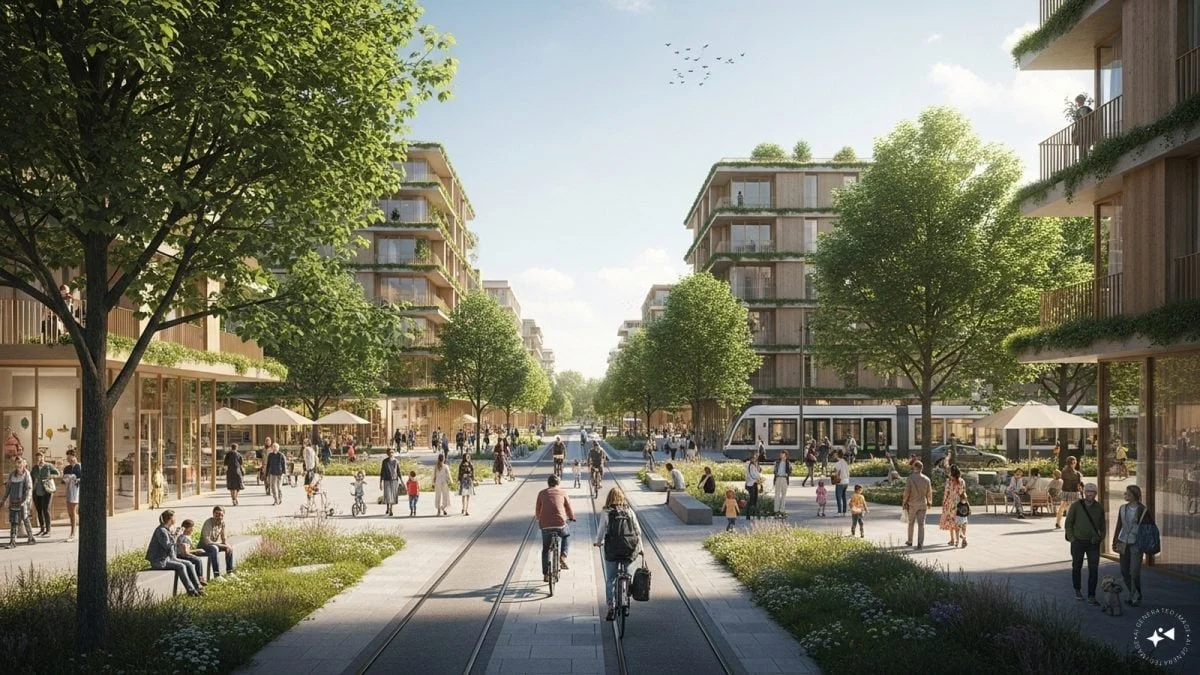
BENGALURU – In an era where Bengaluru’s legendary status as the "Silicon Valley of India" has often been overshadowed by its equally legendary traffic congestion, the Karnataka government has unveiled a blueprint for a radical urban transformation. The revival of the Greater Bengaluru Innovation and Tech City (GBIT) marks a pivotal shift in the state’s approach to urban planning—transitioning from reactive infrastructure patches to a proactive, AI-integrated ecosystem.
Spanning a staggering 7,481 acres in the Ramanagara taluk, GBIT is not merely a residential layout or an industrial park; it is being positioned as India’s first "AI-native" city. Designed to eliminate the daily four-hour commutes that have come to define the Bengaluru experience, this mega-township aims to harmonize professional, personal, and recreational life within a single, sustainable perimeter.
I. Main Facts: The Vision of a ‘Work, Live, Play’ Ecosystem
The Greater Bengaluru Innovation and Tech City is an ambitious integrated township designed to address the systemic failures of traditional urban sprawl. While Bengaluru grew organically (and often chaotically) around its IT corridors, GBIT is a master-planned intervention.
The Scale and Scope
The project covers 7,481 acres of land across nine villages, including Byramangala, Hosur, and Mandalahalli. At its core, the project is built on the "15-minute city" concept—an urban planning philosophy where all essential services, from workplaces to grocery stores and healthcare, are accessible within a short walk or a bicycle ride.
The AI-First Philosophy
What distinguishes GBIT from existing smart cities like GIFT City in Gujarat or the Dholera SIR is its specific focus on Artificial Intelligence. The city is designed to be a living laboratory for AI.
- AI-Driven Utilities: Civic services, including power grids and water supply systems, will use predictive AI to prevent outages and leaks before they occur.
- Intelligent Traffic Management: Though the city aims for "zero traffic" through walkability, the necessary transit systems will be governed by real-time AI algorithms to ensure seamless movement.
- The Business District: A dedicated Central Business District (CBD) will cater exclusively to global giants and startups specializing in Machine Learning, Data Analytics, and Robotics.
Financial and Structural Overview
With an estimated project cost of ₹18,104 crore, the development is being spearheaded by the Greater Bengaluru Development Authority (GBDA). The funding model is expected to be a mix of government allocation and Public-Private Partnerships (PPP), with a heavy emphasis on attracting foreign direct investment (FDI) from global tech conglomerates.
II. Chronology: From a Stalled Blueprint to a Futuristic Reality
The journey of GBIT has been anything but linear. The project’s revival is a testament to the shifting economic priorities of the Karnataka state government.
- 2010–2012: The Initial Conception: The idea for a massive tech-integrated township near Ramanagara was first floated over 15 years ago. It was envisioned as a way to de-congest the main city, but political instability and land acquisition hurdles kept the project confined to paper.
- 2013–2023: The Decade of Stagnation: For over ten years, the project remained in a state of "administrative hibernation." During this period, Bengaluru’s traffic grew to be among the worst in the world, and the demand for a secondary urban hub became a matter of economic survival for the state’s IT sector.
- 2024–2025: The Policy Pivot: Recognizing that the North Bengaluru corridor (near the airport) was reaching its saturation point, the state government turned its gaze south. The Greater Bengaluru Development Authority was empowered to revisit stalled mega-projects.
- May 2026: The Formal Revival: The Karnataka government officially announced the revival of GBIT. Preliminary land acquisition work, which had been partially completed years ago, was fast-tracked, and the project was re-branded from a generic tech city to an AI-focused innovation hub.
- The Road Ahead: The state is currently in the process of appointing an international project management consultancy (PMC) to oversee the architectural and technological execution.
III. Supporting Data: Infrastructure, Sustainability, and Connectivity
To understand the magnitude of GBIT, one must look at the data driving its design. The project is built on three pillars: connectivity, sustainability, and technological infrastructure.
Connectivity: Bridging the Gap
One of the primary criticisms of satellite towns is their isolation. GBIT addresses this through a multi-modal transit strategy:
- Metro Access: The Bengaluru Metro Phase 3 expansion is slated to reach Bidadi, bringing GBIT within a 35-to-40-minute commute of the city’s central business districts.
- Highways: The township enjoys direct access to the Bengaluru-Mysuru Expressway (NH-275) and NH-209. The proximity to the NICE Road ensures that the tech hubs of Electronic City are reachable without entering the city’s congested core.
- The Second Airport Factor: The government is actively scouting locations for Bengaluru’s second international airport. With Kanakapura Road and the Nelamangala-Kunigal corridor under consideration, GBIT stands to benefit from a major international transit hub in the southern region.
Sustainability Metrics
In a departure from traditional concrete-heavy developments, GBIT prioritizes ecological balance:
- Green Cover: Approximately 950 acres—nearly 13% of the total land—have been strictly reserved for lakes and green buffer zones.
- Zero-Waste Model: The city plans to implement a circular economy for waste management, using AI to sort and process refuse on-site.
- Water Security: Given Bengaluru’s historical water struggles, GBIT will feature massive rainwater harvesting systems and 100% greywater recycling to ensure the township remains water-neutral.
Social Infrastructure
The "Live" and "Play" components are backed by significant allocations:
- Sports: Plans include an international-standard cricket stadium and Olympic-grade training facilities to foster a culture of fitness and professional athletics.
- Healthcare and Education: The master plan integrates multi-specialty hospitals and "smart schools" that use AI to personalize learning paths for students.
IV. Official Responses: A Strategic Shift in Governance
The revival of GBIT has been met with both enthusiasm and cautious optimism from various stakeholders. Government officials emphasize that this project is a "necessity, not a luxury."
The State Government Perspective:
According to sources within the Department of Electronics, IT, and BT, the GBIT project is essential to maintaining Karnataka’s competitive edge. "We cannot expect the world’s leading AI companies to set up shop in corridors where their employees spend four hours a day in traffic," a senior official stated. "GBIT is our answer to the global demand for high-quality, tech-integrated living."
The Greater Bengaluru Development Authority (GBDA):
The GBDA has clarified that the land for the project has already been designated as a development zone. The authority is now focusing on the "Global Tendering Process" to bring in a consultancy firm with experience in building smart cities like those in Singapore or South Korea. "We are not just building houses; we are building a sovereign tech ecosystem," a GBDA representative noted.
Urban Planning Experts:
While praising the vision, urban planners have urged the government to ensure that the "zero-traffic" promise is maintained through strict zoning laws. "The challenge with Bengaluru has always been the violation of master plans," says Dr. S. Vishwanath, an urban strategist. "If GBIT sticks to its 15-minute city model, it could become the blueprint for every new city in India."
V. Implications: The Future of Urban India
The successful execution of the Greater Bengaluru Innovation and Tech City holds profound implications for the state of Karnataka and India’s broader urban landscape.
1. Decentralization of the Tech Economy
For decades, Bengaluru’s growth has been lopsided, with a heavy concentration in the North and East. GBIT will effectively pull the economic center of gravity toward the South, creating a more balanced metropolitan region. This decentralization will likely ease the pressure on the current city’s crumbling infrastructure.
2. Real Estate and Economic Growth
The ₹18,104 crore investment is expected to trigger a massive real estate boom in the Ramanagara and Bidadi regions. However, unlike the speculative bubbles seen in other areas, GBIT’s growth is expected to be driven by actual utility and high-value job creation in the AI and Machine Learning sectors.
3. Setting a Global Benchmark
If GBIT achieves its "zero-carbon, zero-waste" goals, it will place India at the forefront of sustainable urban development. At a time when global cities are struggling to retro-fit sustainability into old structures, GBIT has the "late-mover advantage"—the ability to build with the latest green technologies from the ground up.
4. Quality of Life as a Talent Magnet
In the global war for tech talent, quality of life is becoming as important as salary. By offering a "Work, Live, Play" environment with walkable neighborhoods and international-standard sports facilities, Bengaluru can continue to attract the world’s best engineers who might otherwise migrate to Dubai, Singapore, or Silicon Valley.
Conclusion: A Bold Leap Forward
The Greater Bengaluru Innovation and Tech City is more than just a real estate project; it is a declaration of intent. It acknowledges that the old ways of urban expansion—characterized by endless commutes and environmental neglect—are no longer viable. As the "AI City" moves from the drawing board to the groundbreaking phase, it carries the hopes of a city that is desperate to reclaim its title as a livable, breathable, and innovative metropolis. For the residents of Bengaluru, the promise of a commute-free life in a hi-tech oasis may finally be within reach.
