

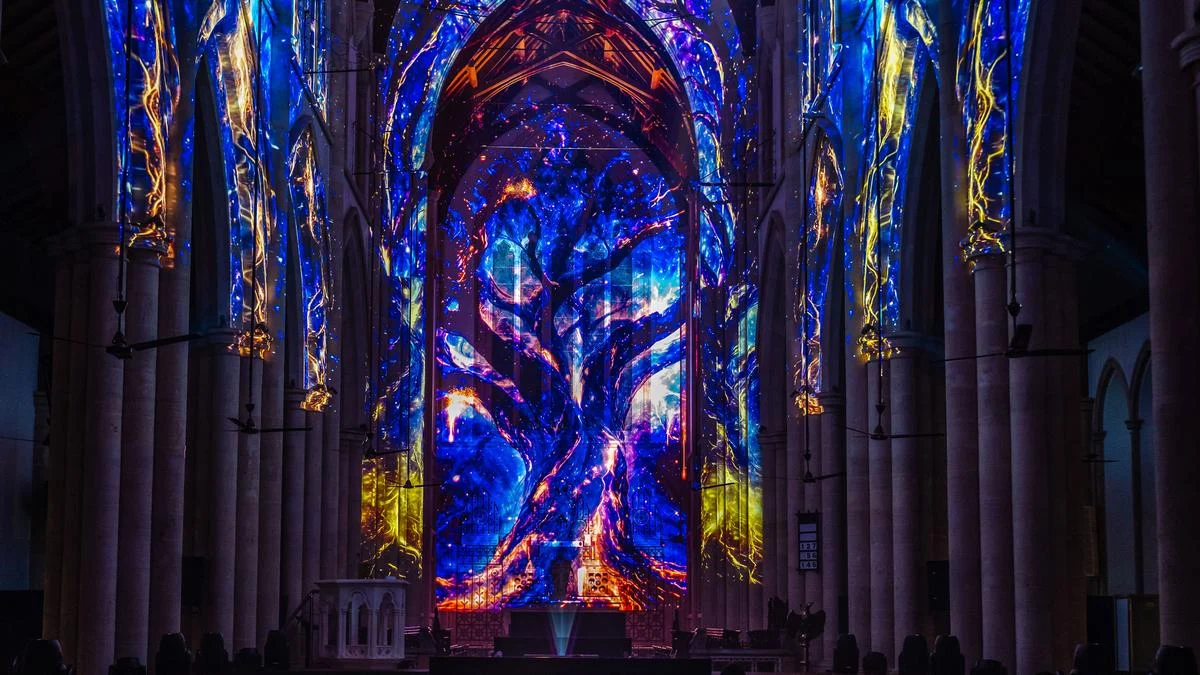
Mumbai, India – September 1, 2026 – For a captivating 15 minutes, the hallowed interiors of Mumbai’s historic Afghan Church in Colaba shed their solemn reverence to become a canvas for a breathtaking celestial ballet. The Gothic arches, soaring vaulted ceilings, and iconic stained-glass windows were artfully reimagined through "Ascension," an immersive projection mapping installation by the Floating Canvas Company (FCC). This groundbreaking event, part of the Mumbai Light Festival from August 27th to 29th, marked FCC’s inaugural projection mapping project within a Grade I heritage structure in the city, ushering in a new era of artistic engagement with Mumbai’s architectural treasures.
A Symphony of Light and Architecture
"Ascension" transcended the conventional notion of a light show, transforming the Afghan Church into an ephemeral universe. As projectors cast their beams, the sacred space was momentarily imbued with the grandeur of the cosmos. Stars, swirling clouds, and ethereal lights danced across the ancient stone, at times receding into the church’s profound depths and at others, tracing the elegant lines of its Gothic arches and climbing towards the sky-piercing ceiling. The installation masterfully navigated the delicate balance between augmenting and respecting the existing architecture.
The visual narrative unfolded in a spectrum of captivating hues. Deep, serene blues initially evoked the vastness of space, gradually giving way to celestial imagery that transitioned into warmer, more vibrant tones of red and gold. Light flowed organically across the pillars and arches, seemingly breathing life into the static structures. The renowned stained-glass windows, rather than being obscured, played a crucial role in the spectacle. They acted as prisms, catching and subtly altering the projected colours, adding another layer of visual richness and complexity to the experience. Throughout this dynamic transformation, the church’s inherent character remained intact, its venerable presence a constant anchor amidst the projected artistry. This deliberate restraint, as explained by Rahul Singh Yadav, Creative Director at FCC, was paramount. "The theme, motifs, and animation are carefully developed to ensure they complement the architecture without altering its character," Yadav stated. "The animation is designed to flow gently through these details, allowing the space to remain the anchor."
The Art of Restraint: Respecting a Sacred Space
The decision to employ such artistic subtlety was not merely aesthetic; it was deeply rooted in the building’s function as an active place of worship. FCC consciously avoided overwhelming every surface with constant visual stimulation. Instead, "Ascension" strategically highlighted individual architectural features, such as a single arch or a segment of the ceiling, allowing moments of profound stillness to punctuate the more dramatic passages. These deliberate pauses provided the audience with ample opportunity to absorb and appreciate the inherent beauty and historical significance of the Afghan Church itself, fostering a dialogue between the past and the present.

Technological Prowess Meets Architectural Nuance
The creation of such a seamless and integrated experience demanded a sophisticated technological approach. FCC undertook an extensive survey of the Afghan Church, meticulously mapping its intricate surfaces to develop multiple digital masks. These masks were essential for accurately projecting the artwork onto the church’s uneven and varied architectural elements. The scale of the installation necessitated the deployment of between 15 to 20 high-resolution, high-lumen projectors. The physical installation and precise calibration of this complex system required three dedicated days, a testament to the meticulous planning and execution involved.
A significant challenge inherent in working with a structure like the Afghan Church was its integration with the stained-glass windows. Unlike solid surfaces that readily reflect light, glass typically allows light to pass through. FCC ingeniously leveraged the unique properties of these iconic windows. "We leveraged the colour, texture, and thickness of the iconic stained glasses to integrate them seamlessly into the overall experience," shared Yadav, highlighting how the glass became an active participant in the artistic narrative rather than a passive element.
An Inward Journey or a Cosmic Voyage?
The thematic core of "Ascension" revolved around a journey, beginning from Earth and progressively ascending towards the cosmos. The visual progression from terrestrial elements like clouds to the vast expanse of stars and drifting light was designed to evoke a sense of boundless movement, extending beyond the physical confines of the church. This narrative invited introspection, prompting viewers to contemplate the nature of their experience. "The experience invites the viewer to question where the journey truly takes place," explained Yadav. "Was it an inward journey or one into the universe?"
The immersive quality was amplified by the audience’s physical presence within the architecture. Unlike projection mapping on building exteriors, where viewers often remain stationary observers, the indoor setting allowed the projections to unfold around them. This sense of being enveloped by the art is a hallmark of FCC’s indoor installations. "The indoor shows are usually more immersive because the experience has to make the viewer feel they are part of it," Yadav noted. This contrasts with FCC’s previous work on the exteriors of several Mumbai heritage structures, where the audience interaction is inherently different.

Mumbai Embraces Global Trends in Heritage Engagement
The projection mapping of heritage buildings is not a nascent concept globally, and Mumbai is now actively embracing this trend. Cities like Paris have long pioneered such immersive experiences. The AURA installation, launched within Paris’s Notre-Dame in 2017, utilized dozens of projectors to transform the basilica’s interior into an immersive light show, drawing over two million visitors and expanding to cathedrals in San Francisco and the Dôme des Invalides. Similarly, Luminescence, a popular touring light-and-sound show that has graced cathedrals across Europe, made its American debut this year in a Philadelphia basilica.
FCC’s "Ascension" project at the Afghan Church builds upon their prior engagement with Mumbai’s architectural heritage, including earlier installations at the David Sassoon Library and subsequent interventions at the Chhatrapati Shivaji Maharaj Vastu Sangrahalaya (CSMVS) Museum and the Rajabai Clock Tower. The broader ambition behind these projects, as articulated by Yadav, is to foster a deeper connection between Mumbaikars and the city’s architectural marvels.
Rekindling Appreciation for Mumbai’s Architectural Legacy
"Mumbai has a rich architectural legacy, ranging from old forts and wadas to magnificent Gothic buildings," Yadav emphasized. "People walk by without really stopping to look at them. We wanted to create a pause." By weaving art and technology into the fabric of these historic structures, FCC aims to bridge the gap between residents and their surroundings, encouraging a renewed sense of appreciation and ownership. The ultimate goal, he suggests, is to "create interesting pathways for how we experience and value our heritage." "Ascension" at the Afghan Church stands as a luminous testament to this vision, demonstrating how innovative artistic expression can breathe new life into venerable landmarks, inviting both locals and visitors to see their city with fresh, wonder-filled eyes. The successful fusion of cutting-edge technology with the timeless beauty of architectural heritage promises a vibrant future for cultural engagement in Mumbai.
