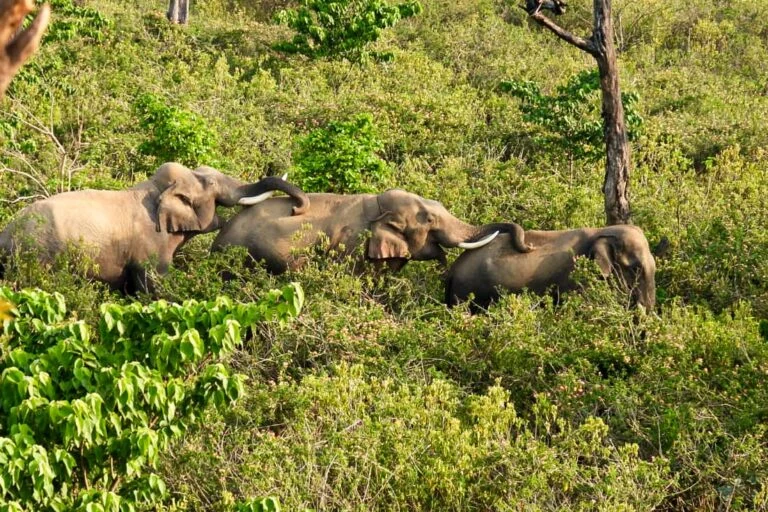
RAJAJI NATIONAL PARK, UTTARAKHAND — For decades, the prevailing narrative in wildlife biology depicted the male Asian elephant (Elephas maximus) as a wandering hermit. Once they reached sexual maturity and were ousted from their maternal herds, bulls were thought to lead largely solitary lives, only seeking out female company for the brief windows of mating. However, a landmark 2026 study conducted in the Shivalik landscape of Uttarakhand is fundamentally rewriting this script.
The research, led by the Wildlife Institute of India (WII), reveals that male elephants in Rajaji National Park and the surrounding Haridwar Forest Division are far more social than previously understood. Far from being random encounters, these male associations are structured, intentional, and heavily influenced by age, reproductive status, and the specific characteristics of the habitat. Perhaps most crucially for conservationists, these social dynamics are playing out in the "grey zones" of the forest—open scrublands and grasslands near human settlements—where the potential for conflict with people is highest.
Main Facts: The Social Architecture of the Bachelor Bull
The study, spearheaded by wildlife biologist Abhimanyu Madhusudanan, provides a granular look at the lives of 219 individual male elephants. By moving beyond simple population counts and focusing on individual histories, the research team identified a complex social hierarchy that shifts as a bull matures.
The central finding challenges the "solitary" label: male elephants were found in groups during a significant portion of the study. While solitary bulls accounted for roughly 30% of sightings, more than 50% of sightings involved males within mixed-sex herds, and nearly 20% were of "all-male" bachelor groups.
“Elephant responses to threats are context-based and vary across regions and populations,” explains Madhusudanan, the corresponding author of the study. “By understanding how individuals associate with one another, we can develop more targeted conflict-mitigation strategies. We are seeing that sociality isn’t just a female trait; it is a survival and reproductive strategy for males as well.”
The data suggests that these all-male groups are not merely temporary huddles but serve as vital social hubs. In these bachelor clusters, younger males likely learn essential survival skills, navigation routes, and social etiquette from their elders—a "mentorship" dynamic that has profound implications for how these animals navigate human-dominated landscapes.
Chronology: From Field Tracks to 2026 Findings
The journey to these findings was a multi-year endeavor that combined traditional forest tracking with advanced statistical modeling.

Phase 1: The Survey Design (January 2024)
The study area was established in the eastern portion of Rajaji National Park and the adjacent Haridwar Forest Division, spanning a total of 475 square kilometers. This region was selected because it represents a "critical landscape"—one that remains a stronghold for elephants but is increasingly fragmented by the Haridwar-Dehradun highway, railway lines, and expanding industrial hubs.
Phase 2: Intensive Data Collection (February – May 2024)
Researchers divided the 475 sq. km area into 19 grid cells, each measuring 25 sq. km. A small, dedicated team surveyed each grid cell ten times over the course of four months. This was a grueling period of field research, involving tracking elephants through dense Sal forests, rugged hilly terrain, and riverine patches.
The team relied on physical signs—dung, footprints, debarked trees, and broken foliage—to locate the animals. Once an elephant was spotted, the team performed the "monumental task" of photographic identification. Each bull was cataloged based on unique physical markers: the shape and length of tusks, tears or notches in the ears, tail length, and specific body scars.
Phase 3: The Analytical Shift (2025 – 2026)
Following the field sessions, the researchers moved from the forest to the lab. They utilized Spatially Explicit Capture-Recapture (SECR) modeling. Unlike traditional methods that might double-count moving animals, SECR estimates population size by tracking the frequency and location of specific individual detections. This allowed the team to estimate that approximately 40 adult males were resident in the specific study area, providing a much higher degree of accuracy than previous census methods.
Supporting Data: Age, Musth, and the Influence of Habitat
The study’s strength lies in its ability to quantify how specific variables change elephant behavior. The researchers found that a male elephant’s social life is a revolving door, dictated by three primary factors.
1. The Age Gradient
Age was the most significant predictor of social grouping.
- Juveniles and Sub-adults: These young males were found to be 66 times and 22 times more likely, respectively, to be seen in mixed-sex herds than in all-male groups. They remain tethered to the protection of the matriarchal unit.
- Early Adults: As males reach early adulthood, they transition into "bachelor groups." These groups averaged 3.4 individuals. This phase is critical for testing strength and establishing rank without the immediate pressure of competing with dominant older bulls.
- Older Adults: As bulls reach their prime, they tend to become more solitary or move between herds as dominant "floaters," seeking mating opportunities.
2. Musth: The Hormonal Driver
Physiological state—specifically musth—drastically altered social preferences. Musth is a periodic condition in male elephants characterized by a massive surge in testosterone and heightened aggression.

- Non-musth males were significantly more likely to form all-male groups, seeking the relative "safety in numbers" or social learning opportunities.
- Males in musth almost exclusively sought out mixed-sex herds or remained solitary as they searched for receptive females, showing little interest in the company of other males unless it was for competitive sparring.
3. Habitat and Risk
The study revealed a startling correlation between habitat type and grouping. All-male groups were most frequently observed in open areas, such as grasslands and scrublands, rather than the deep interior forest.
Crucially, these open areas often bordered human settlements. The researchers noted that these bachelor groups were frequently linked to crop-foraging behavior. This suggests that younger males may be forming "raiding parties," where the collective intelligence of the group allows them to better navigate the risks of entering human farms.
Official Responses: Insights from the Wildlife Institute of India
The findings have sparked a conversation within the Indian wildlife management community regarding the "predictability" of elephant behavior.
Abhimanyu Madhusudanan noted the challenges of the fieldwork, emphasizing the need for caution when dealing with these social units. "We had to maintain a safety buffer given the wide range of male personalities and the unpredictability of musth," he said. "Tracking some males was easier than others, but getting the right angles for identification while ensuring the team’s safety in dense cover was a constant hurdle."
The researchers were particularly surprised by the biological nature of these associations. "We found evidence that socializing with other males is an inherent part of their biology and not just a response to anthropogenic pressure," Madhusudanan added. "However, the fact that these groups are significantly more common in open habitats near humans cannot be ignored."
Forest officials in Uttarakhand have expressed interest in the study’s implications for the Rajaji-Corbett corridor. The consensus among the researchers is that the focus of conservation must shift from "the elephant" as a species to "the individual" as a social actor.
Implications: A New Era for Conflict Mitigation
The 2026 study has profound implications for the future of elephant conservation in India and across Asia.

Targeted Mitigation Strategies
Currently, many human-elephant conflict (HEC) strategies are reactive—using sirens, firecrackers, or fences to drive away any elephant that approaches a village. This study suggests a more "surgical" approach. If forest departments can identify and track specific "stable male groups," they can anticipate when a "raiding party" of young bulls is likely to move toward a settlement. Monitoring these specific individuals, rather than the entire population, allows for more efficient use of resources.
The Mentorship Gap
The discovery of the importance of older males in bachelor groups raises concerns about the impact of losing "patriarchs" to poaching or accidents. If older, more experienced bulls are removed from the population, younger males may lack the social "education" required to stay out of trouble, potentially leading to more erratic and aggressive behavior in human-dominated areas.
Refined Population Tracking
The success of the SECR modeling in this study provides a blueprint for other national parks. By moving toward individual-based tracking, conservationists can gain a much clearer picture of population health, sex ratios, and survival rates, leading to more robust data-driven policy.
Unanswered Questions
Despite the wealth of data, Madhusudanan and his team believe they have only scratched the surface. "There is a lot more to learn about the long-term stability of these all-male groups," he concluded. "How are decisions made during collective movement? Who is the leader? How much do older males actually teach the younger ones? These are the questions that will define the next decade of elephant research."
As Rajaji National Park continues to face the pressures of a growing human footprint, understanding the secret social lives of its bulls may be the key to ensuring that both the giants and the people they live alongside can coexist in an increasingly crowded world.
Data Summary:
- Total Elephants Identified: 706 (excluding calves)
- Total Males Identified: 219
- Estimated Resident Adult Males: ~40
- Sighting Distribution: 50.8% Mixed Herds, 29.8% Solitary, 19.4% All-male groups.
- Average All-male Group Size: 3.4 individuals.
- Study Area: 475 sq. km (Rajaji National Park & Haridwar Forest Division).