

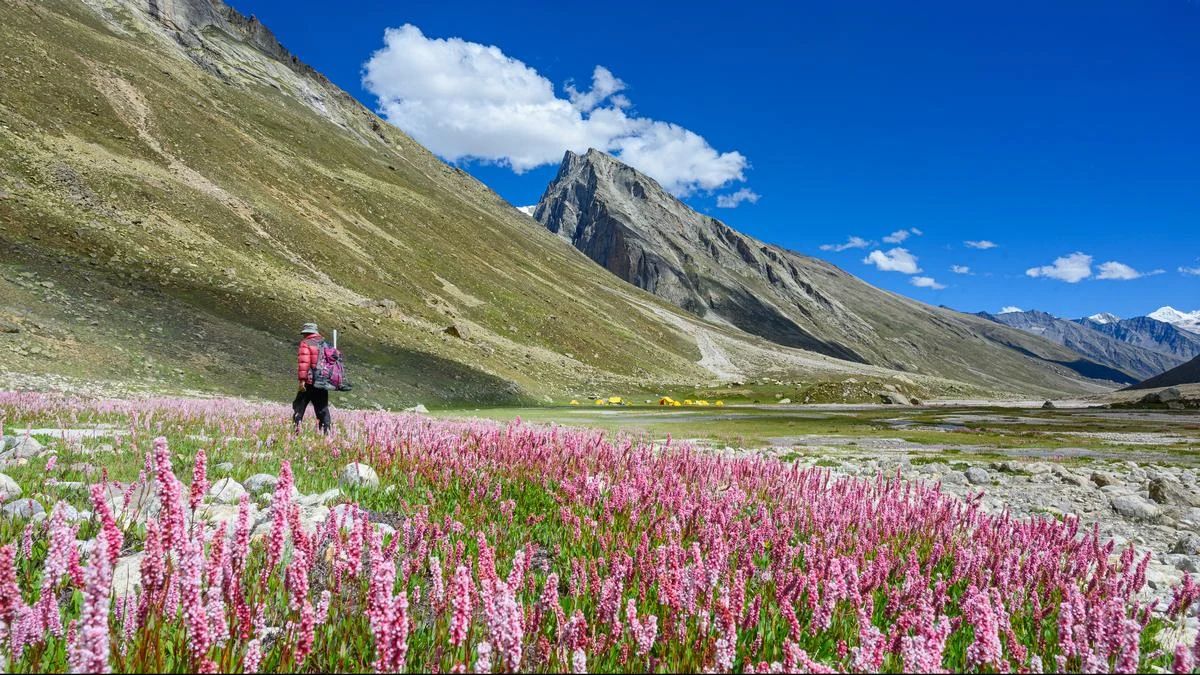
The mountains are awakening in a riot of colour, a breathtaking testament to nature’s vibrant artistry. From the fiery hues of marigold fields and the delicate blush of rhododendron blooms to valleys carpeted with the ethereal Dzukou lily and cheerful violets, this season offers an unparalleled invitation to explore India’s most enchanting floral landscapes. This article delves into the most captivating trails where nature’s palette is at its most vivid, offering a journey of discovery for every nature enthusiast and seasoned trekker.
August’s Floral Tapestry: Kaas Plateau, Maharashtra
As August unfurls, Maharashtra’s very own "Valley of Flowers," the Kaas Plateau, transforms into a breathtaking spectacle. Located approximately 25 kilometres north of the Koyana Sanctuary, this UNESCO World Heritage Site becomes a living canvas, boasting an astonishing array of over 170 species of wildflowers. Beyond its floral grandeur, the plateau is a vital ecosystem, teeming with a diverse population of butterflies, birds, and reptiles, making it a haven for biodiversity enthusiasts.
A Personal Perspective on Conservation:
Randhir Jaya Naidu, the visionary behind Pune-based heritage travel outfit Deccan Drifts, has been curating immersive experiences to this natural wonder, also affectionately known as "Kas Pathar," since 2022. His journey with Kaas began in 2011, a visit that left an indelible mark. "I had the privilege of seeing it untouched," he reminisces, his voice tinged with nostalgia. "We conducted extensive research before launching our day trips, aiming to offer an experience that honored its pristine beauty."

Naidu elaborates on the logistical framework designed to preserve the plateau’s delicate ecosystem. Private vehicles are directed to a designated parking area, from where the Forest Department’s shuttle service transports visitors to the entrance gates of the protected zones. "From the gates, you must tread carefully on pathways meticulously laid out on the flat expanse of this ancient, fossilized volcanic plateau," he explains. Guided tours lead visitors on foot through the plateau’s three distinct zones, ensuring a mindful exploration.
The Evolving Landscape of Kaas:
The UNESCO designation, while bringing much-deserved international acclaim, has also presented challenges. "Kaas Plateau has changed significantly since receiving global recognition," Naidu observes. "The influx of crowds post-UNESCO tag necessitated the installation of barricades and pathways. Unfortunately, this has led to a discernible drop in the number of blooms."
He further explains the delicate timing of the flowering season, typically from mid-September, when the monsoon recedes, to mid-October. However, recent climatic shifts, characterized by persistent September rains, have impacted this natural cycle. The impact of human activity is also a concern. "Visitors often pluck flowers, discard plastic litter, and stray from designated paths to capture photographs on the flowerbeds," Naidu laments. "These actions have collectively hampered the growth rate, and I haven’t witnessed the Kaas Plateau in its original, untouched glory since my first visit."

Experiencing Kaas Plateau:
- Cost: Approximately ₹2,400 per head.
- Booking Information: For reservations, contact 9130641707.
Responsible Exploration: A Guide for Visitors
To ensure the preservation of these natural wonders and to enrich your travel experience, consider the following guidelines:
- Early Bird Advantage: Visit in the early morning to avoid crowds and secure entry passes for trails in advance, where required.
- Support Local Economies: Engage local guides. Their knowledge and expertise not only enhance your trip but also contribute directly to the well-being of the community.
- Immerse and Connect: Go beyond mere sightseeing. Prioritize genuine local connections and immerse yourself in the unique culture of the region.
- Trek Prepared: Undertake preparatory treks that include a balanced mix of cardiovascular and strength training to fully enjoy the trails.
- Sustainable Provisions: Carry your own reusable cutlery and homemade snacks or fruits. Minimize the use of packaged food during your treks.
- Embrace the Unpredictable: While it’s natural to hope for clear skies and perfect views, cultivate an attitude of acceptance. Every weather condition offers its own unique charm, and going with the flow can lead to unexpected joys.
June to August: The Dzukou Valley’s Ethereal Blooms
Nestled in the breathtaking landscape of Nagaland, the Dzukou Valley awakens with the vibrant bloom of the Dzukou lily from June to early August, painting the rolling hills in hues of ethereal beauty. This enchanting valley, a sanctuary of natural splendour, offers a unique trekking experience that combines stunning landscapes with rich cultural immersion.
A Legacy of Exploration:

Khriebu Zhasa, the dynamic Managing Director of the travel outfit Explore Nagaland, shares a deep personal connection with the region’s trekking trails. Her childhood memories are woven with winter treks to Kohima’s Shürho peak, a tradition her family cherished. "There was a small rest house where we would pause," she recounts. "My parents would rest and prepare lunch, while we cousins and nephews would press on to the summit. The descent was challenging, our knees often wobbly, but my father’s steady presence, offering the end of his walking stick and encouraging us to focus on each step and sing along, remains a cherished memory."
Curated Floral Trails and Community Efforts:
Khriebu, along with her sister Nino Zhasa, a pioneer in curating custom tours in the Northeast, offers a diverse range of flower treks. "The village youth have played a significant role in popularizing many flower trails through social media," Nino, the founder of their venture, explains. "Locations like Akule Potato (Kigwema) are celebrated for their stunning hydrangeas in June and July, and Mosen View Point captivates with cosmos from October to November. However, the upkeep of these trails is a collective community endeavor."
The Japfu Peak, offering spectacular rhododendron blooms from October to April, stands as another testament to Nagaland’s floral diversity. Reaching an altitude of 3,048 metres, this trek demands a considerable effort, with an uphill climb of approximately five hours and a three-hour descent.

The Dzukou Valley Trek Experience:
The Dzukou Valley trek is accessible year-round, but the Dzukou lily’s peak bloom, from June to early August, is a sight not to be missed. This particular trek was first introduced by the Zhasa sisters in 2002, during Nino’s hosting of her inaugural British visitors to Nagaland. "We didn’t undertake extensive research, as the trek was a popular local pursuit," Khriebu admits. "We relied on the guidance of my country cousins and camped in the Valley."
The camping experience has evolved. "Camping out in the Valley is no longer permitted," Khriebu notes. "There is now a designated campsite where guests can register and pitch their tents, opt for dormitory stays, or book individual cabins. We also offer day hikes and overnight treks."
Dzukou Valley Trek Information:

- Customised Trails: All treks are tailored to individual preferences.
- Booking: Contact 9089948353 or 8787396634.
Nepal’s Floral Symphony: A Season of Blooms and Culture
Nepal, a land of majestic peaks and diverse landscapes, offers a truly unique floral spectacle throughout the year, each season unveiling a different facet of its natural beauty.
June to September: The Monsoon’s Wildflower Extravaganza
"The monsoon is perhaps Nepal’s most underrated trekking season," states Prashan Poudyal, founder and trekking guide at Waves of Nature. He aptly describes this period as the "season of wildflowers," a time when many travelers shy away from the mountains due to the rains. However, for those who venture forth, the monsoon "breathes life into the landscape."
A Kaleidoscope of Alpine Flora:
"Meadows erupt into colour, forests become lush, and countless alpine flowers bloom across the highlands," Poudyal enthuses. "Among the flowers that make their appearance are Himalayan balsam, Himalayan bistort, Himalayan blue poppies, a variety of Himalayan orchids, and hundreds of other wildflowers." He highlights regions like Khaptad National Park, Dhorpatan, Panch Pokhari, and the Langtang Valley as particularly rewarding during this vibrant period.

October to December: The Cultural Significance of Marigolds and Autumnal Hues
As autumn graces Nepal, clear mountain views become the hallmark of the season. This period is characterized by "flowers woven into everyday life," Poudyal explains. "Marigolds, in particular, hold deep cultural significance during Dashain and Tihar and can be seen adorning homes, temples, courtyards, and village pathways throughout Nepal."
A Tapestry of Late-Season Blooms:
Along the trails, dahlias, Himalayan asters, edelweiss, and delicate late-season wildflowers continue to add splashes of colour to the landscape. Prashan notes that experiences can range from short two-day hikes to expeditions spanning over two weeks, catering to a variety of interests and fitness levels.
The Rich Floral Heritage of Nepal:

Trekking in Nepal, especially with a focus on its floral wonders, is profoundly tied to the seasonality of its landscapes. "Nepal is home to an estimated 6,000 species of flowering plants, nearly 3% of the world’s total, with around 246 species believed to be endemic to the country," Poudyal shares, underscoring the nation’s remarkable botanical richness.
Evolving Trekkers and Seasoned Advice:
Prashan, with five years of guiding experience, has observed a growing interest among younger travelers. "In the past, I encountered a large number of trekkers from West Bengal, Delhi, and regions closer to the Nepal border. More recently, I have noticed a significant increase in visitors from southern and western India as well, particularly from Kerala and Maharashtra."
For those seeking the quintessential Himalayan vistas, Poudyal suggests autumn or spring as ideal seasons. However, for seasoned travelers "willing to embrace uncertainty, the monsoon can offer one of Nepal’s most magical and rewarding adventures."

Trekking Packages in Nepal:
- Organized Guided Treks: Range upwards of ₹4,000 per person, per day.
- Inclusions: Accommodation, transportation, full-board meals, certified trekking guides, and permits.
- Details: Available at wavesofnature.com.
Essential "Don’ts" for Trekkers in Nepal:
- Don’t Rush: Avoid cramming too much into a tight itinerary. Rushing in high-altitude regions significantly increases the risk of Acute Mountain Sickness (AMS).
- Don’t Stray: Never take unknown routes, even if you consider yourself an avid trekker.
- Don’t Litter: Be mindful of your surroundings and avoid leaving any trace behind.
- Avoid Wet Wipes: Opt for biodegradable tissue paper instead of wet wipes.
- Respect the Silence: Do not play music on the trail or use any form of loudspeaker.
- Stay Sober: Refrain from smoking, consuming alcohol, or any intoxicating substances.
Himachal Pradesh: A Symphony of Wildflowers and Dramatic Landscapes
The Indian Himalayas, particularly the Kullu-Manali region of Himachal Pradesh, offer a spectacular canvas of wildflowers during the monsoon months, attracting trekkers with their stunning beauty and diverse terrains.
June to September: The Enchanting Hampta Pass Trek
Indiahikes, a renowned trekking organization, offers a variety of treks in the Kullu-Manali region, including Chandrkani Pass, Bhrigu Lake, Beas Kund, Miyar Valley, the Chandrabhaga glaciers trek, and the iconic Hampta Pass. Ravi Ranjan, Chief of Experience and Safety at Indiahikes, describes the Hampta Pass trek as "one of the country’s most beautiful crossover treks."
A Tale of Two Worlds:

The trek commences in the verdant valleys near Manali, gradually ascending to the Hampta Pass, perched at an altitude of approximately 14,000 feet. The descent leads into the dramatically contrasting, arid landscapes of Lahaul. "This transition is perhaps the trek’s most defining feature," Ranjan explains. "On one side, trekkers experience dense forests, mist-covered slopes, streams, and vibrant greenery. On the other side lies an arid, rugged landscape almost completely devoid of vegetation. Witnessing this sudden shift in geography and ecology over the course of a single trek is a remarkable experience."
A Floral Corridor and Scenic Campsites:
As a valley trek, Hampta Pass allows trekkers to walk alongside flowing rivers for a significant portion of the journey. "During the monsoon season, particularly from mid-July onward, the valley comes alive with wildflowers, transforming the trail into a colourful corridor," Ranjan notes. "The campsites are set in exceptionally scenic locations, where almost every direction offers postcard-worthy views." Indiahikes has been operating this trek since 2011.
A Spectacular Alpine Flower Garden:

The valley blossoms into a "spectacular alpine flower garden" during the season, with the diversity of flowers varying with altitude, terrain, and the timing of the monsoon. Several species stand out, painting the landscape with vibrant hues.
- Himalayan Bistort: "One of the most striking and abundant flowers is the Himalayan bistort," Ranjan observes. "These pink flower spikes carpet entire meadows, especially around the campsites of Jobra, Jwara, and Balu Ka Ghera."
- Himalayan Groundsel: The bright yellow Himalayan groundsel (Senecio) adds a cheerful contrast.
- Himalayan Geranium: The blue-violet Himalayan geranium thrives in moist meadows near streams.
- Himalayan Anemone: Delicate Himalayan anemones, with their white, pale blue, or violet blooms, can also be spotted.
- Primulas (Primroses): "Among the most beautiful flowers found on the trail are the primulas, or primroses, which grow on a single stem topped by clusters of vibrant blossoms," Ranjan adds.
Unforgettable Camping and Diverse Scenery:
One of the trek’s highlights is the Shea Goru campsite, nestled beside a gently flowing river. "The soothing sound of the water, combined with panoramic views of the entire Shea Goru valley, creates an unforgettable camping experience," Ranjan says. "The changing weather patterns between the Kullu region and the Lahaul region further add to the trek’s charm."
The final campsite at Chatru unveils an "entirely different world." Surrounded by barren brown mountains and vast open spaces, the landscape is breathtaking. "The optional visit to Chandratal Lake enhances the experience further," he notes. "Taken together, Hampta Pass offers an unusually complete Himalayan experience: lush valleys, river trails, flower-filled meadows, mist, a dramatic mountain pass crossing, stark desert-like terrain, and a high-altitude lake."

Hampta Pass Trek Information:
- Duration: Six-day trek.
- Cost: Approximately ₹12,950 + GST.
- Details: Available on indiahikes.com.
June to August: Rolling Meadows of Miyar Valley
Deep within the Lahaul region, near Udaipur in Himachal Pradesh, lies the Miyar Valley, offering trekkers a glimpse into a lesser-known side of Himachal. The trek begins at an altitude of around 12,000 feet and largely remains between 12,000 and 13,000 feet. Unlike Hampta Pass, where the landscape undergoes dramatic transformations, Miyar Valley is defined by its vastness and continuity. Indiahikes has operated this trek since 2021.
A Unique, Expansive Landscape:
"The valley is considerably wider than most Himalayan valleys in Himachal and remains largely dry because it lies on the leeward side of the Pir Panjal range, which divides the Kullu valley from the Lahaul valley," Ranjan explains. What sets Miyar Valley apart is "the absence of dense vegetation. Unlike many Himalayan valleys that are lined with forests, rhododendrons, or alpine vegetation, Miyar’s landscape is dominated by open grasslands, shrubs, and rocky terrain." Towering snow-clad peaks flank the valley, while numerous streams and waterfalls cascade from high-altitude glaciers.

Subtle Floral Charm:
As Miyar Valley resides in a relatively drier region of Lahaul, its floral displays are generally more subtle compared to those found in Hampta Pass. However, dominant species like Himalayan bistort and Himalayan geranium create extensive patches of colour across the grasslands.
- Marsh Marigolds: These flowers create beautiful yellow highlights within the meadows.
- Himalayan Blue Poppy: The rare Himalayan blue poppy can occasionally be spotted in certain locations.
Ranjan emphasizes the difference: "Unlike Hampta Pass, where flowers often dominate the landscape visually, Miyar Valley’s flowers tend to remain closer to the ground and blend into the vastness of the terrain. However, this subtlety is part of their charm."
Cultural Resonance and a Pilgrimage-like Journey:

A defining characteristic of Miyar Valley is its strong Buddhist influence, evident in the numerous gompas and cultural landmarks along the trek route. "Because the altitude gain is gradual and the trail involves very little strenuous climbing, the experience feels less like a mountain ascent and more like a journey through a vast natural sanctuary," Ranjan notes. "Walking across endless meadows with the Miyar River accompanying the trail creates an almost pilgrimage-like feeling."
Highlights of Miyar Valley:
- The expansive meadows of Gompa.
- The grasslands and water channels around Palpu.
- The crystal-clear glacial lakes at the Miyar River’s origins.
Miyar Valley Trek Information:
- Duration: Week-long trek.
- Cost: Approximately ₹14,950 + GST.
- Inclusions: Accommodation, meals, essential camping gear, safety gear, trek leader, and local guides.
- Details: Available on indiahikes.com.
This season, answer the call of the mountains and immerse yourself in the breathtaking beauty of India’s floral landscapes. Each trail offers a unique narrative, a chance to connect with nature, and an opportunity to create memories that will bloom long after your journey concludes.
