

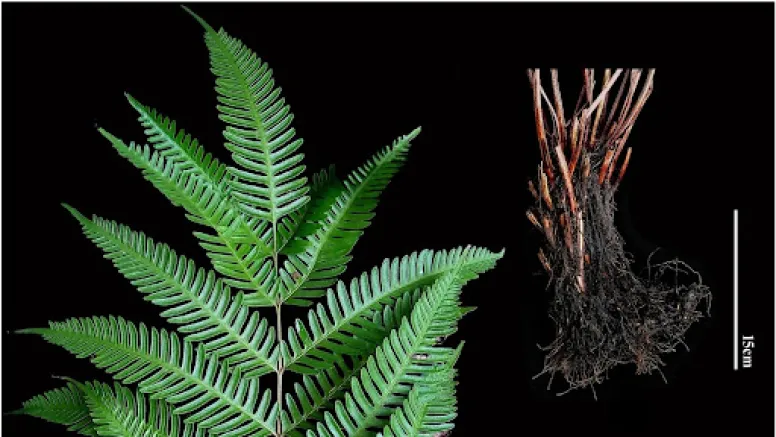
In the rugged, mist-shrouded landscapes of the Kolli Hills in Tamil Nadu, a team of Indian botanists has unearthed a biological rarity that underscores both the richness of India’s biodiversity and the fragility of its remaining wilderness. The discovery of Pteris madhusoodananii, a previously unknown species of fern, has sent ripples through the scientific community, not only for its unique morphological characteristics but for its dire conservation status. Immediately upon its identification, the species has been classified as "Critically Endangered," a stark reminder that even as we discover new life, we are on the verge of losing it.
The discovery was the result of a collaborative effort between researchers from Government Victoria College and Sri Vyasa NSS College in Kerala. Their findings, published following rigorous taxonomic and genetic analysis, highlight the Eastern Ghats—often overshadowed by the more famous Western Ghats—as a critical frontier for botanical research and conservation.
I. Main Facts: A New Sentinel of the Shola Forests
The newly identified species, Pteris madhusoodananii, belongs to the Pteridaceae family, a diverse group of ferns known for their resilience and wide distribution. However, this particular species is anything but common. Found nestled on the outskirts of the Puliansolai shola forest within the Kolli Hills, the fern is currently known to exist in only two highly localized sites.
Physical Characteristics
Unlike many of its more delicate relatives, Pteris madhusoodananii is distinguished by its robust and aesthetically striking appearance:
- Foliage: The leaves (fronds) are stiff, leathery, and possess a lustrous, deep green hue that allows them to stand out against the forest floor.
- Architecture: It features a unique pinna-pinnule arrangement. Specifically, it has a very prominent lobe at the base of its lower segments, a structural detail that separates it from other members of the Pteris genus.
- Microscopic Features: Under a scanning electron microscope (SEM), the plant’s spores reveal a narrow, wavy-edged belt known as a "cingulum." This is a definitive taxonomic marker, as similar species typically possess smooth or much wider belts.
The Namesake
The species is named in honor of Professor Dr. P. V. Madhusoodanan, the former Head of the Department of Botany at the University of Calicut. Dr. Madhusoodanan is a legendary figure in Indian pteridology (the study of ferns), and the researchers chose this name to recognize his decades of contribution to the field and his mentorship of generations of botanists.

II. Chronology of Discovery: From the Field to the Lab
The journey to identifying Pteris madhusoodananii was a multi-stage process that combined traditional "boots-on-the-ground" botany with cutting-edge molecular biology.
1. The Initial Expedition (Late 2024 – Early 2025)
The research team was conducting a broad taxonomic revision of ferns across Southern India. While the Western Ghats have been extensively documented, the Eastern Ghats remain relatively under-explored. During a trek through the Kolli Hills—part of the Eastern Ghats mountain range—the team entered the Puliansolai shola forest. It was here that they encountered a population of ferns that defied immediate categorization. While they bore the hallmarks of the Pteris genus, their leathery texture and specific leaf patterns suggested something new.
2. Taxonomic Suspicion and Sampling
Recognizing that the plant did not match descriptions in existing botanical keys, the researchers collected samples for further study. They documented the environmental conditions: the specific altitude, the humidity of the shola forest, and the proximity to water sources. These ecological markers were crucial, as Pteris species are often highly sensitive to their micro-habitats.
3. Laboratory Analysis and DNA Sequencing
Back in the laboratories in Kerala, the team employed a "polyphasic" approach to identification. They didn’t rely on sight alone.
- Morphometrics: Detailed measurements of the fronds, stems, and lobes were compared against herbarium specimens of known Pteris species.
- Palynology: Using Scanning Electron Microscopy (SEM), they analyzed the spores. The discovery of the narrow, wavy cingulum was a "eureka" moment, providing physical proof of the species’ uniqueness.
- Phylogenetics: To leave no room for doubt, the team conducted DNA sequencing. By mapping the plant’s genetic markers, they were able to place Pteris madhusoodananii accurately on the evolutionary family tree, confirming it was a distinct species and not a regional variant of a known plant.
4. Classification and Formal Publication
After confirming the uniqueness of the species, the researchers assessed its population density and habitat range. Finding only two small populations within an eight-square-kilometer radius, they applied the IUCN (International Union for Conservation of Nature) Red List criteria, leading to the "Critically Endangered" designation.

III. Supporting Data: Why the Kolli Hills Matter
The discovery of Pteris madhusoodananii is a testament to the biological importance of the Kolli Hills. These hills are part of the Eastern Ghats, a discontinuous range of mountains along India’s eastern coast.
The "Sky Island" Ecosystem
The Puliansolai shola forest where the fern was found is a type of high-altitude tropical montane forest. These "sholas" are often referred to as "sky islands"—isolated pockets of unique vegetation surrounded by a sea of different ecosystems (usually grasslands or lower-altitude deciduous forests). Because they are isolated, evolution often takes a unique path here, leading to high levels of endemism (species found nowhere else on Earth).
Comparative Data: Pteris Species in India
The Pteris genus is one of the largest among ferns, with over 200 species worldwide. In India, they are found from the Himalayas to the tip of Kanyakumari. However, Pteris madhusoodananii is geographically restricted. Unlike the common Pteris vittata (the ladder brake fern), which can grow in cracks in city walls, the new species requires the specific, humid, and shaded environment of the shola outskirts.
| Feature | Pteris madhusoodananii | Common Pteris Relatives |
|---|---|---|
| Leaf Texture | Stiff, Leathery, Lustrous | Usually Papery or Herbaceous |
| Spore Belt | Narrow, Wavy-edged Cingulum | Smooth or Wide Cingulum |
| Habitat Range | ~8 Square Kilometers | Regional or National |
| Conservation | Critically Endangered | Least Concern / Data Deficient |
IV. Official Responses and the Conservation Crisis
The announcement of the discovery has been met with a mixture of scientific acclaim and environmental alarm. Botanical experts and conservationists are calling for immediate intervention by state and central authorities.
The Threat of Infrastructure
The primary threat to Pteris madhusoodananii is habitat loss. The Kolli Hills are increasingly being developed for tourism and agriculture. The researchers noted that the specific sites where the fern thrives are currently threatened by:

- Road Construction: New paths being carved through the hills to facilitate transport are fragmenting the already tiny habitat.
- Logging and Agriculture: The conversion of natural forest into farmland and the clearing of timber are encroaching on the shola borders.
- Invasive Species: As the forest canopy is opened by human activity, invasive weeds can move in, outcompeting native ferns for space and nutrients.
Calls for Protected Status
Scientists from Government Victoria College have urged the Tamil Nadu Forest Department to declare the Puliansolai shola outskirts a "Biological Heritage Site" or an "Eco-Sensitive Zone." Currently, the two sites where the fern exists do not fall under any official protection, leaving them vulnerable to private land development.
"The discovery of a species is only the first step," said one of the lead authors of the study. "If we do not act within the next 24 to 36 months to protect these specific eight square kilometers, we may be the only generation to have ever known Pteris madhusoodananii existed."
V. Implications: The Broader Botanical Context
The discovery of this fern carries weight far beyond the borders of Tamil Nadu. It highlights several critical issues in modern Indian science and environmental policy.
1. The Taxonomic Impediment
There is a growing concern in the scientific community known as the "taxonomic impediment"—the shortage of trained taxonomists who can identify and describe new species. This discovery shows that there is still much to learn about India’s flora, but without continued funding for traditional botany and field expeditions, many species will go extinct before they are even named.
2. The Eastern Ghats vs. Western Ghats
For decades, the Western Ghats have received the lion’s share of conservation funding and international attention as a "Biodiversity Hotspot." This discovery serves as a reminder that the Eastern Ghats are equally vital and perhaps more at risk because they are less protected and more fragmented. The Kolli Hills, in particular, represent a "relic" ecosystem that preserves ancient lineages of plants.

3. Climate Change Vulnerability
Shola-dependent species are "canaries in the coal mine" for climate change. Because they require specific temperature and moisture regimes found only at certain altitudes, even a slight rise in regional temperatures could push Pteris madhusoodananii off the mountain. The "Critically Endangered" status is not just a result of human encroachment but also a reflection of the species’ inability to migrate to new habitats as the climate shifts.
4. A Legacy of Learning
By naming the species after Professor Madhusoodanan, the researchers have highlighted the importance of the academic lineage in Indian science. It underscores a tradition of passing down specialized knowledge—the ability to look at a microscopic spore and see a new branch of the tree of life.
Conclusion
The discovery of Pteris madhusoodananii is a bittersweet milestone. It is a triumph of Indian botanical scholarship and a testament to the hidden wonders of the Eastern Ghats. Yet, its "Critically Endangered" status is a loud alarm bell. As road crews and logging operations move closer to the heart of the Kolli Hills, the window of opportunity to save this deep-green, leathery survivor is rapidly closing. The fate of this fern now rests not in the hands of botanists, but in the hands of policymakers and the public. To lose a species just as we have learned its name would be a tragedy of the highest order for India’s natural heritage.
