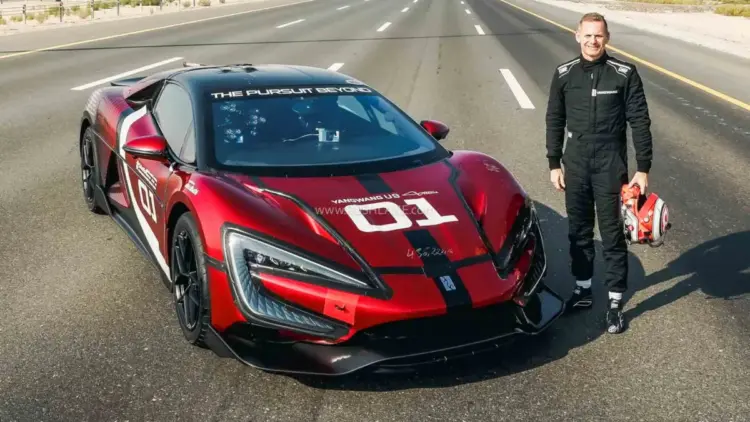
In a watershed moment for the global automotive industry, BYD’s high-performance sub-brand, Yangwang, has officially rewritten the history books. The Yangwang U9 Xtreme, an ultra-limited evolution of the brand’s flagship electric supercar, has become the first production vehicle in history to eclipse the 500 km/h (310.7 mph) threshold on an open road. Clocking a staggering top speed of 503.17 km/h in Abu Dhabi, United Arab Emirates, the vehicle has been formally recognized with a Guinness World Record, signaling a definitive shift in the hierarchy of automotive performance.
This achievement does more than just secure a trophy for the Chinese automaker; it represents the arrival of the "Multi-Megacar" era. While the industry has long been dominated by European legacy marques in the pursuit of terminal velocity, BYD’s successful run in the Middle East proves that the future of extreme performance is not only electric but is being pioneered by Eastern engineering prowess.
Chronology of a Record: From "Dancing" Prototype to World Champion
The journey of the Yangwang U9 to the 500 km/h club has been one of rapid, iterative brilliance. To understand the magnitude of the Xtreme variant’s success, one must look back at the platform’s public evolution.
The Debut of the DiSus-X (2023)
The automotive world first took notice of the Yangwang U9 not for its speed, but for its agility and "personality." Upon its debut, the U9 showcased the DiSus-X Intelligent Body Control System. In a series of viral demonstrations, the car was seen "dancing" to music by independently modulating its suspension and, most impressively, jumping off the ground to demonstrate its ability to mitigate impact from potholes or obstacles. At the time, critics viewed these features as high-tech novelties, but they were actually the foundational tests for the high-speed stability required for the record-breaking run.
The German Benchmark (September 2023)
The pursuit of raw speed began in earnest in late 2023. An earlier iteration of the U9 Xtreme was taken to a high-speed testing facility in Germany, where it recorded a top speed of 496.22 km/h. While falling just short of the 500 km/h milestone, the data gathered during this session was instrumental in refining the vehicle’s thermal management and aerodynamic profile.

The Nürburgring Conquest
Shortly after the German speed trials, the U9 Xtreme took to the Nürburgring Nordschleife. It became the first mass-produced electric supercar to break the seven-minute barrier, recording a lap time of 6:59.157. This proved that the U9 was not merely a "straight-line missile" but a sophisticated performance machine capable of handling the world’s most grueling cornering circuits.
The Abu Dhabi Breakthrough (November 2024)
The culmination of these efforts took place on a closed stretch of open road in Abu Dhabi. Benefiting from the region’s unique climate and specialized asphalt, the U9 Xtreme pushed past its previous German record by 6.95 km/h, officially hitting 503.17 km/h.
Supporting Data: The Engineering of a 2,977 BHP Multi-Megacar
The Yangwang U9 Xtreme is categorized as a "Megacar"—a term reserved for vehicles producing more than one megawatt (1,341 bhp) of power. However, the U9 Xtreme transcends this definition. Built on BYD’s proprietary 1200V e4 (Yi Si Fang) platform, the vehicle is a "Multi-Megacar," boasting a peak output of 2,977 bhp.
Power Unit and Drivetrain
The heart of the Xtreme is a quad-motor setup. Each wheel is driven by an independent electric motor capable of reaching an unprecedented 30,000 RPM. This configuration allows for a power-to-weight ratio of approximately 1,200 bhp per tonne.
Crucially, the e4 platform utilizes a sophisticated torque vectoring system that eliminates the need for conventional mechanical axles. This digital system adjusts torque distribution at a rate of 100 times per second, ensuring that even at speeds exceeding 500 km/h, the vehicle maintains optimal traction and directional stability.

Battery Technology and Discharge Rates
Sustaining nearly 3,000 bhp requires a battery capable of massive energy throughput. The U9 Xtreme is equipped with an 80 kWh battery pack featuring a 30C discharge rate. In electrical engineering terms, a "30C" rating means the battery can discharge 30 times its rated capacity in an hour. This high-density discharge is what allows the 1200V architecture to surge 1000A of current to the motors during a top-speed run.
Aerodynamic and Structural Enhancements
To prevent the vehicle from becoming airborne at half the speed of sound, BYD engineers overhauled the standard U9’s aerodynamics. The "Xtreme" variant features:
- Carbon Fiber Splitter: A massive front assembly designed to create a high-pressure zone, pinning the front wheels to the tarmac.
- Dual-Channel Hood: Specifically engineered to manage airflow over the cabin and reduce lift.
- Swan Neck Rear Spoiler: Unlike traditional wings, the swan neck mount allows for undisturbed airflow on the underside of the wing, where the majority of downforce is generated.
- Rear Diffuser: A cavernous carbon fiber diffuser that accelerates airflow under the car, creating a vacuum effect.
The Record Run: A Masterclass in Precision
The Guinness World Record attempt was captured in a high-production documentary format, revealing the intense preparation required for such a feat. The professional test driver spent approximately 60 seconds performing high-torque "burnouts" and weaving maneuvers to bring the bespoke tires to their optimal operating temperature, maximizing the coefficient of friction.
The acceleration phase was a calculated exercise in throttle management. To prevent wheel spin and thermal runaway in the initial stages, the driver maintained the throttle at a mid-position until the vehicle crossed the 380 km/h mark. Only once the aerodynamic downforce was sufficient to "lock" the car to the road did the driver apply full "pedal to the metal" acceleration, surging from 380 km/h to the record-breaking 503.17 km/h in a matter of seconds.
Official Responses and Production Exclusivity
While BYD has not released a lengthy corporate manifesto following the run, the sentiment from the Yangwang engineering team is clear: this record is a demonstration of the e4 platform’s ceiling. A spokesperson for the brand noted that the U9 Xtreme serves as a "halo" vehicle, proving that the technologies found in BYD’s more accessible consumer EVs—such as blade batteries and integrated motor controllers—can be scaled to the absolute limits of human engineering.

Guinness World Records officials were present on-site to verify the telemetry data, ensuring that the run met the stringent criteria for a production car record. This includes the requirement that the car is technically available for purchase, albeit in highly restricted quantities.
Production Details:
- Availability: Limited to 30 units worldwide.
- Customization: Each unit features unique "Xtreme" graphics and a weight-optimized interior.
- Target Audience: Ultra-high-net-worth collectors and automotive museums.
Implications: A Paradigm Shift in the Supercar Hierarchy
The success of the Yangwang U9 Xtreme has profound implications for the future of the automotive industry.
1. The Death of the Internal Combustion Speed King
For decades, the 300 mph (482 km/h) barrier was the "Holy Grail" for internal combustion engines (ICE). Bugatti and Koenigsegg spent years and millions of dollars perfecting quad-turbocharged W16 and V8 engines to reach these heights. BYD has achieved and surpassed this using a purely electric powertrain, suggesting that the ceiling for EV performance is significantly higher than previously thought.
2. China’s Emergence as a Luxury Powerhouse
Historically, Chinese automakers were seen as manufacturers of affordable, mass-market vehicles. The Yangwang U9 Xtreme shatters this stereotype. By conquering the Nürburgring and setting a world speed record, BYD has positioned itself as a legitimate rival to the likes of Rimac, Pininfarina, and Lotus.

3. Safety and Control Tech Trickle-Down
While the average driver will never need to travel at 500 km/h, the systems developed to make the U9 Xtreme stable at those speeds will eventually find their way into everyday vehicles. The DiSus-X suspension and the ultra-fast torque vectoring are technologies that can improve emergency maneuvers and stability in rain or snow for standard passenger cars.
4. The Challenge to Legacy Brands
The pressure is now on European manufacturers to respond. With the U9 Xtreme setting the bar at 503 km/h, the "speed wars" have been reignited. However, the barrier to entry is no longer just aerodynamics; it is the ability to manage 1200V electrical architectures and extreme battery discharge rates—areas where BYD currently holds a significant vertical integration advantage.
Conclusion
The BYD Yangwang U9 Xtreme’s 503.17 km/h run in Abu Dhabi is more than a speed record; it is a declaration of intent. By combining the "dancing" agility of the DiSus-X system with the raw, terrifying power of a 2,977 bhp quad-motor setup, BYD has created a machine that defies traditional categorization. As only 30 individuals prepare to take delivery of this historic Megacar, the rest of the world is left to contemplate a new reality: the fastest production car on Earth no longer burns gasoline, and it hails from a brand that, until recently, was best known for its buses and hatchbacks. The era of the electric Multi-Megacar has officially arrived.