Introduction

In the rapidly evolving landscape of the Indian automotive market, Hyundai Motor India Limited (HMIL) has consistently demonstrated an uncanny ability to identify and fill microscopic niches within the SUV segment. The latest manifestation of this strategy is the Hyundai Bayon. Positioned strategically between the sub-four-meter Venue and the segment-defining Creta, the Bayon is not merely a "gap-filler." It is a sophisticated, software-defined vehicle designed to appeal to a younger, tech-savvy demographic that demands premium aesthetics without the bulk of a full-sized mid-size SUV.

Recently put to the test during an intensive media drive in the varied terrains of Goa, the Bayon—specifically in its top-tier IVT (Intelligent Variable Transmission) trim—revealed itself to be a calculated strike against established rivals, most notably the Maruti Suzuki stable. With a starting price of ₹9.99 lakh (ex-showroom), Hyundai has signaled a price war, offering high-end technology and European-inspired driving dynamics at a price point that undercuts much of its immediate competition.

I. Main Facts: The Bayon Blueprint
The Hyundai Bayon enters the market with a clear set of specifications aimed at balancing urban maneuverability with highway stability.

- Strategic Positioning: Slots between the Venue (sub-compact) and Creta (mid-size).
- Dimensions: Measures 4,245 mm in length with a class-leading wheelbase of 2,600 mm.
- Powertrain: Equipped with the proven 1.5-litre, four-cylinder Naturally Aspirated (NA) Petrol engine.
- Performance Metrics: Delivers 115 PS of peak power and 143.8 Nm of maximum torque.
- Transmission Options: 6-speed Manual Transmission (MT) and a stepped Intelligent Variable Transmission (IVT) with paddle shifters.
- Pricing: Starts at a competitive ₹9.99 lakh, extending upward for the feature-loaded ADAS trims.
- Key Differentiators: First-in-segment Generative AI voice assistant, Level 2+ ADAS, and a "Software-Defined Architecture."
II. Chronology: The Evolution of Hyundai’s SUV Dominance
The arrival of the Bayon is the latest chapter in a decade-long narrative of SUV expansion for Hyundai in India.

- The Creta Revolution (2015): Hyundai redefined the premium SUV space, establishing a dominance that remains largely unchallenged.
- The Venue Introduction (2019): Recognizing the growth of the sub-four-meter segment, Hyundai introduced the Venue, bringing "connected car" technology (BlueLink) to the masses.
- The Premium Pivot (2021-2023): With the launch of the Alcazar and the Tucson, Hyundai moved upmarket, focusing on luxury and ADAS (Advanced Driver Assistance Systems).
- The Bayon Launch (2024): The Bayon represents the "democratization of premium tech." It takes the sophisticated electronics of the Tucson and the reliability of the Creta’s powertrain, packaging them into a more agile, urban-friendly footprint. It marks Hyundai’s shift toward "Art of Steel" design and Generative AI integration.
III. Supporting Data: Design, Technology, and Performance
1. "Art of Steel" Design Language
The Bayon is the standard-bearer for Hyundai’s latest design philosophy. Unlike the rugged, boxy silhouettes of traditional SUVs, the Bayon adopts an "Urban Confident" stance.

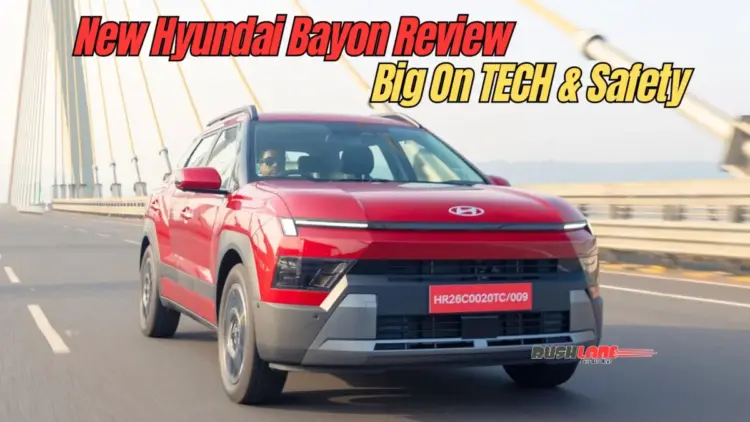
- Front Facia: Features the signature H-Edge LED DRLs and high-intensity dual LED projector headlamps. The sculpted bonnet and bold character lines provide a sense of motion even at a standstill.
- Profile: Flared wheel arches house machined 17-inch alloy wheels, while wide rear haunches give the vehicle a planted look.
- Rear: A flared spoiler integrates an Aero-style vertical high-mount stop lamp. Notably, Hyundai has eschewed the ubiquitous "connected tail light" trend in favor of a more distinct, three-dimensional light signature.
- Customization: Buyers can choose from six monotone, two dual-tone, and two premium Matte finishes. The exterior choice dictates the interior palette—dual-tones receive a sporty all-black cabin with red accents, while others feature a sophisticated Black and Olive Grey theme.
2. The Premium Digital Cabin
Inside, the Bayon moves away from the utilitarian feel of many B-SUVs. The "Command Centre" is the focal point, featuring a curved panoramic housing that contains two 12.3-inch high-resolution displays.

- Materials: Leatherette upholstery on the seats is complemented by soft-touch door trims and a unique fabric insert on the dashboard, significantly elevating the tactile experience.
- Ergonomics: A D-cut steering wheel featuring the new "quad dot" branding (Morse code for ‘H’) houses the Drive Mode selector for easy access.
- Amenities: The cabin is a tech-lover’s sanctuary, featuring a Bose premium 8-speaker audio system with a dedicated subwoofer, ventilated front seats, a powered driver’s seat, and a panoramic sunroof that enhances the sense of space.
3. Generative AI and Connectivity
The Bayon is Hyundai’s first offering to feature a Generative AI voice assistant, developed in partnership with Perplexity and Soundhound AI. Unlike standard voice commands, this system utilizes NVIDIA computing to engage in natural language processing. It can provide real-time data, answer complex questions, and manage over 500 embedded vehicle commands in multiple regional languages.

4. Safety and Architecture
Safety is anchored by the "Global K" enhanced platform, which Hyundai claims is engineered for a 5-star safety rating.

- ADAS Level 2+: The Bayon features 23 autonomous functions, including navigation-based adaptive cruise control, blind-spot monitoring, and forward collision avoidance.
- Software-Defined Architecture: The vehicle supports Over-The-Air (OTA) updates for 19 different controllers, ensuring the car’s software remains current throughout its lifecycle.
5. Driving Dynamics
During the test drive in Goa, the 1.5L NA engine proved to be a model of refinement.

- Dash Boost Mode: A unique feature that optimizes transmission ratios and engine mapping for sudden bursts of acceleration, aiding in highway overtaking.
- Ride Quality: With 205 mm of ground clearance, the Bayon handled broken patches and mild off-road trails with ease. The suspension is tuned with a hint of European firmness, which minimizes body roll during cornering—a common complaint in high-ground-clearance vehicles.
- Braking: The inclusion of disc brakes on all four wheels ensures sure-footed stopping power, a critical safety feature often omitted by competitors in this price bracket.
IV. Official Responses and Market Context
While official executive quotes often highlight "synergy" and "customer-centricity," industry analysts point to the Bayon as a strategic "volume protector."

According to market insiders, Hyundai’s internal research suggested a growing segment of buyers who felt the Venue was too small for family duties but found the Creta’s size (and price) unnecessary for city-centric living. The Bayon is the official response to this data.

Hyundai engineers have emphasized that the Bayon’s 2,600 mm wheelbase is the "sweet spot" for Indian families, providing rear-seat legroom that rivals vehicles in the segment above. By utilizing the 1.5L engine—a unit that has already seen over 6 lakh satisfied customers in India—Hyundai is leveraging "proven reliability" to offset the "newness" of the Bayon’s futuristic design.

V. Implications: The Future of the Indian SUV Market
The introduction of the Hyundai Bayon has several far-reaching implications for the Indian automotive industry:

1. The "Feature War" Reaches a Zenith:
By offering Generative AI and Level 2+ ADAS in a vehicle starting under ₹10 lakh, Hyundai is forcing competitors to accelerate their technology timelines. Features that were considered "luxury" just 24 months ago are now becoming entry-level expectations.

2. Efficiency vs. Experience:
While Maruti Suzuki continues to dominate the "efficiency" narrative with hybrids and CNG, Hyundai is betting on the "experience" narrative. The Bayon targets the buyer who prioritizes NVH (Noise, Vibration, Harshness) levels, interior ambiance, and software integration over pure mileage figures.

3. Software-Defined Residual Value:
The ability to update 19 controllers via OTA suggests a shift in how cars will depreciate. A car that "gets smarter" over time through software updates may hold its value better than a purely mechanical rival, potentially changing the secondary market dynamics.

4. Segment Blurring:
The Bayon effectively blurs the lines between the B-SUV and C-SUV segments. Its length and features put it in competition with everything from the Maruti Suzuki Brezza and Fronx to the lower variants of the Tata Harrier or Mahindra XUV700.

Conclusion
The Hyundai Bayon is a meticulously engineered product that reflects the changing aspirations of the Indian car buyer. It moves the needle from "transportation" to "lifestyle device." With its combination of a refined 1.5L powertrain, a sophisticated "Art of Steel" aesthetic, and a technological package that punches well above its weight, the Bayon is poised to become a formidable player on the sales charts. For the consumer, it offers a compelling proposition: the prestige and tech of a flagship SUV, delivered in a package that is both affordable and perfectly sized for the modern Indian landscape.