
New Delhi: As the Common Admission Test (CAT) 2026 approaches, a narrative has begun to circulate across aspirant circles: a noticeable dip in registrations signals a potential drop in cutoffs and, consequently, an easier path to securing coveted percentile ranks. However, a closer examination of historical data and the fundamental mechanics of the CAT exam reveals a more nuanced reality. While the absolute number of registrations has decreased, the impact on individual percentile calculations is far less dramatic than the widespread speculation suggests. The true determinant of success, experts contend, remains the nature of the exam itself and a candidate’s preparedness.
The Headline Figure: A Closer Look at Registration Trends
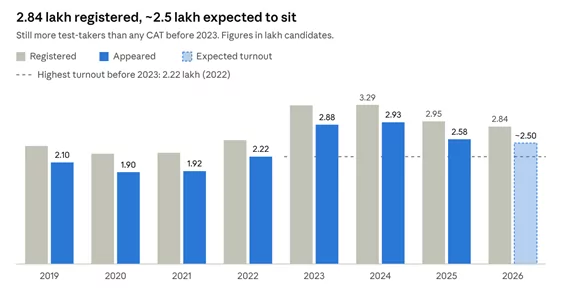
CAT 2026 has seen approximately 2.84 lakh registrations, a decrease of about 11,000 (3.7%) compared to the 2.95 lakh registrations in the previous year. This marks the second consecutive year of decline since the peak of 3.29 lakh registrations in 2024. While this reduction might appear significant at first glance, a broader historical perspective reveals that the 2023-24 surge was an anomaly rather than the new norm. Even with the current decrease, the 2026 registration numbers remain higher than those recorded in any year prior to 2023, a period when achieving high percentiles was still a formidable challenge for many.
The prevalent sentiment, amplified across social media platforms and aspirant forums, suggests that fewer registrations automatically translate to lower cutoffs and a more accessible percentile. This "good news" offers a glimmer of hope to candidates grappling with the intense pressure of preparation. However, relying solely on this perceived advantage without a deeper understanding of the exam’s dynamics can be a strategic misstep.
Beyond Registration: The True Competition Pool
The crucial distinction lies between the number of individuals who register for CAT and the number who actually appear for the examination. Historically, the turnout for CAT has been between 11% and 17% lower than the registered numbers since 2019. In CAT 2025, for instance, out of 2.95 lakh registrations, approximately 2.58 lakh candidates actually took the exam. Projections for CAT 2026 suggest a similar turnout, potentially around 2.5 lakh candidates.
This gap between registered and appearing candidates comprises individuals who may have registered out of curiosity, students who secured campus placements before the exam, or working professionals whose career timelines shifted. These individuals, while having paid the registration fee, were unlikely to be serious contenders for the top percentile ranks. Therefore, the actual number of serious competitors experiences a more modest reduction than the headline registration figures might imply. This nuanced understanding is critical, as it directly impacts the percentile calculations later in the process.
Percentile: A Measure of Relative Performance, Not Absolute Numbers
It is imperative to understand that a percentile rank signifies the percentage of candidates a particular candidate has outperformed, not the absolute number of candidates. For example, a 99th percentile means a candidate has scored better than 99% of those who appeared for the exam. If the number of test-takers decreases, the absolute number of candidates within each percentile bracket also shrinks proportionally.
In CAT 2025, with approximately 2.58 lakh appearing candidates, the 99th percentile was achieved by roughly the top 2,580 individuals. For CAT 2026, with an expected 2.5 lakh test-takers, this number would be around the top 2,500. While the pool is smaller, the proportion remains consistent. A smaller applicant pool does not automatically grant a higher percentile; it merely means that the competition within each percentile band becomes slightly less crowded. The actual score required to achieve a specific percentile is a separate and far more significant factor.

The Decisive Factor: Exam Difficulty, Not Candidate Count
The most critical determinant of the marks required to achieve a particular percentile is the difficulty level of the CAT paper itself. Over the past five years, the marks needed to secure the 99th percentile have fluctuated significantly, ranging from 76 to 98. This wide variation cannot be adequately explained by the changes in the number of candidates.
Consider the transition from CAT 2023 to CAT 2024. Despite a marginal increase in the number of test-takers, the score required for the 99th percentile jumped by a substantial 19 marks. This surge was primarily attributed to a relatively easier paper in CAT 2024, which allowed more candidates to score higher marks. Conversely, between CAT 2021 and CAT 2022, an additional 30,000 candidates appeared for the exam, yet the 99th percentile score actually decreased by 14 marks. This highlights that a more challenging paper can lead to lower scores being required for the same percentile, irrespective of the total number of participants.
The fundamental lesson is that the difficulty of the CAT paper, and how effectively the entire cohort navigates it, directly dictates the score-to-percentile conversion. A reduction of 11,000 registrations will not significantly alter this conversion compared to the impact of a single challenging section, such as Data Interpretation and Logical Reasoning (DILR). Aspirants seeking to understand this dynamic more deeply can refer to detailed analyses of CAT score versus percentile trends.
A Modest Advantage: The Nuance of Lower Percentile Bands
While the top percentile ranks are largely unaffected by registration numbers, a smaller candidate pool can offer a marginal advantage at lower percentile bands, particularly concerning IIM shortlistings. IIMs typically maintain a fixed number of seats. When the number of candidates appearing for the exam decreases, IIMs may need to delve deeper into the percentile list to fill their desired interview slots.
To illustrate this point, consider the following hypothetical scenarios for shortlist sizes:
| If an institute calls… | ~2.93 lakh appear (2024) | ~2.58 lakh appear (2025) | ~2.5 lakh appear (2026, expected) |
|---|---|---|---|
| 3,000 candidates (top-IIM) | 98.98 %ile | 98.84 %ile | 98.80 %ile |
| 15,000 candidates (mid-tier) | 94.88 %ile | 94.19 %ile | 94.00 %ile |
At the higher end, the percentile threshold for selection might shift by approximately 0.2 percentile points, a difference of merely a couple of marks, often within the margin of error for a single incorrect answer in a TITA (The answer is type) question. However, in the 94-95 percentile band, the shift can be closer to 0.9 percentile points. This represents a more tangible, albeit still modest, tailwind for candidates targeting mid-tier IIM calls.
It is crucial to acknowledge two significant caveats. Firstly, IIMs officially publish minimum percentile cutoffs as a policy, and these are generally not adjusted downwards simply due to a dip in candidate numbers. Secondly, the final shortlist is a composite score that incorporates academic performance (Class 10, 12, graduation), work experience, and diversity factors. Therefore, candidates should not solely rely on percentile shifts and must consult specific IIM shortlisting criteria.
Who is Likely Opting Out? Understanding the Shifting Demographics
While official data on non-registrants is unavailable, informed reasoning suggests that the candidates likely opting out are not typically those vying for the 95+ percentile ranks. Several factors are believed to be contributing to the recent decline in registrations:
- A Robust Job Market for Graduates: A strong campus placement scenario for fresh graduates may be encouraging more students to enter the workforce directly rather than pursuing further management education immediately.
- Rising IIM Fees: The substantial increase in fees for flagship IIM programs, now nearing ₹21 lakh, can be a deterrent for some prospective students.
- A Crowded Entrance Exam Calendar: The proximity of other prominent management entrance exams like NMAT, SNAP, and XAT may lead some candidates to prioritize those tests, especially if they align better with their preferred B-schools.
- Past Admissions Irregularities: The admission cycles of the previous year, marked by issues like revoked offers and revised result lists, may have created a sense of uncertainty and deterred more casual aspirants.
These pressures disproportionately affect undecided aspirants. Candidates who have diligently prepared, taken numerous mock tests, analyzed their performance, and strategized their exam approach are less likely to be deterred by fee hikes or a crowded calendar. Consequently, the CAT 2026 applicant pool is likely to be composed of a more committed and serious cohort, rather than being significantly diluted. This underscores the importance of sustained effort rather than complacency.
Strategic Focus for the Remaining Preparation Period
Given that the decrease in registrations has a minimal impact on the top percentile scores, candidates should redirect their focus towards factors within their control. The remaining 38 days of preparation should be strategically utilized in areas that demonstrably influence performance:
- Intensified Mock Test Analysis: Beyond taking mocks, a rigorous analysis of performance is crucial. Identifying weak areas, understanding error patterns, and refining test-taking strategies are paramount.
- Targeted Sectional Practice: Dedicate focused effort to improving accuracy and speed in specific sections, particularly those identified as weaker through mock test performance.
- Revision of Core Concepts: Revisit fundamental concepts across Quantitative Aptitude, Data Interpretation & Logical Reasoning, and Verbal Ability & Reading Comprehension to build a strong foundation.
- Time Management Drills: Practice timed sections and full-length mocks to enhance efficiency and ensure optimal time allocation during the actual exam.
- Mental Preparedness and Stress Management: Cultivate a positive mindset, manage pre-exam anxiety through relaxation techniques, and ensure adequate rest.
A More Constructive Message to Share
Instead of propagating the misconception that reduced registrations will automatically lower cutoffs, a more accurate and empowering message to share within aspirant communities would focus on the enduring importance of individual effort and exam performance. Consider sharing the following points:
- Percentile is relative: Your rank is determined by your performance against others who appear, not just the total number registered.
- Exam difficulty is the key driver: The marks needed for a percentile are primarily influenced by the paper’s challenge, not applicant numbers.
- Actual competition is smaller: The number of serious contenders is less affected by registration dips than headline figures suggest.
- Marginal advantage exists lower down: A smaller pool might slightly improve chances for mid-tier calls, but this effect is modest.
- Focus on what you control: Your preparation, strategy, and execution are the most significant factors for success.
The upcoming CAT 2026 exam will be a test of preparation and resilience, not a reflection of shifting registration trends. With fewer than 38 days remaining, the focus must remain squarely on honing skills, refining strategies, and approaching the exam with a clear understanding of what truly determines success. The anxiety of the competition may persist, but the path to achieving one’s goals remains paved with diligent preparation and a strategic approach to the examination itself.
Connect with alumni and students for insights. Join: CAT 2026 Exam Preparation, Discussion | PaGaLGuY.