

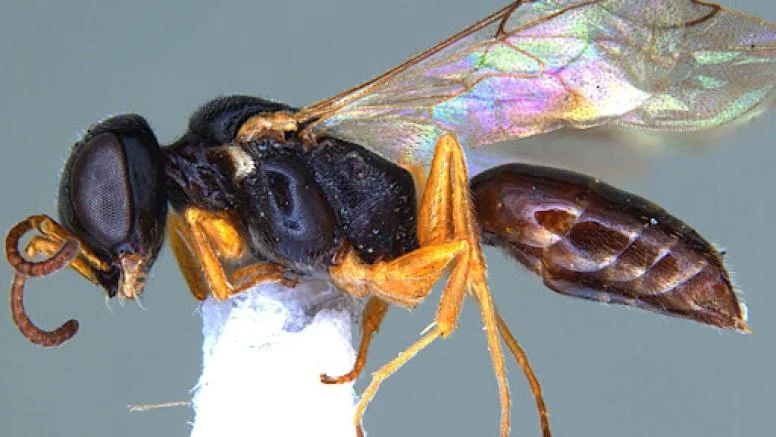
KOZHIKODE — In a significant contribution to the field of entomology and India’s biological records, scientists have announced the discovery of a previously unknown species of wasp in the Kozhikode district of Kerala. The insect, a diminutive but ecologically vital predator named Spilomena malabarica, belongs to a group colloquially known as "aphid wasps."
The discovery, spearheaded by researchers from the Zoological Survey of India (ZSI), underscores the immense, yet often invisible, biodiversity flourishing within the Western Ghats region. This find not only adds a new name to the global register of Hymenoptera but also challenges existing taxonomic frameworks, prompting a potential re-evaluation of how these beneficial insects are classified on the evolutionary tree of life.
Main Facts: The Emergence of a Micro-Predator
The newly identified species, Spilomena malabarica, was described by researchers S. Amal and P. Girish Kumar of the Zoological Survey of India. Measuring a mere 3.5 millimeters in length, the wasp is a "micro-wasp" that plays a disproportionately large role in its habitat as a natural pest controller.
Taxonomic Significance
This discovery marks the 11th species of the genus Spilomena to be recorded within Indian borders and the 98th species identified worldwide. The genus Spilomena is comprised of solitary wasps known for their specialized hunting habits; they primarily target aphids—tiny, sap-sucking insects that are notorious for damaging agricultural crops and spreading plant viruses.
Physical Characteristics
Under the high-powered magnification of a stereomicroscope, Spilomena malabarica reveals a complex morphology that distinguishes it from its global cousins. The wasp exhibits a sleek black-and-brown coloration. However, its most defining scientific feature lies in its wing venation. It possesses a single submarginal cell—a specific enclosed area formed by veins on the forewing—a trait that is relatively rare within its genus.

Furthermore, the researchers noted specific cranial features that set it apart from its closest relative, Spilomena unus. Unlike S. unus, which features an unusually elongated head, S. malabarica possesses a well-proportioned head with a flatter facial structure, known in entomological terms as a less convex clypeus.
Chronology of the Discovery: From Field to Lab
The journey of Spilomena malabarica from an anonymous inhabitant of the Kerala brush to a recognized scientific entity followed a meticulous process of field collection and laboratory analysis.
The Collection Phase
The "type specimen"—the specific individual used to describe and name the species—was collected in the Kozhikode district. The field operation was conducted by researcher K. Ayana Sudheer, who utilized a method known as "yellow pan trapping."
Yellow pan traps are a staple tool in entomology. These traps consist of shallow containers filled with a preserving liquid and painted a specific shade of bright yellow. The color mimics the ultra-violet reflections of flowers, tricking various insects into landing in the liquid, where they are captured intact for study. This method is particularly effective for capturing small Hymenoptera that are often missed by traditional sweeping nets.
Analysis and Identification
Following the collection, the specimens were transferred to the Zoological Survey of India’s facilities. Over the subsequent months, S. Amal and P. Girish Kumar subjected the insects to rigorous morphological examination.

Using modern 3D imaging software and advanced microscopy, the team compared the Kozhikode specimens against existing records of the 97 other known Spilomena species. By June 18, 2026, the data confirmed that the traits observed—the specific wing cell structure combined with the head proportions—did not match any previously described wasp, leading to the formal declaration of a new species.
Supporting Data: The Biological Blueprint of S. malabarica
To the untrained eye, many micro-wasps look identical, but for taxonomists, the devil is in the details. The supporting data for Spilomena malabarica focuses on "morphometrics"—the quantitative analysis of form and structure.
Comparative Morphology
The researchers focused heavily on the "Malabarica" versus "Unus" comparison. While both species share the single submarginal cell trait, the "vertex" (the top of the head) and the "clypeus" (the lower part of the face) provided the definitive evidence for a new species designation. In S. malabarica, the distance between the compound eyes and the top of the head is significantly more compact than in other members of the genus found in the Palearctic or Indomalayan realms.
The Role of the Malabar Region
The naming of the species—malabarica—is a deliberate tribute to the Malabar Coast. This region, nestled between the Western Ghats and the Arabian Sea, is recognized as a global biodiversity hotspot. Supporting data suggests that the unique micro-climates of Kerala, characterized by high humidity and dense tropical vegetation, provide the ideal breeding ground for specialized parasitoids like Spilomena.
Official Responses and Scientific Debate
The discovery has sparked a dual response within the scientific community: celebration of India’s growing taxonomic catalog and a call for a broader revision of insect classification.

The ZSI Perspective
Officials from the Zoological Survey of India have hailed the discovery as a testament to the importance of continued field surveys. "Every new species discovered is a piece of the puzzle of our ecosystem," noted a representative involved in the study. "For a country like India, where agriculture is the backbone of the economy, understanding the diversity of insects that naturally control pests like aphids is of paramount importance."
The Taxonomic Challenge
The discovery has also reignited a long-standing debate among hymenopterists (wasp experts). The unique physical traits of S. malabarica appear to "blur" the traditional boundaries between two distinct wasp groups: Spilomena and Arpactophilus.
Currently, these groups are separated based on specific physical markers. However, S. malabarica exhibits a combination of traits that suggests these two genera might be more closely related than previously thought. Researchers S. Amal and P. Girish Kumar have suggested that this discovery necessitates a shift toward "integrative taxonomy"—a method that combines physical descriptions with DNA barcoding and life-cycle observations to redraw the evolutionary tree.
Implications: Why a 3.5mm Wasp Matters
While the discovery of a tiny wasp might seem like a niche academic event, the implications for agriculture, conservation, and evolutionary science are profound.
1. Natural Pest Management
Aphids are among the most destructive pests in the world, capable of decimating vegetable crops, fruit trees, and grains. Spilomena wasps act as "parasitoids" or specialized hunters. They capture aphids, paralyze them, and use them as a food source for their larvae.
By identifying and protecting native species like S. malabarica, scientists can develop "biological control" strategies. This reduces the reliance on chemical pesticides, which often harm the environment and human health. The presence of S. malabarica suggests that the Malabar region has a built-in defense system against aphid outbreaks.

2. Biodiversity Conservation
The Western Ghats are under constant pressure from urbanization, deforestation, and climate change. The discovery of a new species in an area like Kozhikode serves as a reminder that we are still discovering the inhabitants of these forests even as they face threats. Protecting the habitat of S. malabarica ensures the survival of countless other "cryptic" species that have yet to be identified.
3. Advancing Genetic Research
The researchers’ call for DNA studies on S. malabarica opens the door for a more modern approach to Indian entomology. Mapping the genome of these wasps can help scientists understand how they evolved to hunt specific pests and how they might adapt to a changing climate.
4. Strengthening the "Taxonomic Impediment"
There is a global shortage of taxonomists—scientists who can identify and name species. This discovery highlights the critical role of the Zoological Survey of India in bridging this gap. By documenting the 11th species of this genus in India, the ZSI is providing the foundational data necessary for all other biological and environmental research in the region.
Conclusion: The Small Things That Run the World
As the renowned biologist E.O. Wilson once said, "It is the little things that run the world." Spilomena malabarica is a perfect embodiment of this sentiment. Though it measures less than half a centimeter, its existence is a vital thread in the complex tapestry of Kerala’s ecology.
The discovery by S. Amal, P. Girish Kumar, and K. Ayana Sudheer is more than just a new entry in a ledger; it is a call to action to preserve the delicate balance of the Malabar coast. As science moves forward with DNA sequencing and deeper ecological monitoring, Spilomena malabarica will stand as a symbol of the hidden wonders waiting to be found in the sun-dappled forests of Southern India.
