

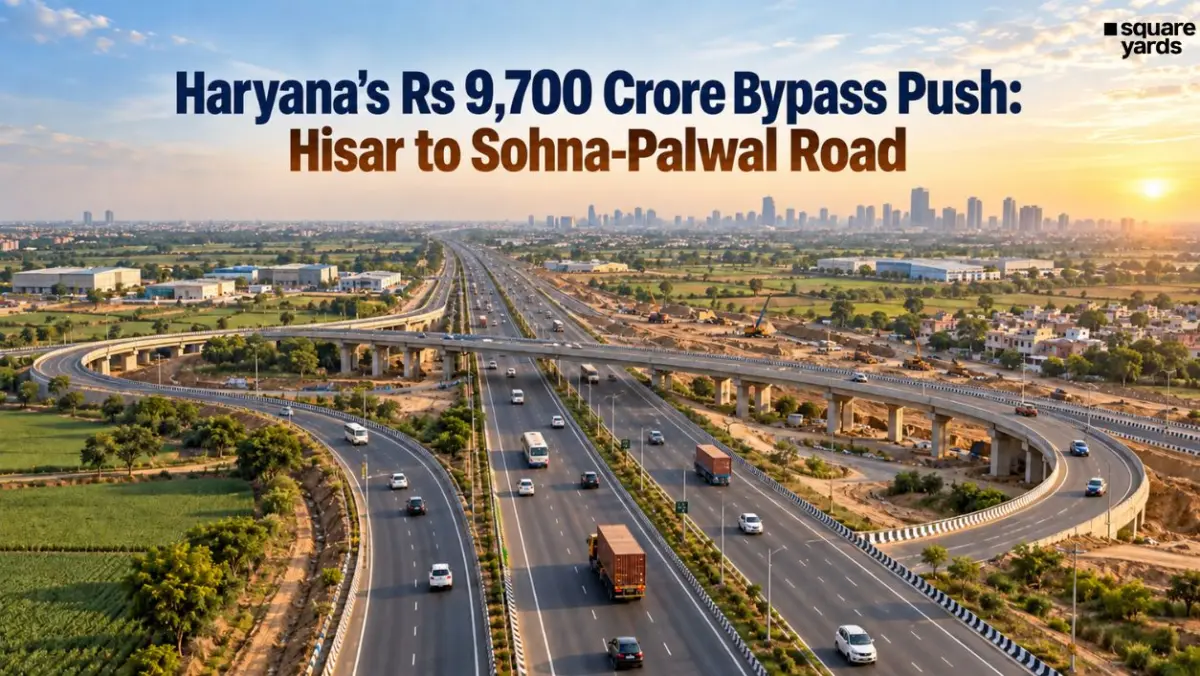
CHANDIGARH — In a move set to fundamentally alter the logistical and urban landscape of North India, the Chief Minister of Haryana, Nayab Singh Saini, has officially greenlit a massive ₹9,700 crore road infrastructure package. This ambitious initiative targets five critical bottlenecks across the state, authorizing the construction of major bypass projects in Hisar, Kurukshetra, Narnaul, Jind, and the rapidly appreciating Palwal-Sohna belt.
Beyond the immediate construction of asphalt and concrete, the announcement signals a paradigm shift in how Haryana manages its urban growth. By decoupling long-haul transit from local city life, the state aims to revitalize aging town centers while simultaneously creating new economic frontiers on their peripheries.
1. Main Facts: The ₹9,700 Crore Blueprint
The approved package is not merely a collection of isolated road projects but a synchronized effort to integrate Haryana’s secondary cities into the National Highway network. The Chief Minister’s directive emphasizes a standardized approach to urban transit, mandating that every town in Haryana with a population exceeding 100,000 must eventually be serviced by an outer ring road or a national highway bypass.
The Five-Project Breakdown:
- Hisar Bypass: A strategic link connecting NH-52 with the Hisar-Delhi and Hisar-Kaithal roads.
- Kurukshetra-Ladwa Bypass: A project focused on decongesting the historic city’s core, particularly during peak pilgrimage seasons.
- Narnaul City Bypass: An 11-km stretch designed to streamline traffic toward the Rajasthan border via NH-148B.
- Jind Bypass: A dual-layered solution combining an outer ring road with a four-lane bypass on NH-352.
- Palwal-Sohna Bypass: The "crown jewel" of the package, sitting at the intersection of the Delhi-Mumbai Industrial Corridor (DMIC) and the Kundli-Manesar-Palwal (KMP) Expressway.
To ensure the financial viability of these projects, a high-powered three-member committee has been established. Comprising senior officials from the Finance, Public Works (PWD), and Urban Local Bodies departments, this committee is tasked with negotiating the cost-sharing ratios with the Central Government, ensuring that the state’s fiscal health remains robust while infrastructure expands.
2. Chronology: From Congested Hubs to Seamless Corridors
The evolution of Haryana’s road network has moved through three distinct phases, leading up to this ₹9,700 crore announcement.
- Phase I (2000–2015): The NCR Centricity. Initial development focused almost exclusively on Gurugram and Faridabad, leveraging their proximity to Delhi. This led to massive growth but created an imbalance, where the rest of the state struggled with antiquated infrastructure.
- Phase II (2016–2023): The Expressway Era. The completion of the KMP and KGP (Kundli-Ghaziabad-Palwal) Expressways provided a high-speed orbital route around Delhi. However, while these expressways moved traffic around the capital, they often dumped that same traffic into the narrow, congested streets of Haryana’s mid-sized towns like Jind and Hisar.
- Phase III (2024 and Beyond): The Decongestion Mandate. The current phase, spearheaded by CM Nayab Singh Saini, focuses on "last-mile highway connectivity." The realization that an expressway is only as good as the bypasses feeding into it has led to the current policy of ring roads for all major urban centers.
This chronology suggests that the government is no longer content with just "passing through" Haryana; the goal is to create "destination hubs" where traffic flows smoothly into industrial and residential zones without choking the traditional city centers.
3. Deep Dive into the Projects: Supporting Data and Micro-Market Analysis
Each of the five bypasses serves a specific economic purpose, backed by regional data and industrial trends.
Hisar: The Logistics and Aviation Play
Hisar is currently the site of the Maharaja Agrasen International Airport project. The new bypass, connecting NH-52 to the Delhi and Kaithal routes, is the "missing link" for the city’s ambition to become a north Indian cargo hub. By allowing heavy freight to avoid the city center, the bypass reduces transit times for logistics companies by an estimated 30–40 minutes, making Hisar a more attractive destination for warehousing.
Kurukshetra-Ladwa: The Tourism Economy
The Detailed Project Report (DPR) for this bypass is already finalized. Kurukshetra is a global spiritual destination, and the influx of millions of pilgrims during events like the International Gita Mahotsav often brings the city to a standstill. The bypass will provide a dedicated route for through-traffic, preserving the city’s heritage core for pedestrians and local tourism.
Narnaul: The Gateway to Rajasthan
The 11-km Narnaul bypass is a strategic necessity for the NH-148B corridor. Historically an overlooked market, Narnaul’s inclusion in this package signals its integration into the wider development corridor linking Haryana’s industrial south to the mineral-rich regions of Rajasthan.
Jind: The Dual-Layer Strategy
Jind’s project is unique because it offers two layers of relief. The four-lane bypass on NH-352 handles interstate highway traffic, while the outer ring road manages local suburban movement. This "double-envelope" design is expected to become the blueprint for other Tier-2 cities in the state.
Palwal-Sohna: The Real Estate Powerhouse
This bypass is the most significant from an investment perspective. It operates within the Gurugram-Sohna-Palwal growth corridor. Data indicates that property prices in Sohna have surged by 151% over the last five years, with average prices reaching approximately ₹15,600 per sq. ft. This growth is attributed to the Sohna Elevated Corridor and the KMP Expressway. The Palwal-Sohna bypass will further link this region to the DND-Faridabad-Ballabhgarh link and the upcoming Jewar International Airport, creating a "Golden Quadrilateral" of connectivity in the NCR.
4. Official Responses and Policy Framework
The state government has been vocal about the "Ring Road Policy." Chief Minister Nayab Singh Saini has directed that this initiative must align with the Central Government’s framework to ensure seamless funding and design standards.
Statements from the Administration:
- On Urban Planning: "We are moving away from piecemeal road repairs toward a holistic ring-road philosophy," a spokesperson for the PWD noted. "The goal is to ensure that no heavy vehicle needs to enter a city center unless it has a delivery destination there."
- On Cost Sharing: The three-member committee is currently in talks with the National Highways Authority of India (NHAI). The state is proposing a model where land acquisition costs are shared, given the immense appreciation in land value that these projects generate.
- On Future-Proofing: The CM’s office has emphasized that these bypasses are being designed for 20-year traffic projections, featuring wider rights-of-way to allow for future expansion into 6 or 8-lane corridors.
5. Economic and Real Estate Implications
The "Bypass Effect" is a well-documented phenomenon in Indian real estate. While a highway often brings noise and pollution to a town center, a bypass creates a "new center" on the outskirts.
The Two-Phase Re-rating
Land along the new bypass alignments typically experiences value growth in two distinct stages:
- The Speculative Phase: Triggered by the confirmation of the alignment and government notification. This is where early-stage investors enter.
- The Infrastructure Phase: Occurs when construction hits the 50% mark and service roads are laid. This is when developers launch residential and commercial projects.
In the Palwal-Sohna region, developers are already planning nearly 16,000 housing units over the next 36 months. Similarly, the Haryana State Industrial and Infrastructure Development Corporation (HSIIDC) is developing a 607-hectare industrial township along the KMP Expressway, which will be directly serviced by the new bypass infrastructure.
The Logistics Advantage
For the industrial sectors of Hisar and Jind, the bypasses represent a reduction in "Total Cost of Logistics." By avoiding city traffic, fleet operators save on fuel, wear-and-tear, and "entry taxes" or time-restricted windows often imposed by city police on heavy vehicles.
6. Risks and Challenges: The Road Ahead
Despite the optimism, several hurdles remain that could delay the realization of these benefits.
- Land Acquisition: This remains the most volatile variable. While the ₹9,700 crore package includes provisions for land, local resistance or litigation over compensation rates can stall projects for years.
- Administrative Coordination: The success of the "3-member committee" depends on how quickly the Finance and PWD departments can align with the Central Government’s budget cycles.
- Speculative Bubbles: In markets like Palwal, there is a risk that land prices may outpace actual utility. Investors paying "future prices" today may find their ROI diluted if construction takes longer than the projected three-to-five-year window.
- Construction Disruption: The transition period—where existing roads are diverted and dust levels rise—can lead to a temporary dip in the quality of life and business revenue for local shopkeepers along the old routes.
Conclusion: A Connected Future
The ₹9,700 crore bypass package is a definitive statement of intent from the Haryana government. It recognizes that for a state to transition from an agrarian economy to a logistics and service powerhouse, its cities must be allowed to breathe.
By pulling through-traffic out of the congested cores of Hisar, Kurukshetra, Narnaul, Jind, and Palwal, the state is effectively reclaiming its urban centers for its citizens while handing its outskirts to the engines of industrial growth. If executed within the stipulated timelines, this "Ring Road Revolution" could serve as the definitive catalyst for Haryana’s next decade of economic expansion, making it the most well-connected state in the Indian union.
