

HYDERABAD — In a landmark decision that is set to redefine the geographical and economic landscape of Telangana, the Public-Private Partnership Appraisal Committee (PPPAC) has formally approved the northern stretch of the Hyderabad Regional Ring Road (RRR). This approval clears the most significant administrative and financial hurdle for the 161.5-kilometer access-controlled corridor, a project that urban planners describe as the "lifeline of future Telangana."
Estimated at a staggering cost of nearly Rs 23,996 crore, the northern RRR will be developed under the Hybrid Annuity Model (HAM). This project is not merely a highway; it is a strategic intervention designed to decentralize growth, alleviate the mounting pressure on the existing Outer Ring Road (ORR), and catalyze the next phase of industrial and real estate expansion across the northern districts of the state.
I. Main Facts: The Blueprint of the Northern Corridor
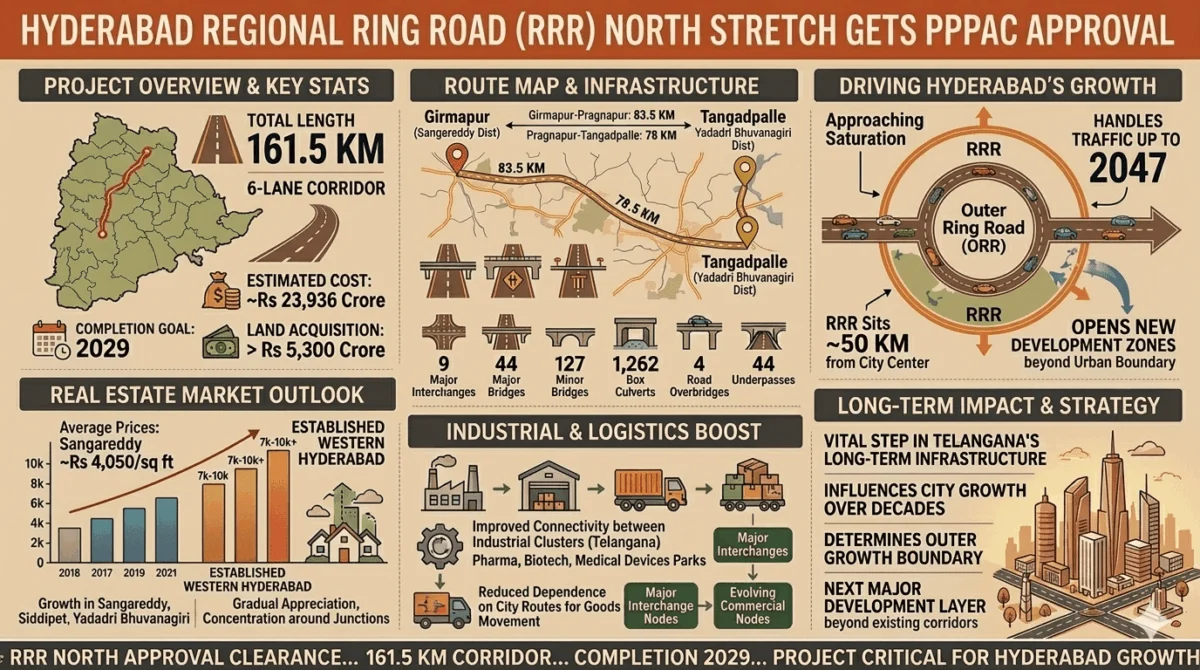
The northern stretch of the RRR is an ambitious engineering feat that seeks to create a semi-circular arc around the northern periphery of the Hyderabad metropolitan region. Running from Girmapur to Tangadpalle, the corridor will span approximately 161.5 kilometers of high-speed, six-lane roadway.
Key Project Specifications:
- Total Length: 161.5 km
- Total Estimated Cost: ~Rs 23,996 crore
- Development Model: Hybrid Annuity Model (HAM)
- Projected Completion: 2029
- Lanes: 6-lane access-controlled expressway
- Jurisdiction: Spans Sangareddy, Medak, Siddipet, and Yadadri Bhuvanagiri districts.
The project has been divided into two distinct operational packages to ensure efficient execution:
- Package I (83.5 km): Connecting Girmapur in Sangareddy district to Pragnapur in Siddipet district.
- Package II (78 km): Stretching from Pragnapur to Tangadpalle in the Yadadri Bhuvanagiri district.
By situating the alignment roughly 50 kilometers away from the Hyderabad city center, the RRR effectively doubles the "urban footprint" of the region, creating a massive buffer zone for future satellite towns and industrial clusters.
II. Chronology: From Conception to PPPAC Approval
The journey of the Regional Ring Road has been marked by shifting economic climates and evolving urban requirements. Initially conceived as a solution to the anticipated saturation of the Outer Ring Road (ORR), the project has seen its scope and budget expand significantly over the last few years.
- Initial Estimates: In the early planning stages, the project was estimated to cost approximately Rs 15,000 crore. However, inflationary pressures on raw materials, revised engineering standards for higher speeds, and a dramatic rise in land values in Telangana led to the current estimate of nearly Rs 24,000 crore.
- The Land Acquisition Phase: One of the most complex aspects of the chronology has been land procurement. With over Rs 5,300 crore earmarked specifically for land acquisition, the state and central governments have had to coordinate closely to minimize legal delays and ensure fair compensation for farmers and landowners across the four primary districts.
- PPPAC Intervention: The recent approval by the Public-Private Partnership Appraisal Committee (PPPAC) serves as the "green light" for the tendering process. By approving the project under the Hybrid Annuity Model (HAM)—where the government pays 40% of the cost during construction and the remaining 60% as annuities over a period of years—the committee has ensured a balanced risk-sharing mechanism between the public sector and private developers.
- The 2029 Target: With the administrative hurdles cleared, the focus now shifts to the bidding process and the commencement of physical work. Authorities have set a rigorous deadline of 2029 for the completion of the northern stretch, positioning it as a centerpiece for the state’s 2047 development vision.
III. Supporting Data: Engineering Scale and Financial Breakdown
The scale of the northern RRR is best understood through the sheer volume of infrastructure components required to traverse the diverse terrain of northern Telangana.
Engineering Infrastructure:
The 161.5-km stretch is not just a flat asphalt ribbon; it includes a massive array of structures designed to ensure seamless connectivity with existing local networks:
- Major Bridges: 44
- Minor Bridges: 127
- Box Culverts: 1,262 (ensuring local drainage and irrigation pathways remain uninterrupted)
- Road Overbridges (ROBs): 4
- Underpasses: 44 (facilitating local vehicular and pedestrian movement)
- Interchanges: 9 major junctions where the RRR will intersect with existing National and State Highways.
Financial Allocation:
The jump in cost to Rs 23,996 crore reflects the premium being placed on high-quality, long-lasting infrastructure.
- Land Acquisition: ~Rs 5,300 crore (approx. 22% of total cost).
- Construction & Civil Works: The remainder covers the complex task of building a six-lane expressway that meets international safety and speed standards.
Traffic Projections:
The Highway authorities presented data during the appraisal process showing that the existing 158-km Outer Ring Road (ORR) is rapidly approaching its saturation point. Current traffic growth rates suggest that by 2030, the ORR would struggle to handle heavy commercial transit. The RRR is designed to divert heavy-duty, long-distance interstate traffic (from Maharashtra, Karnataka, and Chhattisgarh) away from the city’s immediate periphery, thereby extending the life and efficiency of the ORR.
IV. Official Responses: A Strategic Vision for 2047
While official statements emphasize the technical readiness of the project, the underlying sentiment from planners and government representatives is one of "future-proofing."
Highway authorities have argued that the RRR is the cornerstone of the "Greater Hyderabad 2047" plan. By creating a high-speed corridor 50 kilometers out, the government is effectively signaling where the next 20 years of investment should be directed.
Planners have noted that:
"The RRR is not just a road; it is a development corridor. It is designed to ensure that the growth of Hyderabad is not confined to its current boundaries but is distributed across the districts of Sangareddy, Siddipet, and Yadadri. This will prevent the hyper-congestion seen in other Indian megacities."
Furthermore, the choice of the Hybrid Annuity Model (HAM) has been lauded by financial analysts as a move to attract top-tier global and domestic construction firms. By guaranteeing annuity payments, the government reduces the traffic-volume risk for private players, ensuring that the project does not stall due to financial instability of the concessionaire.
V. Implications: Real Estate, Industry, and Regional Economy
The approval of the northern RRR stretch is expected to trigger a "domino effect" across several sectors of the Telangana economy.
1. The Transformation of Hyderabad Real Estate
For the real estate sector, the RRR is a game-changer. Historically, Hyderabad’s growth has been heavily skewed toward the West (Gachibowli, HITEC City, Tellapur). The RRR shifts the spotlight to the North and North-East.
- Affordability and Land Bank: Unlike the western corridor, where land prices have reached astronomical levels, areas along the RRR northern stretch currently offer lower entry points. Residential property in Sangareddy, for instance, averages around Rs 4,050 per sq. ft., making it an attractive destination for long-term investors and developers looking for large parcels of land.
- Satellite Townships: The 9 major interchanges are expected to become the nuclei for new satellite townships. These will not be mere residential suburbs but self-sustaining urban units with their own schools, hospitals, and shopping centers.
- Shift in Buyer Sentiment: As connectivity improves, the "50-kilometer distance" will no longer be a deterrent. High-speed access will allow professionals to live in greener, less congested environments like Siddipet while maintaining access to the city’s core.
2. Industrial and Logistics Expansion
The northern RRR passes through regions that are already burgeoning hubs for pharmaceuticals, biotechnology, and manufacturing.
- Pharma and Med-Tech: The proximity to the Genome Valley and other industrial parks in Medak and Sangareddy means the RRR will provide a dedicated logistics backbone for these sectors.
- The Logistics "Sweet Spot": The intersection of the RRR with major National Highways (like NH-65 and NH-44) will create prime locations for warehousing and cold storage. As e-commerce continues to grow, these interchanges will likely evolve into massive distribution hubs for Southern India.
- Employment Generation: The construction phase alone is expected to generate thousands of direct and indirect jobs. Post-completion, the industrial clusters along the route will provide long-term employment opportunities for the rural population in the surrounding districts.
3. Regional Connectivity and De-congestion
By 2029, the northern RRR will serve as a massive "bypass" for the city.
- Interstate Transit: Heavy trucks traveling from Nagpur or Mumbai toward Vijayawada or Chennai will no longer need to touch the city’s inner roads or even the ORR. This will significantly reduce carbon emissions and road accidents within the Hyderabad metropolitan area.
- District Integration: For the first time, districts like Siddipet and Yadadri Bhuvanagiri will have high-speed, direct access to each other without having to navigate through Hyderabad’s urban sprawl.
Conclusion: Shaping the Next Decade
The PPPAC’s approval of the northern Regional Ring Road marks the beginning of a new era for Telangana. With an investment of nearly Rs 24,000 crore, the project represents one of the largest infrastructure outlays in the state’s history.
While the 2029 completion date seems distant, the market response is likely to be immediate. Investors, developers, and industrial houses are already recalibrating their strategies to align with the RRR’s path. If executed according to plan, the northern RRR will not only solve the traffic woes of the future but will also serve as the primary engine of economic growth, ensuring that Hyderabad remains a competitive, livable, and expansive global city for decades to come.
