

PATNA, Bihar – The Janata Dal (United) has significantly escalated its opposition to the renewal of the Farakka Treaty, launching a comprehensive new organisational initiative dubbed "Nitish Samvad." Under this ambitious programme, party leaders are currently traversing 12 districts along the Ganga river in Bihar, engaging with the populace to galvanise support against the existing water-sharing agreement between the Union government and Bangladesh, which is slated to expire in December. This concerted effort, coming less than a year after the Bihar Assembly elections and with no immediate local polls on the horizon, has sparked considerable debate regarding its underlying political motives, even as party functionaries maintain a non-electoral stance.
The Farakka Treaty, a pivotal bilateral agreement governing the sharing of the Ganga’s waters, has long been a contentious issue for Bihar, with state politicians consistently arguing that its provisions are detrimental to the state’s interests. As the 30-year pact approaches its expiry, the JD(U), led by Chief Minister Nitish Kumar, is strategically leveraging this long-standing grievance to connect with voters, particularly in the electorally crucial Ganga-belt regions. While officially denying any immediate political agenda, a party leader candidly admitted, "If JD(U) works hard in these areas, it will ultimately help the NDA in elections," underscoring the undeniable electoral implications of this grassroots outreach.
The Farakka Conundrum: A Decades-Old Grievance
At the core of the JD(U)’s "Nitish Samvad" initiative lies the party’s unwavering opposition to the Farakka water-sharing arrangement. This opposition is rooted in a deep-seated belief among Bihar’s political class and populace that the Farakka Barrage, and consequently the treaty, has inflicted severe ecological and economic damage upon the state.
The Treaty’s Genesis and Bihar’s Discontent
The Ganges Water Sharing Treaty, signed by India and Bangladesh on December 12, 1996, was designed to regulate the sharing of the Ganga’s waters at the Farakka Barrage, located in West Bengal. Its primary focus is on the dry season, from January 1 to May 31, ensuring equitable distribution of water to both nations. The Farakka Barrage itself was commissioned in 1975 with the primary objective of diverting Ganga waters into the Hooghly River to flush out silt from the Calcutta Port, thereby improving navigability.
However, for Bihar, an upstream riparian state, the barrage and the subsequent water-sharing agreement have been a source of continuous distress. Critics in Bihar argue that the construction of the barrage and the regulated water flow have led to a significant increase in siltation upstream, within Bihar’s boundaries. This excessive siltation is believed to reduce the river’s carrying capacity, exacerbating flood situations during the monsoon and contributing to water scarcity during the dry months. Farmers along the Ganga, particularly those dependent on its waters for irrigation, frequently report adverse impacts on agricultural productivity. The altered river dynamics are also cited as a cause for erosion of agricultural land and displacement of riverside communities.
Historically, Chief Minister Nitish Kumar has been a vocal critic of the Farakka Barrage, consistently raising concerns about its detrimental effects on Bihar. He has, on multiple occasions, advocated for either the dismantling of the barrage or a drastic revision of its operational protocols to mitigate the ecological damage to Bihar. This long-standing stance now forms the ideological bedrock of the "Nitish Samvad" campaign, allowing the JD(U) to connect with a genuine grievance felt by many across the state.
Environmental and Economic Repercussions
Beyond the immediate concerns of siltation and flooding, the Farakka Barrage has been linked to broader environmental degradation in Bihar. The disruption of natural river flow has impacted aquatic biodiversity, affecting the livelihoods of fishing communities. The reduced water availability during lean seasons also strains groundwater resources as communities turn to alternative sources. Economically, the agricultural sector, which forms the backbone of Bihar’s rural economy, bears the brunt of these issues. Crop failures due to erratic water supply or floods can lead to significant financial losses for farmers, many of whom belong to backward castes and are already economically vulnerable. The JD(U)’s campaign, by highlighting these issues, directly addresses the daily struggles of a substantial demographic in these districts.
"Nitish Samvad": A Grassroots Mobilisation
The "Nitish Samvad" initiative is more than just a political rally; it represents a structured organisational outreach designed to build a strong public mandate against the Farakka Treaty’s renewal. The campaign’s strategic choice of the 12 Ganga-belt districts underscores the deep connection between the river, the treaty, and the lives of the people residing there.
Campaign Rollout and Reach
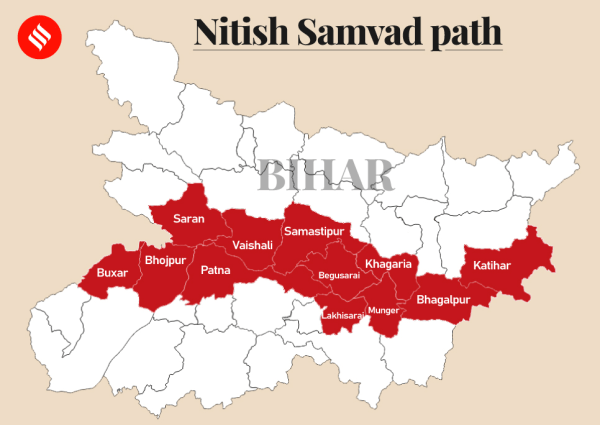
The 12 districts targeted by the JD(U) are Buxar, Bhojpur, Saran, Patna, Vaishali, Samastipur, Begusarai, Lakhisarai, Munger, Khagaria, Bhagalpur, and Katihar. These districts collectively form a significant geographical and demographic segment of Bihar, directly experiencing the effects of the Ganga’s flow. The JD(U) has methodically rolled out the campaign, having already covered four districts—Buxar, Bhojpur, Begusarai, and Khagaria. The party plans to cover Saran, Vaishali, Patna, and Samastipur in October, with the remaining four districts scheduled for November. This phased approach allows for focused engagement and sustained momentum leading up to the treaty’s expiry in December.
During the "Samvad" (dialogue) sessions, party leaders are expected to engage in direct conversations with local communities, explaining the historical context of the Farakka Treaty, its perceived adverse impacts on Bihar, and the party’s consistent efforts to address these issues. The initiative aims to demystify the complex inter-state and international agreement, translating it into tangible local concerns such as agricultural losses, flood damage, and water scarcity. This direct communication strategy is designed to foster a sense of shared grievance and collective action, portraying the JD(U) as the primary champion of Bihar’s interests.
The Stated vs. Unstated Objectives
JD(U) leaders have been quick to deny any immediate political motive behind the "Nitish Samvad" exercise, particularly given the absence of local elections in the state. They frame it as a matter of state interest and welfare. However, the timing and geographical focus of the campaign suggest a shrewd political calculation. By actively engaging with a critical issue that resonates deeply with the rural populace, especially farmers and riverside communities, the JD(U) aims to reinforce its political relevance and strengthen its grassroots presence.
Within the broader context of the National Democratic Alliance (NDA) in Bihar, this campaign serves multiple purposes. Firstly, it allows the JD(U) to carve out a distinct identity within the alliance, showcasing its commitment to a core state issue that Chief Minister Nitish Kumar has championed for decades. Secondly, as the unnamed party leader suggested, a stronger JD(U) presence and increased public goodwill in these areas would undoubtedly benefit the NDA as a whole in future elections, whether they be Lok Sabha or Assembly polls. It can be seen as a long-term investment in voter engagement and loyalty, preparing the ground for upcoming electoral contests.
Electoral Battleground: The Ganga-Belt Districts
The strategic importance of these 12 Ganga-belt districts cannot be overstated in Bihar’s political landscape. Together, they encompass 83 Assembly constituencies, accounting for approximately 34% of Bihar’s 243-member Assembly. This substantial bloc of seats is critically important for all major political players in the state, including the JD(U)’s NDA ally, the BJP, and the principal opposition, the Rashtriya Janata Dal (RJD).
A Critical Electoral Landscape
These constituencies are not just numerically significant; they are also demographically diverse and economically vital. A substantial section of the population in these areas comprises backward castes, a key voting bloc whose support is often decisive in Bihar’s elections. Their livelihoods are frequently tied to agriculture and the river, making issues like water management, flood control, and irrigation highly pertinent. By focusing on the Farakka Treaty, the JD(U) is tapping into a tangible issue that directly impacts the daily lives and economic well-being of these communities, potentially consolidating their support. The success of the "Nitish Samvad" campaign in mobilising public opinion around this issue could therefore have profound implications for the political fortunes of parties in the region.
Unpacking the Numbers: A Shifting Political Calculus
An in-depth analysis of electoral results in these 83 constituencies over the 2015, 2020, and 2025 (hypothetical future election, presented as past data in the original text) Assembly elections reveals significant shifts in the political landscape, particularly a pronounced rise in the performance of the BJP and a subsequent resurgence of the JD(U), juxtaposed against a declining trend for the opposition RJD and Congress.
The BJP’s Ascendance
The Bharatiya Janata Party (BJP) has demonstrated a remarkable upward trajectory in these Ganga-belt districts.
- 2015: Contested 53 seats, won 13, with an average vote share of 36.09%.
- 2020: Contested 39 seats, won 25, with its average vote share climbing to 40.78%. This marked a significant improvement in both seat tally and strike rate despite contesting fewer seats.
- 2025: In the hypothetical 2025 Assembly elections, where the BJP-led NDA reportedly registered a landslide victory in Bihar, the BJP contested only 37 seats in this stretch but secured a formidable 35 victories, achieving an impressive strike rate of 94%. Its vote share across these seats surged to 49%. This data indicates a strong consolidation of support for the BJP in this crucial region.
JD(U)’s Resurgence
The JD(U)’s journey in these constituencies has been more variable, reflecting its changing alliance dynamics, but culminating in a strong performance in the most recent hypothetical election.
- 2015: As part of the Mahagathbandhan (Grand Alliance) with the RJD and Congress, JD(U) contested 31 seats, winning 23 with an average vote share of 41.62% and a strike rate of 74%. This was a robust performance within the alliance.
- 2020: After rejoining the NDA, the JD(U) contested 42 seats but saw a significant dip, winning only 10, with its strike rate plummeting to 23.8%. Its average vote share also fell to 31.44%, indicating a struggle to transfer its Mahagathbandhan support base to the NDA platform in this specific region.
- 2025: However, the JD(U) showcased its strongest performance in the region in the hypothetical 2025 elections, winning 28 of the 33 seats it contested. This propelled its strike rate to an impressive 84% and saw its vote share increase substantially to 46%, suggesting a successful realignment of its voter base within the NDA and a strong electoral rebound.
Opposition’s Waning Influence
Conversely, the principal opposition parties, the RJD and Congress, have experienced a sustained decline in their electoral fortunes in these 83 constituencies.
- RJD:
- 2015: Contested 36 seats and emerged victorious in 32, achieving a high strike rate of 89% and an average vote share of 47.11% as part of the Mahagathbandhan.
- 2020: The party contested 48 seats but saw its tally drop to 28 wins, bringing its strike rate down to 58%. Its vote share also decreased to 41.44%.
- 2025: The RJD’s decline deepened in the hypothetical 2025 elections, contesting 49 seats but securing only 11 victories, reducing its strike rate to a mere 22.44%. Its vote share fell further to 39.88%.
- Congress:
- 2015: Contested seats (number not specified in original data, but won 11) with an average vote share of 38.89%.
- 2020: Contested 23 seats, winning nine, with its vote share falling to 35.45%.
- 2025: In the hypothetical 2025 elections, the Congress contested 20 seats but managed to win only one, while its average vote share declined further to 32.63%.
The Left and LJP’s Variable Fortunes
The performance of other regional and ideological blocs also provides valuable insights:
- Left Parties (CPI, CPM, CPI(ML) Liberation):
- 2015: Collectively contested 84 seats, winning only two (both by CPI(ML) Liberation), with a combined vote share of 4.65%.
- 2020: Their performance significantly improved, contesting 16 seats and winning 10, securing a combined vote share of 41%, primarily due to their alliance with the Mahagathbandhan.
- 2025: However, this momentum was not sustained. In the hypothetical 2025 elections, they contested 16 seats again but won only two, with their vote share falling to 33.46%.
- Lok Janshakti Party (LJP):
- 2015: As a united entity within the NDA, it contested 19 seats and won one, with a vote share of 27.56%.
- 2020: Contesting independently after leaving the NDA, the LJP fielded candidates in 50 seats across the region but managed only one victory (Matihani), with its vote share falling to 12.33%. This was its sole victory statewide.
- 2025: Following its split in 2021 into the Rashtriya Lok Janshakti Party (RLJP) and LJP (Ram Vilas) headed by Chirag Paswan, the latter, as part of the NDA, contested 12 seats in these districts and won six. Its vote share notably rose to 42.13%, indicating a significant comeback and an effective consolidation of support under Chirag Paswan’s leadership within the NDA.
Interpreting the Trends
The electoral data paints a clear picture: the Ganga-belt districts have witnessed a strong consolidation of the NDA’s base, particularly evident in the hypothetical 2025 results. The BJP has consistently grown its footprint, while the JD(U), after a dip in 2020, effectively regained its lost ground within the NDA framework. The LJP (Ram Vilas) also emerged as a significant force. This suggests that the issues championed by the NDA, coupled with strong alliance coordination, have resonated with the electorate in these regions. The "Nitish Samvad" campaign, by focusing on a potent issue like the Farakka Treaty, aims to further solidify this support, especially for the JD(U), and project itself as a key protector of Bihar’s interests within the dominant alliance. The consistent decline of the RJD and Congress in this crucial region, despite their historical strength, highlights the challenge they face in countering the NDA’s narrative and regaining voter trust.
Official Stances and Future Prospects
As the Farakka Treaty’s December expiry date looms, the political temperature in Bihar is rising, with a united front emerging from the state leadership regarding its future.
Bihar’s United Front
Bihar Chief Minister Samrat Choudhary has also been vocal in pressing for the state’s interests to be robustly protected in any future arrangement concerning the Ganga’s waters. This indicates a rare consensus across party lines within Bihar on this critical issue, lending significant weight to the JD(U)’s campaign. Rajeev Ranjan Prasad, JD(U) national spokesperson, articulated the party’s firm stance: "Nitish Kumarji has always raised the issues of Bihar’s interests and several issues have become an agenda of discussion because of him. The Farakka treaty is one such issue. The existing form of the treaty is not acceptable." This statement underscores the party’s intention to push for a renegotiation that addresses Bihar’s long-standing grievances, rather than a mere renewal of the current terms. The "Nitish Samvad" is effectively building public pressure that the state government can then leverage in its discussions with the Union government.
The Union Government’s Balancing Act
The Union government faces a delicate balancing act. On one hand, it must consider Bihar’s legitimate concerns regarding the adverse effects of the Farakka Barrage. On the other, it must uphold its long-standing bilateral relationship with Bangladesh, which also depends on the equitable sharing of Ganga waters. Renegotiating an international treaty involves complex diplomatic engagements and careful consideration of all riparian stakeholders. The pressure from a politically significant state like Bihar, especially when articulated through a high-profile public campaign, will undoubtedly factor into the Union government’s strategy as it prepares for discussions with Bangladesh. The challenge will be to find a solution that addresses Bihar’s environmental and economic concerns without jeopardising India’s international commitments or creating new diplomatic tensions.
Implications: Electoral, Environmental, Diplomatic
The JD(U)’s "Nitish Samvad" campaign, focused on the Farakka Treaty, carries multifaceted implications that extend beyond immediate political gains, touching upon domestic electoral dynamics, environmental sustainability, and international relations.
Domestic Political Ramifications
Electorally, the campaign serves as a strategic move for the JD(U) to re-assert its identity and relevance within the NDA. By championing a state-specific issue that has deep emotional and economic resonance, the party aims to solidify its traditional vote base, particularly among backward castes and rural populations dependent on the Ganga. A successful campaign could bolster Nitish Kumar’s image as a strong advocate for Bihar’s interests, potentially offsetting any perceived erosion of his influence within the NDA. For the broader NDA, a united front on the Farakka issue could further consolidate its position in the Ganga-belt districts, making it harder for the opposition to make inroads.
The opposition, particularly the RJD and Congress, face a significant challenge. Having historically been part of governments at both state and national levels, their inability to effectively address the Farakka issue or articulate a compelling counter-narrative could further alienate voters. The JD(U)’s initiative forces the opposition to either align with the existing narrative, thereby ceding ground to the JD(U), or risk appearing indifferent to a critical state concern.
Inter-State and International Dynamics
Environmentally, the renewed focus on the Farakka Treaty brings critical issues of riverine health, siltation, flood management, and water scarcity back into the spotlight. A renegotiation that genuinely addresses Bihar’s concerns could lead to more sustainable water management practices, potentially benefiting millions of people and the fragile ecosystem of the Ganga basin. This could involve exploring technical solutions to reduce siltation, improve flood control mechanisms, and ensure adequate water flow for all riparian states.
Diplomatically, the expiry of the Farakka Treaty presents both a challenge and an opportunity for India and Bangladesh. While Bihar’s strong stance adds domestic pressure, it also opens a window for a comprehensive review of the 30-year-old agreement. This could lead to a more modern, scientifically informed, and mutually beneficial water-sharing mechanism that takes into account current hydrological data, climate change impacts, and the needs of all stakeholders. A successful renegotiation, sensitive to both domestic concerns and international obligations, would be a testament to India’s diplomatic prowess and its commitment to regional cooperation. Failure to find common ground, however, could strain bilateral relations and exacerbate water-related conflicts.
In conclusion, the JD(U)’s "Nitish Samvad" is more than a simple public outreach programme. It is a multi-layered political manoeuvre, strategically timed and geographically focused, aimed at harnessing a long-standing grievance for electoral advantage, while simultaneously pushing for a critical renegotiation of an international treaty. As December approaches, the fate of the Farakka Treaty, and indeed the political landscape of Bihar, hangs in the balance, underscored by the powerful currents of public opinion being stirred along the mighty Ganga.
