

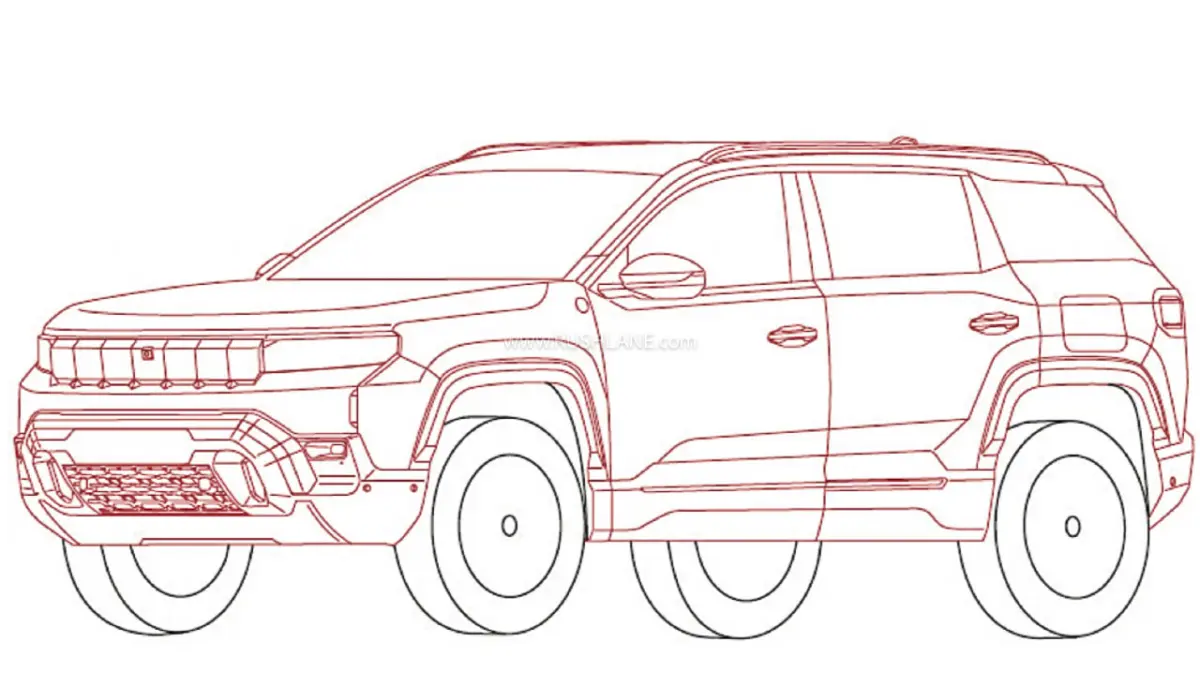
The automotive landscape in India is currently witnessing a fascinating tug-of-war between legacy brand heritage and the cold realities of commercial viability. At the center of this narrative is Jeep, a brand synonymous with off-road prowess, which has recently stirred the industry with the design patenting of its third-generation Compass in India. While the global iteration of the SUV was introduced last year to much acclaim, its path to the Indian subcontinent has been shrouded in uncertainty. The filing of these patents provides more than just a glimpse of a new vehicle; it offers a roadmap of Jeep’s potential transition toward electrification and a premium market repositioning.
Main Facts: The Patent Filing and the Electric 4×4 Revelation
The recently surfaced patent images in India showcase the third-generation Jeep Compass, specifically what appears to be the high-performance, full-electric 4×4 variant. This model represents a significant departure from the current Compass sold in India, both in terms of its underlying architecture and its aesthetic language.
A New Design Language
The patented design highlights a "chiselled" and more commanding presence. While maintaining the iconic seven-slot grille—now optimized for an electric vehicle’s cooling requirements—the new-gen Compass features sharper lighting elements and a rugged bumper design. The full-electric 4×4 version, as seen in the patents, is distinguished by enhanced approach and departure angles, signaling that Jeep is not willing to sacrifice its "Trail Rated" heritage in the pursuit of zero emissions.

Key exterior features identified in the patent include:
- Squared-off wheel arches: A hallmark of Jeep design, now paired with thick protective cladding.
- Aerodynamic Profile: A sloped roofline and a more raked windshield to improve the drag coefficient for better EV range.
- Distinctive Rear Styling: Funky wraparound tail lamps, a roof-mounted spoiler, and a chunky rear bumper that emphasizes the vehicle’s width.
The STLA Medium Foundation
Globally, the third-gen Compass is built on the Stellantis STLA Medium platform. This is a "modular-by-design" architecture that allows for a variety of propulsion systems, including Battery Electric (BEV), Plug-in Hybrid (PHEV), and Mild-Hybrid (MHEV). The patenting of this specific architecture in India suggests that if Jeep does bring the vehicle to the local market, it will be a technological powerhouse capable of competing with both luxury Germans and high-end domestic EVs.
Chronology: The Journey of the Compass
To understand the weight of these new patents, one must look at the timeline of the Compass in India and its global evolution.

- 2017 – The Indian Debut: Jeep entered the mainstream Indian market with the first-generation Compass. It was an instant success, praised for its build quality and driving dynamics. It established Jeep as a premium yet accessible SUV brand.
- 2021 – The Mid-Life Facelift: Jeep updated the Compass with a much-needed interior overhaul, introducing better technology to keep pace with rivals like the Hyundai Tucson and the Volkswagen Tiguan.
- 2023 – Global Unveiling of Gen-3: Stellantis introduced the third-generation Compass for international markets including Europe, Australia, and the Middle East. This version was significantly larger and more tech-heavy.
- Early 2024 – The Viability Crisis: Reports emerged that Jeep India had put plans for the third-gen Compass on hold. Internal assessments reportedly suggested that the cost of localizing the STLA Medium platform was too high, potentially making the vehicle "commercially unviable" for the price-sensitive Indian market.
- Late 2024 – The Patent Filing: Despite the rumors of cancellation, the design patents were filed in India. This move is often dual-purpose: it either signals a reconsidered launch strategy or serves as a defensive measure to protect Intellectual Property (IP) from local competitors.
Supporting Data: Technical Specifications and Dimensions
The third-generation Compass is a larger, more sophisticated machine than its predecessor. The data points from the global model provide a clear picture of what the Indian market could expect.
Dimensions and Capacity
The new-gen model has grown in almost every direction to address one of the primary criticisms of the current Compass: rear-seat legroom.
- Length: 4,550 mm (an increase over the current model).
- Wheelbase: 2,800 mm (providing an extra 55 mm of rear legroom).
- Boot Capacity: Approximately 550 liters, making it a viable family tourer.
Powertrain Options (Global Spec)
The versatility of the STLA Medium platform allows for a wide range of outputs:

- e-Hybrid (Mild Hybrid): A 1.2-liter 3-cylinder turbo petrol engine paired with a 48V motor, producing 145 hp and mated to a 6-speed DCT.
- PHEV (Plug-in Hybrid): A 1.6-liter turbo petrol engine combined with an electric motor, delivering between 195 hp and 228 hp, with an electric-only range of 80 km.
- BEV (Full Electric):
- Standard: 213 hp, 74 kWh battery, ~500 km range (WLTP).
- Long Range: ~650 km range.
- 4xe Full-Electric (Patented Version): Dual motors, 375 hp, and a range of approximately 600 km. This variant can charge from 20% to 80% in just 31 minutes using DC fast charging.
Interior Technology
The cabin is a digital-first environment, featuring:
- 16-inch touchscreen infotainment system (one of the largest in its class).
- 10-inch digital instrument cluster.
- Level 2 ADAS Suite: Including adaptive cruise control, lane positioning assist, and automatic emergency braking.
Official Responses and Strategic Context
While Jeep India has not officially confirmed the launch of the third-gen Compass, the brand’s broader strategy in the region is undergoing a massive transformation.
The Intellectual Property Argument
Industry analysts suggest that the patent filing might be a standard procedure for Stellantis to protect its global designs. However, the timing is curious. Jeep has been facing declining sales volumes in India, and a "halo" product like the Compass Electric could be exactly what the brand needs to reinvigorate its image.

The Tata Motors Collaboration
In a significant strategic pivot, Jeep has confirmed plans for a new "Made in India" SUV slated for a 2028 launch. Crucially, this vehicle will be built on a platform shared with or derived from Tata Motors. This move is aimed at drastic cost reduction through local sourcing and shared infrastructure. It remains to be seen if the patented 3rd-gen Compass will exist as a premium, low-volume CBU (Completely Built Unit) or CKD (Completely Knocked Down) import, while the Tata-based SUV handles the mass-market volume.
Implications: What This Means for the Indian Market
The patenting of the new Compass has several implications for the Indian automotive sector and Jeep’s survival in the country.
1. Premiumization of the Brand
By patenting the 375 hp Electric 4×4 version, Jeep is signaling a move upmarket. If launched, this vehicle would likely sit in the ₹45 lakh to ₹60 lakh price bracket, competing with the likes of the Volvo XC40 Recharge, the Kia EV6, and the upcoming Hyundai Ioniq 5 updates.

2. The Electric Off-Road Niche
Currently, the Indian EV market is dominated by urban-centric crossovers. A genuine 4×4 electric SUV with Jeep’s "Selec-Terrain" system would create a unique niche. It would appeal to the lifestyle buyer who wants zero-emission commuting during the week and rugged trail capability on the weekend.
3. Pressure on Local Rivals
The specifications of the 3rd-gen Compass—specifically the 600+ km range and the 16-inch screen—set a high bar. Domestic giants like Mahindra (with its XUV.e and BE series) and Tata (with the Harrier EV and Safari EV) will be watching closely. If Jeep manages to localize even a portion of this technology, it could disrupt the burgeoning premium EV segment.
4. Sustainability of the Dealership Network
Jeep dealers in India have been vocal about the need for new products to drive footfall. The current portfolio (Compass, Meridian, Wrangler, Grand Cherokee) is aging or caters to a very thin slice of the market. The arrival of the 3rd-gen Compass, even in limited numbers, would provide a much-needed boost to dealer morale and brand visibility.

Conclusion
The design patent of the third-generation Jeep Compass Electric in India is a classic "wait-and-see" scenario. While commercial hurdles remain significant, the technical prowess of the STLA Medium platform and the undeniable appeal of a 375 hp electric Jeep offer a compelling argument for its introduction. Whether this patent is a shield for IP protection or a precursor to a high-voltage launch, it confirms one thing: Jeep is not ready to surrender its position in the Indian market just yet. The road to 2028, marked by collaborations and electrification, promises to be the most critical chapter in Jeep’s Indian journey.
