NEW DELHI – JSW MG Motor India has announced its sales performance for October 2026, showcasing a period of significant expansion and a deepening footprint in the Indian automotive landscape. The company reported total retail sales of 8,013 units, representing a robust 25% year-on-year (YoY) growth compared to the same period in 2025. This growth trajectory highlights the successful synergy of the JSW-MG partnership, which has prioritized "New Energy Vehicles" (NEVs) while simultaneously revitalizing its Internal Combustion Engine (ICE) lineup.
The month was characterized by the continued dominance of the MG Windsor and MG Comet EVs, alongside the stabilization of the newly launched Tomahawk EV. However, the data also reveals a fascinating resurgence in the brand’s legacy ICE models, such as the Hector and Astor, suggesting a dual-track strategy that appeals to both early tech adopters and traditional SUV buyers.
1. Main Facts: A Deep Dive into the October 2026 Numbers
The headline figure of 8,013 units signifies a major milestone for JSW MG Motor India. To understand the gravity of this performance, one must look at the composition of these sales.
The EV Dominance
MG continues to be a pioneer in the electrification of the Indian mass market. In October 2026, Electric Vehicles (EVs) accounted for 78.34% of the company’s total volumes. While this is a slight dip from the 80.96% share recorded in September 2026, it remains the highest EV-to-ICE ratio among major manufacturers in the country.
- Total EV Sales: 6,277 units (Approx.)
- Total ICE Sales: 1,736 units
ICE Growth from a Low Base
Perhaps the most startling statistic from the October report is the 416.67% YoY jump in ICE sales. In October 2025, MG’s ICE volumes had dipped to a mere 336 units as the company pivoted heavily toward the Windsor and Comet launches. Fast forward to 2026, and the ICE portfolio has clawed back to 1,736 units. This suggests that MG has successfully recalibrated its supply chain and marketing efforts to ensure that the Hector and Astor remain relevant in an increasingly competitive mid-size SUV segment.
2. Chronology: The Road to 8,013 Units
The journey to this October peak began in late 2025 and early 2026, following the formalization of the JSW Group’s stake in MG Motor India.

- Q4 2025: MG faced a transition period. While the Comet EV was finding its footing, the ICE portfolio saw a temporary decline in focus as the company prepared for a massive EV onslaught.
- Q1-Q2 2026: The MG Windsor was introduced, positioning itself as a "CUV" (Crossover Utility Vehicle). It quickly became the brand’s bestseller, leveraging its unique design and spacious interior.
- September 2026: The highly anticipated MG Tomahawk EV commenced deliveries. The launch month saw a massive spike of 1,933 units as MG cleared its initial booking backlog.
- October 2026: The brand stabilized its operations. Despite a minor month-on-month (MoM) decline of 0.06% in total sales, the month solidified the "new normal" for MG—a consistent 8,000-unit-per-month player.
3. Supporting Data: Model-by-Model Performance Analysis
The success of October 2026 was not evenly distributed across the portfolio. A granular look at the models reveals where the momentum lies and where challenges persist.
The Volume Drivers: Windsor and Comet
The MG Windsor remains the undisputed king of the MG stable. With 3,943 units sold in October, it accounted for nearly half of the company’s total sales. Although this was an 11% decline compared to the 4,445 units sold in October 2025 (when the model was in its peak launch hype), it saw a healthy 19% MoM increase from September 2026. Rumors within the industry suggest a larger 61 kWh battery variant is slated for 2027, which could further boost its appeal for long-distance travelers.
The MG Comet EV continues to defy skeptics who doubted the micro-EV segment. Selling 1,202 units, the Comet saw a 19% YoY increase and a 23% MoM increase. Together, the Windsor and Comet represent 64.2% of MG’s total sales, proving that the brand’s "urban mobility" strategy is resonating with Indian consumers.
The New Entrant: Tomahawk EV
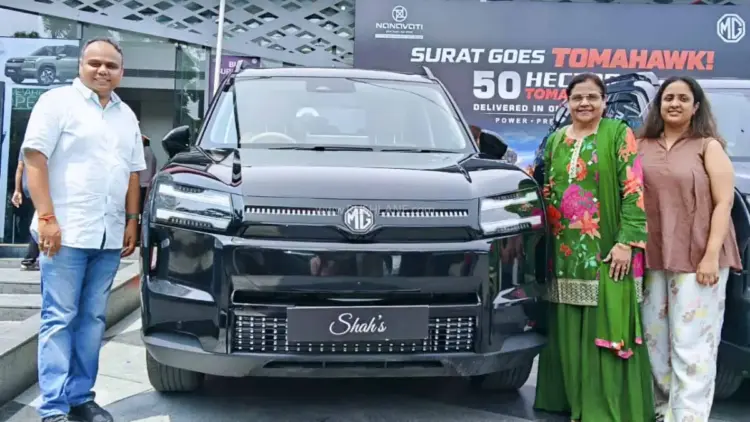
The Tomahawk EV recorded 1,089 units in its second full month of deliveries. While this was a 43.6% drop from September’s 1,933 units, such a trend is common after the initial "launch burst." The Tomahawk is positioned as a more premium, rugged alternative in the EV space. Interestingly, MG is set to launch the PHEV (Plug-in Hybrid Electric Vehicle) version of the Tomahawk in November 2026, which is expected to capture buyers who still suffer from range anxiety but want the benefits of an electric drivetrain.
The ICE Revival: Hector and Astor
The MG Hector, the vehicle that started it all for the brand in India, saw a massive resurgence. Sales reached 956 units, a staggering 325% increase from the 225 units sold in October 2025. This 32% MoM growth indicates that the Hector’s feature-rich cabin and commanding road presence continue to attract buyers in the ₹15-25 lakh price bracket.
The MG Astor also showed signs of life with 263 units, a 158% YoY improvement, though it did see a slight 7% dip from September. The Majestor (MG’s premium offering) remained perfectly stable, mirroring its September performance with exactly 517 units.

The ZS EV: A Changing of the Guard?
The most concerning data point for MG is the ZS EV, which saw sales plummet to just 43 units. This represents a 93% YoY decline and an 85% MoM decline. It appears the ZS EV is being cannibalized by its own siblings—the Windsor and the Tomahawk. As the ZS EV ages, consumers are gravitating toward the newer design language and updated tech suites found in the newer MG electric models.
4. Official Strategy and Corporate Outlook
While JSW MG Motor India has not released a formal statement regarding the specific October numbers, the company’s recent strategic moves provide context. The partnership with JSW has allowed MG to aggressively localize its supply chain, particularly for battery assembly and electronic components.
The "NEV First" Philosophy:
JSW MG’s leadership has consistently emphasized that their goal is not just to sell cars but to build an ecosystem. The introduction of the Tomahawk PHEV is a testament to this. By offering a Plug-in Hybrid, MG is bridging the gap between ICE and pure EVs, a move that several competitors have been hesitant to make in the Indian market.
Expanding the Infrastructure:
Supporting these 8,013 sales is MG’s continued investment in charging infrastructure. The company has been working on "MG Charge," an initiative to install 1,000 chargers in residential localities across India, ensuring that the 78% of their customers who buy EVs have a seamless ownership experience.
5. Implications: What This Means for the Indian Auto Industry
The October 2026 sales report from JSW MG Motor India carries several implications for the broader market:
1. The Normalization of EVs
MG has proven that a brand can survive and thrive in India with nearly 80% of its sales coming from electric vehicles. This challenges the narrative that EVs are only a secondary "niche" market. As MG approaches the 10,000-unit monthly mark, other manufacturers like Tata Motors and Mahindra & Mahindra will likely feel the pressure to accelerate their own EV roadmaps.

2. The Death of the "One-Size-Fits-All" EV
The contrast between the Windsor’s success and the ZS EV’s decline shows that the Indian EV consumer is becoming more discerning. Buyers are no longer just looking for "any" electric car; they want the latest platform, the best software integration, and specific body styles (like the Windsor’s CUV form factor).
3. The Hybrid Middle Ground
With the Tomahawk PHEV arriving in November, MG is testing the waters for a technology that has seen massive success in markets like China but has been underutilized in India. If the Tomahawk PHEV becomes a hit, it could force a shift in government policy regarding hybrid incentives, which currently favor pure EVs.
4. Competitive Resilience of ICE
The 416% growth in ICE sales (from a low base) proves that there is still a significant portion of the population—particularly in Tier 2 and Tier 3 cities—where charging infrastructure remains sparse. MG’s ability to maintain the Hector’s popularity ensures they don’t lose out on this traditional market while they build for the future.
Conclusion
JSW MG Motor India enters the final two months of 2026 with strong momentum. While the decline of the ZS EV marks the end of an era, the rise of the Windsor and the promising start of the Tomahawk signal the beginning of a new one. With a total volume of 8,013 units and a 25% YoY growth rate, MG has cemented its position as the primary challenger to the established automotive giants in India’s transition to a greener future. All eyes will now be on the Tomahawk PHEV deliveries in November to see if MG can sustain this growth through the end of the year.