

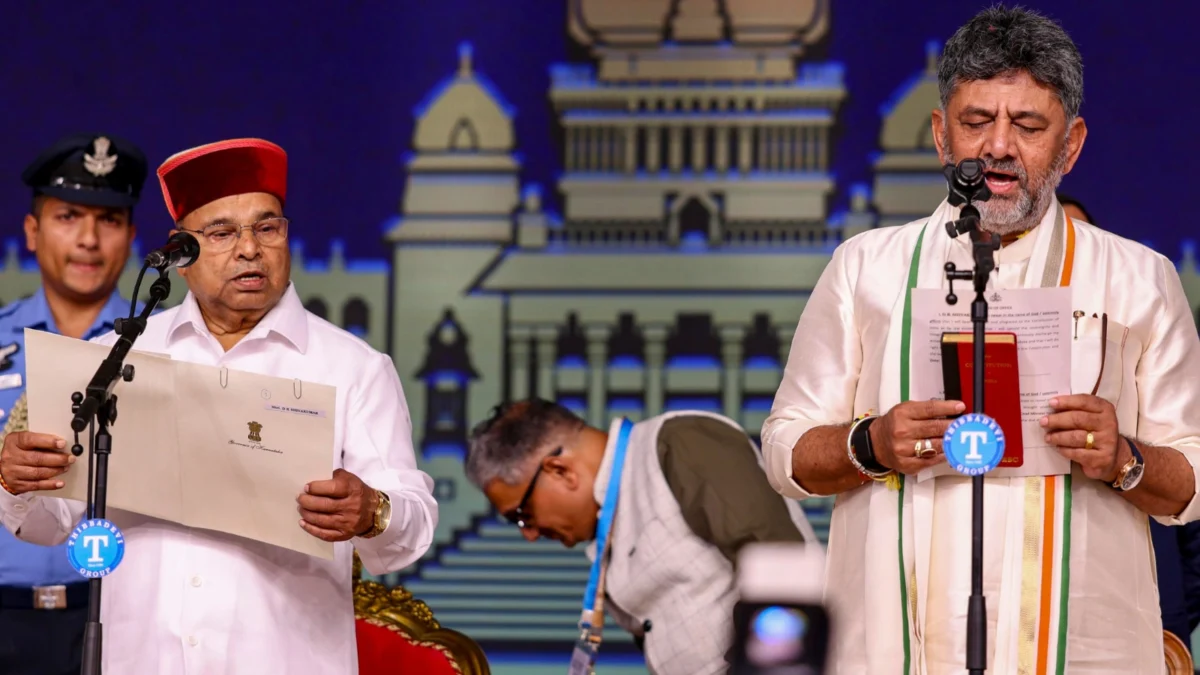
In a significant political transition, D.K. Shivakumar officially assumed office as the Chief Minister of Karnataka on Wednesday, marking a new chapter for the state’s governance. His swearing-in ceremony, a culmination of intense political deliberations following the recent assembly elections, saw him replace the outgoing Chief Minister, Siddaramaiah. Alongside Chief Minister Shivakumar, thirteen other prominent leaders were also sworn into the cabinet, signaling the Congress party’s intent to establish a robust and representative administration. This initial formation of the cabinet is a crucial step for the Congress, which secured a decisive mandate from the electorate, and reflects a delicate balancing act of experience, regional representation, and community aspirations.
The induction of these thirteen ministers lays the foundation for Shivakumar’s government, with a clear emphasis on incorporating both seasoned politicians who have previously held significant portfolios and fresh faces poised to bring new energy to the administration. This strategic mix is designed to leverage deep political wisdom while injecting dynamism into policy-making and implementation. The cabinet’s composition also meticulously addresses the diverse social and geographical fabric of Karnataka, a critical consideration for any ruling party aiming for stability and broad-based support.
A Diverse Mandate: Unpacking the Composition of the New Cabinet
The newly formed Shivakumar Cabinet is a testament to the Congress party’s efforts to ensure broad representation across Karnataka’s complex social and geographical landscape. The selection process appears to have been guided by a strategic vision to balance various community interests, electoral strongholds, and party loyalties.
Caste and Community Representation:
The initial cabinet of fourteen ministers (including the Chief Minister) showcases a conscious effort to include key demographic groups that form the backbone of Karnataka’s electorate. Notably, the cabinet includes three ministers from the influential Lingayat community, a historically dominant and politically significant group in the state. This allocation underscores the Congress’s commitment to regaining and consolidating support from a community that has often swung electoral outcomes.
Equally significant is the inclusion of three ministers from the Scheduled Caste (SC) community. This strong representation highlights the party’s focus on empowering marginalized communities and acknowledging their crucial role in its electoral victory. The Vokkaliga and Kuruba communities, both vital to the state’s political dynamics, are represented by two ministers each. The Vokkaligas, particularly strong in Old Mysuru region, and the Kurubas, traditionally associated with the former CM Siddaramaiah, are critical vote banks for the Congress.
Furthermore, the cabinet ensures representation for other significant communities: the Reddy community, Scheduled Tribes (ST), Christians, and Muslims each have one minister. The inclusion of a Muslim minister, particularly U T Khader, is pivotal in affirming the party’s commitment to minority rights and representation, especially given the political climate in the state. This intricate caste and community arithmetic reflects a calculated strategy to ensure that various segments of society feel represented in the highest echelons of power, fostering a sense of inclusivity and potentially consolidating the party’s diverse voter base.
Geographic Representation: Balancing Regional Aspirations:
The geographical distribution of the new ministers is another critical aspect revealing the Congress’s strategic considerations. A majority of the initial cabinet members hail from South Karnataka, reflecting the region’s significant contribution to the party’s electoral success. Four ministers are from the Bengaluru Urban district alone, underscoring the capital city’s political weight and the party’s strong performance there. Additionally, one minister each has been drawn from Bengaluru South, Bengaluru Rural, Tumakuru, Mysuru, and Dakshina Kannada districts, further solidifying the South Karnataka dominance. This concentration is likely a reward for strong performances in these areas and an acknowledgment of their electoral significance.
In contrast, North Karnataka, while crucial, has a smaller representation in this initial cabinet. Two ministers are from Kalaburagi district, and one each from Belagavi, Vijayapura, and Bidar districts. This regional imbalance in the first round of inductions might be addressed in subsequent cabinet expansions, as the article notes that "more ministers are likely to be sworn in later." Such phased inductions often allow parties to fine-tune regional and community balances, manage internal dissent, and accommodate leaders who might have narrowly missed out in the first phase. The distribution aims to project a government that understands and addresses the specific needs and aspirations of different regions, though the initial tilt towards the south may draw attention.
Experience Meets New Energy: Seniority and Fresh Faces:
The cabinet strikes a commendable balance between seasoned politicians and relatively newer entrants, aiming to harness both invaluable experience and fresh perspectives. Veterans like Dr. G. Parameshwara, K.H. Muniyappa, and K.J. George bring decades of legislative and administrative experience, having held various crucial portfolios in previous governments. Their inclusion provides stability, institutional memory, and a deep understanding of governance mechanisms. These senior leaders are often instrumental in guiding policy, managing legislative affairs, and acting as mentors for newer cabinet members.
On the other hand, the cabinet also features leaders like Priyank Kharge, representing the younger generation, who bring a more contemporary approach to politics, often with a stronger emphasis on technology, social justice, and engagement with modern electoral dynamics. The blend ensures that while the government benefits from the wisdom of its elders, it remains agile and responsive to evolving challenges and aspirations, particularly those of the youth. This strategic mix is crucial for a party looking to consolidate its present gains while also building for the future.
Profiles of the Inaugural Cabinet: A Blend of Experience, Influence, and Regional Strength
The thirteen ministers who took oath alongside Chief Minister D.K. Shivakumar represent a cross-section of the Congress party’s leadership, each bringing a unique background, set of experiences, and political strengths to the new administration. Their profiles collectively paint a picture of a cabinet designed to be both effective in governance and politically astute in managing the state’s diverse interests.
Dr. G. Parameshwara (Koratagere MLA), Tumakuru district
A formidable figure from the Scheduled Caste community, Dr. G. Parameshwara, 74, is a highly educated politician holding a PhD in Plant Physiology from Australia. His political journey commenced in the 1980s, marking his first Assembly election victory from Madhugiri in 1989. Over the years, he has represented both Koratagere and Tumakuru constituencies, demonstrating a strong electoral base. Dr. Parameshwara’s extensive ministerial experience includes critical portfolios such as Higher Education and Home Affairs. Notably, he also served as Deputy Chief Minister in the JD(S)-Congress coalition government, showcasing his ability to navigate complex political landscapes. As one of the longest-serving state party chiefs, his calm demeanour and academic prowess have made him a pivotal Dalit face within the state Congress, known for his steady leadership and intellectual contributions to party strategy.
K.H. Muniyappa (Devanahalli MLA), Bengaluru Rural
At 78, K.H. Muniyappa stands as the senior-most minister in the Shivakumar Cabinet, a veteran Congressman hailing from the Madiga Scheduled Caste community and Kolar district. His illustrious career includes seven consecutive terms as an MP from Kolar (1991-2014), a remarkable feat testifying to his enduring popularity and influence. During his tenure as a Union Minister in Dr. Manmohan Singh’s cabinet, he managed crucial portfolios such as Road Transport & Highways, Railways, and MSMEs, demonstrating significant administrative acumen at the national level. His return to state politics in 2023 saw him win from Devanahalli (SC) and subsequently be appointed Minister for Food & Civil Supplies and Consumer Affairs, a portfolio directly impacting citizens’ welfare. His political legacy is further cemented by his daughter, Roopa Shashidar, who is also an MLA, indicating a strong family presence in state politics.
K.J. George (Sarvagnanagar MLA), Bengaluru Urban
Born in Kerala’s Kottayam district, 76-year-old K.J. George migrated to Kodagu before making Bengaluru his political base. A close confidante of former CM Siddaramaiah, George has been repeatedly elected from the Sarvagnanagar constituency, establishing himself as a powerful urban leader. His political roots trace back to the Youth Congress in the 1960s, from where he steadily climbed the organizational ranks. George has held a diverse range of high-profile portfolios, including Home, Bengaluru Development & Town Planning, Industries, and Energy in the previous Siddaramaiah Cabinet. Known for his exceptional organizational skills and resourcefulness, he wields significant influence in Bengaluru politics and maintains strong ties with the party high command, making him an indispensable asset to the new government.
M.B. Patil (Babaleshwar MLA), Vijayapura district
M.B. Patil, 61, is an engineer by training and a prominent Lingayat leader. His political career began in 1991 with a victory from Tikota, followed by a stint as an MP from Bijapur (1998-99). Having been elected five times as an MLA, currently representing Babaleshwar, Patil has a solid legislative record. As Water Resources minister from 2013-18, he earned accolades for reviving stalled irrigation projects, showcasing his administrative effectiveness. He also served as Home Minister under H.D. Kumaraswamy. In 2023, he was appointed Minister for Industries and Infrastructure Development. Recognised for his clean image and extensive philanthropic work through the BLDE Association, Patil is often viewed as a potential chief ministerial contender, owing to his strong Lingayat base and considerable administrative experience. His brother, Sunilgouda Patil, was formerly an MLC, further highlighting the family’s political standing.
Ramalinga Reddy (BTM Layout MLA), Bengaluru Urban district
Ramalinga Reddy’s political journey began in the 1970s through the Congress’s student wing, NSUI, eventually leading him to serve as a corporator before becoming an MLA. He has consistently represented BTM Layout since 2008, prior to which he secured multiple terms from the Jayanagar constituency. His long and distinguished political career has seen him hold a wide array of portfolios, including Food & Civil Supplies, Primary & Secondary Education & Sakala, Transport, and Home Affairs (2017-18). In 2023, he was sworn in as Transport and Muzrai Minister. His daughter, Sowmya Reddy, is also a former MLA, indicating the family’s deep-rooted presence in Bengaluru politics. Reddy’s extensive experience across various sectors makes him a valuable and versatile member of the cabinet.
Satish Jarkiholi (Yemkanmardi MLA), Belagavi district
Satish Jarkiholi, 64, belongs to the powerful Valmiki community and is a prominent leader from North Karnataka. His political journey started with the Janata Dal before he joined the Congress in the early 2000s. A five-time MLA from Yemkanmardi, Jarkiholi is known for his grassroots activism, outspoken style, and strong advocacy for tribal rights. He has held portfolios such as Small Scale Industries and Public Works Department. With D.K. Shivakumar’s elevation, Jarkiholi, who commands significant support among tribal and rural voters and is said to have the backing of many legislators from his community and the North Karnataka region, is often considered a "CM-in-waiting" by his supporters. He was also a strong aspirant for the Karnataka Congress president post, reflecting his ambition and considerable influence within the party.
Krishna Byregowda (Byatarayanapura MLA), Bengaluru Urban district
Krishna Byregowda, a Vokkaliga leader, is known for his modern and technocratic approach to politics. Educated at Christ College, Bengaluru, and Tufts University, USA, he entered politics in 1999 and has represented the Byatarayanapura constituency since 2008. As Agriculture Minister in the first Siddaramaiah Cabinet, he implemented significant reforms in crop insurance and farmer welfare programs. He also served as Rural Development & Panchayat Raj minister in the coalition government. In 2023, he was appointed Minister for Revenue. Byregowda is highly regarded for his articulate speeches and policy-oriented approach, making him one of the Congress’s intellectual leaders.
Priyank Kharge (Chittapur MLA), Kalaburagi district
Priyank Kharge, 47, is the son of AICC president Mallikarjun Kharge, inheriting a significant political lineage. He entered state politics in 2009, following his father’s move to national politics, and successfully won from the Chittapur constituency. Priyank has held important portfolios such as IT & BT and Social Welfare. In 2023, he became Minister for Rural Development & Panchayat Raj. Known for his outspoken criticism of BJP policies and the RSS, Priyank represents the younger, more vocal generation of Congress leaders. He is actively involved in Dalit rights advocacy and has cultivated an image as a technocrat committed to social justice, bringing a youthful yet experienced voice to the cabinet.
U.T. Khader (Mangalore MLA), Dakshina Kannada district
U.T. Khader is the lone Muslim minister in the cabinet, a significant inclusion given his popularity and the party’s focus on minority representation. He succeeded his father, U.T. Fareed, and is a five-time MLA from Mangalore. Khader held the prestigious position of Speaker of the Legislative Assembly during Siddaramaiah’s tenure as CM from 2023-26, making him the first Muslim to hold this constitutional office in Karnataka. Prior to that, he served as Health & Family Welfare and Food & Civil Supplies minister. Khader is a highly popular minority leader from the coastal Karnataka region, known for his ability to connect with diverse communities, making him a crucial bridge in the government.
Eshwar Khandre (Bhalki MLA), Bidar district
Eshwar Khandre, a prominent Lingayat leader, entered politics in the 1990s. A four-time MLA from Bhalki, he has served as Minister for Municipal Administration and later as KPCC Working President, demonstrating his organizational capabilities within the party. In 2023, he was appointed Minister for Forest, Ecology & Environment. Khandre is also the influential president of the All India Veerashaiva Mahasabha, the apex body of Lingayats, giving him significant sway within the community. His son, Sagar Khandre, is the Lok Sabha MP from Bidar, further solidifying the family’s political footprint in the region.
Dr. Yathindra Siddaramaiah (MLC), Mysuru district
Dr. Yathindra Siddaramaiah, the son of former CM Siddaramaiah, is unique in this initial list as the only MLC inducted into the cabinet. A medical doctor with an MD in Pathology, he entered politics after the untimely death of his elder brother, Rakesh Siddaramaiah. He was elected MLA from Varuna constituency in 2018, succeeding his father. He later vacated the Varuna seat for his father to contest the 2023 polls and was subsequently elected as an MLC, securing his continued presence in the state legislature and now, the cabinet. His inclusion reflects both his own political capabilities and a nod to his father’s considerable influence.
Byrathi Suresh (Hebbal MLA), Bengaluru Urban
Byrathi Suresh, hailing from the Kuruba community, transitioned from a successful business career into politics. He entered the political arena relatively recently, becoming an MLC in 2012 before winning the Hebbal constituency as an MLA in 2018. A close aide of former CM Siddaramaiah, Suresh has rapidly built significant influence in Bengaluru’s northern belt, demonstrating strong organizational skills and grassroots connectivity. In 2023, he was appointed Minister for Urban Development, a critical portfolio given Bengaluru’s rapid expansion and infrastructural needs. His rise signifies the growing importance of new-age politicians with strong local bases.
Dr. Sharan Prakash Patil (Sedam MLA), Kalaburagi district
Dr. Sharan Prakash Patil, a Lingayat leader, is a medical doctor by training. He entered politics in the 1990s and has been elected multiple times from Sedam, showcasing his consistent electoral strength. He has twice held the crucial Medical Education portfolio, reflecting his expertise and background in the health sector. His continued inclusion in the cabinet underscores the party’s reliance on experienced professionals who can bring specialized knowledge to specific ministries.
Strategic Implications and Future Outlook
The formation of D.K. Shivakumar’s initial cabinet carries profound strategic implications for the Congress party in Karnataka and sets the tone for the new administration. The meticulous balancing of caste, community, and regional representation is not merely an act of political appeasement but a calculated strategy to consolidate the party’s diverse voter base, reward loyalists, and address historical imbalances.
Political Strategy and Consolidation:
The inclusion of three Lingayat ministers is a clear signal from the Congress that it aims to win back and retain the support of this powerful community, which has often leaned towards the BJP. Similarly, robust representation for Scheduled Castes and Tribes, Kurubas, and Vokkaligas reinforces the party’s commitment to its core vote banks and aims to strengthen its social coalition. The lone Muslim minister, U.T. Khader, is crucial for affirming the party’s secular credentials and its dedication to minority representation, especially in the sensitive coastal region. This careful social engineering is designed to ensure that the Congress remains a truly representative force in Karnataka, capable of garnering support from all sections of society.
The dominance of South Karnataka, particularly Bengaluru, in the initial cabinet reflects the party’s strong performance in these areas during the recent elections. It is a reward for electoral success and an acknowledgment of the strategic importance of urban and semi-urban centers. However, the relatively lower representation for North Karnataka in this initial phase implies that future cabinet expansions will likely focus on addressing these regional disparities, allowing the party to bring in more leaders from areas that might feel underrepresented. The statement that "more ministers are likely to be sworn in later" provides the flexibility needed to fine-tune this balance, manage potential dissent, and accommodate other deserving leaders. This phased approach is a common political tactic to keep aspirations alive and prevent immediate internal friction.
Governance Challenges and Official Responses:
The new government faces a myriad of challenges, from fulfilling its ambitious electoral promises, particularly the five ‘guarantees’ (such as free bus travel for women, 200 units of free electricity, and unemployment allowance), to fostering economic growth, ensuring social harmony, and improving infrastructure across the state. The composition of the cabinet, with its blend of experienced administrators and dynamic younger leaders, suggests an intent to tackle these issues head-on. The selection of ministers with specific expertise, such as M.B. Patil for Industries and Infrastructure, and Dr. Sharan Prakash Patil for portfolios related to health, indicates a focus on leveraging specialized knowledge for effective governance.
While direct "official responses" in the form of quotes are not provided in the original text, the very act of forming such a diverse and experienced cabinet serves as an implicit official response to the electorate’s mandate. It signifies the Congress’s commitment to delivering stable governance, fulfilling its promises, and representing the aspirations of all Kannadigas. The party’s leadership, including Chief Minister Shivakumar, will be expected to articulate this vision and ensure that the cabinet works cohesively towards these goals. The inclusion of figures like Dr. G. Parameshwara and K.H. Muniyappa also reassures the public of continuity and stability, drawing on their long careers in public service.
Conclusion:
The swearing-in of D.K. Shivakumar as Chief Minister and his thirteen cabinet colleagues marks a pivotal moment for Karnataka. This initial cabinet formation is a meticulously crafted political statement, reflecting the Congress party’s strategic vision to build a stable, inclusive, and effective government. By carefully balancing community representation, regional aspirations, and a mix of seasoned and new leadership, the Shivakumar administration is poised to embark on its mandate to govern the state. The coming months will reveal how effectively this diverse team navigates the challenges ahead and delivers on the promises made to the people of Karnataka, setting the trajectory for the state’s political and socio-economic future. The anticipated expansion of the cabinet will further refine this delicate balance, ultimately shaping the long-term impact of this new leadership on the state.
