

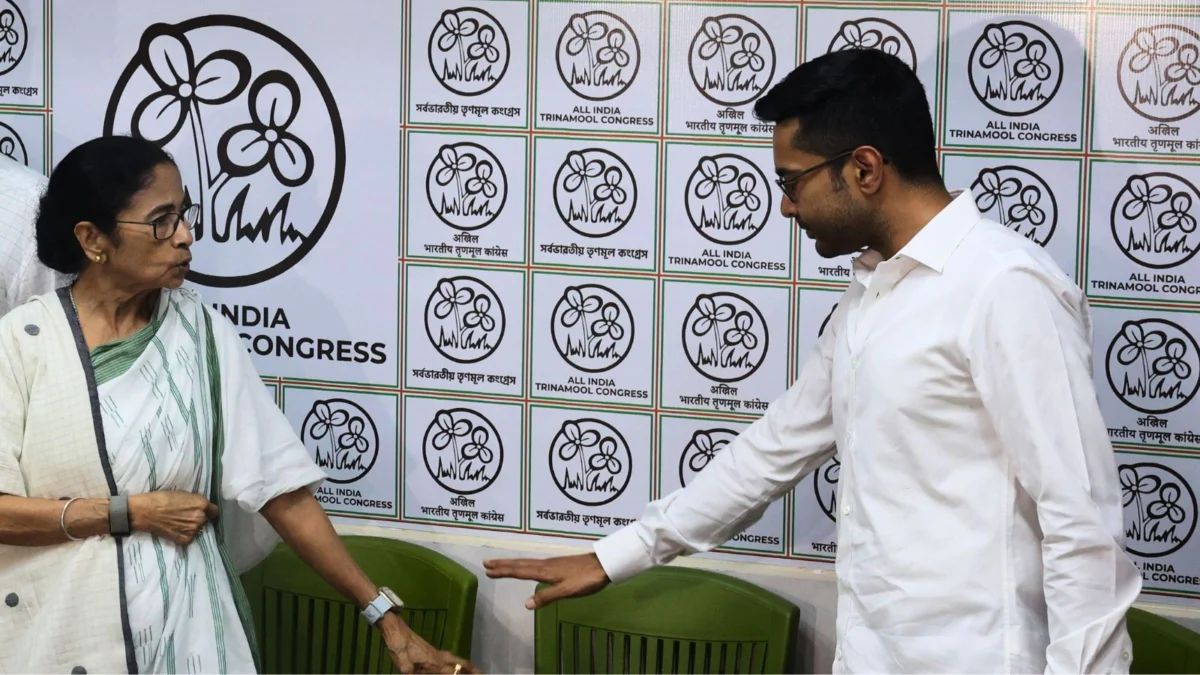
KOLKATA, India – Just a month after suffering a significant electoral setback in the recent Lok Sabha elections, the Trinamool Congress (TMC), West Bengal’s dominant political force, finds itself staring down the barrel of an unprecedented internal crisis. What began as post-election rumblings has rapidly escalated into a full-blown rebellion, threatening to cleave the party at its core and fundamentally alter the political landscape of the state. Despite securing a formidable 41% of the votes in previous state elections, the party’s cohesion is now in question, with senior leaders openly challenging the leadership of Chief Minister Mamata Banerjee’s nephew and heir apparent, Abhishek Banerjee.
The brewing storm, initially characterized by veiled criticisms and quiet dissent, has now erupted into public defiance, spearheaded by figures like Uluberia Purba MLA and former Rajya Sabha MP Ritabrata Banerjee. The rebels’ central demand is a clear distancing from Abhishek Banerjee’s perceived arrogance and influence, while paradoxically maintaining their loyalty to Mamata Banerjee. This intricate balancing act underscores the deep-seated grievances that have been simmering beneath the surface, now exposed by the vulnerability of electoral defeat. The crisis carries the ominous echoes of recent political upheavals in states like Maharashtra, where powerful regional parties have fractured, raising fears that the TMC could follow a similar path, potentially leading to a battle over the party’s very name and symbol.
The Aftermath of Defeat: Cracks Emerge
The recent Lok Sabha election results, which saw the TMC’s national ambitions curtailed and its dominance in West Bengal challenged, served as the undeniable catalyst for the current turmoil. While the party retains power in the state assembly, the national defeat created a vacuum for introspection and, critically, a space for long-suppressed frustrations to surface. The initial shock of the results on May 4th quickly transformed into an environment ripe for discontent. Leaders, once united under the formidable shadow of Mamata Banerjee, began to question the strategies, decision-making, and increasingly, the influence of certain individuals within the party hierarchy. This period of immediate post-election analysis quickly exposed the fragile fault lines that ran through the Trinamool Congress, particularly concerning the meteoric rise of Abhishek Banerjee and the role of external political consultancy firms like I-PAC.
Abhishek Banerjee’s Ascendancy and Mounting Discontent
Abhishek Banerjee, widely seen as the political successor to Mamata Banerjee, has been at the heart of much of the internal friction. His rapid ascent within the party, coupled with his decisive role in strategic decisions and candidate selection, has alienated a significant section of veteran MLAs and MPs who feel sidelined and disrespected. The perceived shift in power dynamics, where loyalty to the "new guard" often overshadowed years of dedicated service, became a source of simmering resentment. This discontent was further fueled by a general sense among senior party members that their experience and grassroots connection were being undervalued in favour of data-driven strategies and a more corporate approach to politics, championed by Abhishek and I-PAC. The electoral defeat, rather than fostering unity, amplified these existing tensions, laying bare the profound disconnect between the party’s old guard and its new, modernizing faction.
A Chronology of Disintegration: From Silent Dissent to Open Revolt
The current crisis within the Trinamool Congress has unfolded through a series of dramatic events, each peeling back layers of internal discord and bringing the party closer to a potential schism. What began as whispers of discontent after the Lok Sabha election results has rapidly morphed into a public confrontation, characterized by open defiance, strategic meetings, and accusations of forgery.
The May 4th Tremors: A Defeat Unacknowledged
The first tremors of rebellion were felt almost immediately after the Lok Sabha election results became clear on May 4th. The party, despite its significant state presence, had not met its national expectations, leading to an atmosphere of disappointment and recrimination. It was in this charged environment that the seeds of dissent began to sprout. A particularly telling incident occurred just two days later at a crucial meeting convened at Chief Minister Mamata Banerjee’s residence. During this gathering, the former CM, in what many perceived as an attempt to consolidate power around her chosen successor, asked all MLAs present to stand up and give a standing ovation to Abhishek Banerjee.
This seemingly innocuous gesture, however, became a moment of silent, yet profound, defiance. As one disgruntled MLA recounted, "Mamata Banerjee was not ready to accept defeat. When she asked us to stand up, many senior MLAs did not do so, but they also said nothing." This quiet refusal spoke volumes, indicating a deep-seated reluctance among party veterans to endorse Abhishek’s leadership, especially in the wake of an electoral setback. It was a clear signal that the party’s internal hierarchy was far from unified, and that loyalty to the supreme leader did not automatically extend to her nephew. The moment marked a critical juncture, transforming private misgivings into a collective, albeit unspoken, challenge to the established power structure.
The Jahangir Khan Affair: A Flashpoint for Frustration
Adding fuel to the nascent fire was the controversy surrounding Falta strongman Jahangir Khan. Known to be close to Abhishek Banerjee, Khan unexpectedly withdrew his name from a crucial repoll in his constituency without prior consultation with the party leadership. This unilateral decision, perceived as an act of indiscipline, sparked widespread unease. What truly exacerbated the situation, however, was the leadership’s apparent reluctance to take decisive action against Khan.
This perceived leniency, particularly given Khan’s proximity to Abhishek, was interpreted by many as a clear example of preferential treatment and a symptom of the new power dynamics within the party. When questioned about the party’s response to the Jahangir Khan incident, Abhishek Banerjee’s dismissive reply – "See the party’s tweet" – further inflamed tensions. A senior TMC MLA articulated the widespread frustration: "Not only that, the leadership, especially Abhishek Banerjee, was so arrogant. Even after such a humiliating defeat, when asked about what the party was doing about Jahangir Khan, he just said, ‘See the party’s tweet.’ Mamata Banerjee also announced she would not resign as CM. After that, the seeds of the rebellion were laid." This incident solidified the narrative of an arrogant, unapproachable "new guard" unwilling to heed the concerns of the party’s traditional strongmen, and critically, unwilling to accept responsibility for the recent electoral outcome.
Ritabrata Banerjee Emerges as the Rebel Standard-Bearer
As the internal discontent simmered, a clear leader for the burgeoning rebellion began to emerge: Ritabrata Banerjee, the Uluberia Purba MLA and former Rajya Sabha MP. TMC sources indicate that it was around this time that disgruntled MLAs started coordinating, laying the groundwork for a more organized revolt. Ritabrata, with his past experience in national politics and a perceived independent streak, quickly became the focal point for those disaffected with the party’s current trajectory. His role was soon solidified when he was unexpectedly recognized by the Speaker as the Leader of the Opposition (LoP), a move that directly challenged the party’s official stance and effectively formalized the rebellion within the legislative assembly. This development gave the dissenting faction a legitimate platform and a recognized voice, transforming their scattered grievances into a cohesive political challenge.
The Delhi Connection and Kolkata Conclaves
The rebellion gained significant momentum following Ritabrata Banerjee’s crucial visit to Delhi. There, he reportedly met with Suvendu Adhikari, the Leader of Opposition in the West Bengal Assembly and a prominent BJP leader. This meeting, with a key opposition figure, marked a critical turning point, signaling the rebels’ willingness to engage with external political forces, if necessary, to press their demands. Upon his return from the national capital, Ritabrata intensified his efforts to galvanize support. "After Ritabrata returned from Delhi, the plan gathered pace," a rebel MLA confirmed. He convened a series of meetings, both at the MLAs’ hostel and in private hotels across Kolkata, strategically gathering like-minded legislators.
These clandestine conclaves became the operational hubs for the rebellion. "All the MLAs started receiving calls to unite against leadership that had largely been mum and not proactive," explained a rebel MLA. The primary target of their collective ire was unequivocally Abhishek Banerjee. "However, our main target was Abhishek Banerjee. We are not against Mamata Banerjee, but we can’t accept Abhishek’s leadership anymore," the MLA reiterated, underscoring the nuanced yet firm stance of the dissenting faction. These meetings laid the strategic foundation for their coordinated actions, aiming to exert maximum pressure on the TMC high command.
The Signature Forgery Scandal: A Battle for Legitimacy
The internal strife reached a dramatic crescendo with the "signature forgery controversy," a battle over the legitimate representation of the opposition within the assembly. On June 1st, the TMC leadership submitted a letter to the Speaker’s office, officially designating Sobhabdeb Chattopadhyay as the Leader of Opposition, Nayona Bandyopadhyay and Ashima Patra as Deputy LoPs, and Firhad Hakim as Chief Whip. This move was clearly an attempt by the party’s loyalist faction to assert control and sideline Ritabrata Banerjee.
However, Suvendu Adhikari quickly added fuel to the fire, publicly alleging that Ritabrata and fellow TMC MLA from Entally, Sandipan Saha, had complained that their signatures on this official letter had been forged. Further compounding the crisis, Adhikari revealed that MLAs Arup Roy and Baharul Islam had admitted to the CID, which was investigating the matter, that they too had not signed the letter. This explosive allegation of forgery not only undermined the credibility of the TMC leadership’s submission but also exposed the deep divisions within the party. It transformed the internal power struggle into a public scandal, questioning the very legitimacy of the party’s official representation and demonstrating the extent to which internal trust had eroded. The signature forgery controversy became a significant flashpoint, solidifying the rebellion and providing concrete evidence of the deep-seated mistrust pervading the party.
Voices from the Fray: Decoding the Rebellion’s Motives
The rebellion within the Trinamool Congress is not a monolithic movement; rather, it is a complex tapestry woven from various threads of grievance, ambition, and pragmatic concerns. The voices of the dissenting MLAs reveal a nuanced approach, largely centered around a clear distinction between Mamata Banerjee and her nephew, Abhishek, while also highlighting practical issues faced on the ground.
The Mamata-Abhishek Dichotomy: Loyalty vs. Leadership
A recurring theme among the rebel MLAs is their unwavering loyalty to Mamata Banerjee, the party’s founder and charismatic leader, juxtaposed with their outright rejection of Abhishek Banerjee’s leadership. "We are against Abhishek Banerjee and have no problem with Mamata Banerjee’s leadership," another rebel MLA affirmed, echoing the sentiment expressed by many. This strategic differentiation is crucial. It allows the rebels to claim ideological purity and adherence to the party’s foundational principles, while simultaneously challenging the current power structure. It suggests that for many, the issue is not with the party’s core ideology or its supreme leader, but with the direction and control exerted by Abhishek and his coterie.
This dichotomy also serves a pragmatic purpose. By maintaining allegiance to Mamata, the rebels hope to avoid the full wrath of the party’s formidable machinery, which traditionally views any challenge to Didi as an act of ultimate betrayal. They understand that to directly oppose Mamata would be political suicide for many. Instead, by framing their dissent as a necessary corrective to Abhishek’s perceived missteps, they aim to force a recalibration within the party, hoping Mamata will eventually intervene to restore the balance they believe has been lost.
Beyond Ideology: Practical Grievances and Ground Realities
Beyond the high-level power struggle, many rebel MLAs are driven by very tangible, ground-level grievances. Barnali Dhara, the TMC MLA from Kulpi in South 24 Parganas, articulated a common sentiment rooted in practical concerns. "I am not a political person as such and became MLA to work for people," she told The Indian Express. "I thought I could do that if I went with this group. Our workers are facing violence and we are not receiving help from the administration."
This statement highlights a critical dimension of the rebellion: the breakdown of administrative support and the inability to effectively serve constituents. For grassroots politicians, securing administrative assistance for their workers and addressing local issues is paramount. The perception that the current party leadership is either unwilling or unable to provide this support, or that access is controlled by a select few, drives many to seek alternative alliances. Dhara’s subsequent meeting with the Leader of Opposition Suvendu Adhikari, where she was "assured… he would talk to the administration," further underscores this pragmatic motivation. "I think I will get help from the administration as well if I remain with this bloc," she concluded, openly acknowledging the practical benefits of aligning with the rebel faction, even if it means cooperating with the opposition. This reveals that for some, the rebellion is less about ideological purity and more about effective governance and survival in a hostile political environment.
Another MLA from the minority community added a layer of complexity, stating, "Mamata Banerjee is not ready to understand that we are not against the party. We can’t go with the BJP and in the fight against BJP, we need Mamata Banerjee." This voice introduces the dilemma of those who are disillusioned with the current TMC leadership but are ideologically opposed to the BJP, highlighting the difficult position many find themselves in. They seek a stronger, more united front against the BJP but believe the current internal strife and Abhishek’s leadership are weakening that very fight.
The I-PAC Factor: External Influence or Strategic Misstep?
The role of the political consultancy firm I-PAC (Indian Political Action Committee), brought in by Abhishek Banerjee to manage the party’s election strategy, has also emerged as a significant point of contention. Many senior MLAs view I-PAC’s involvement as an unwelcome external interference that has marginalized seasoned party functionaries and diluted the party’s organic connection with its cadre.
A senior MLA voiced this frustration, stating, "We were humiliated by what Abhishek Banerjee did in the signature controversy. Senior MLAs are not ready to accept that. We have no problem with Mamata Banerjee, but we will not allow Abhishek or any agency to interfere in the functioning of the party." This criticism goes beyond individual personalities, targeting a perceived shift in the party’s operational culture. The veteran leaders, who have built the party brick by brick through years of grassroots work, resent being dictated to by external consultants, especially when the electoral results following their strategies were less than stellar. The signature controversy, in this context, became a symbol of this perceived humiliation, where the authority and autonomy of senior MLAs were allegedly overridden or disregarded, further fueling the demand for a return to what they consider a more traditional, cadre-driven party structure.
Official Responses and Counter-Allegations: TMC’s Fightback
Faced with an increasingly audacious internal rebellion, the Trinamool Congress leadership has responded with a mixture of swift punitive action and a robust counter-narrative, primarily articulated by Mamata Banerjee herself. The party’s strategy appears to be twofold: to decisively crush dissent through disciplinary measures and to reframe the rebellion as an externally orchestrated conspiracy.
Swift Expulsion: A Firm Hand from the High Command
The TMC high command wasted no time in demonstrating its intolerance for open rebellion. On Monday, the party promptly expelled Ritabrata Banerjee and Sandipan Saha, the two MLAs at the forefront of the dissent, on grounds of "anti-party activities." A formal letter communicating this decision was sent to the Speaker of the Legislative Assembly, solidifying the party’s official stance and effectively stripping the rebel leaders of their formal party affiliation.
This decisive action sends a clear message to any other potential defectors or fence-sitters within the party: dissent will not be tolerated, and loyalty to the established leadership is paramount. The expulsions serve as a warning, aiming to deter further defections and to reassert the authority of the party high command, particularly in the face of challenges to Abhishek Banerjee’s leadership. It is a classic move by a party determined to maintain discipline and control, even at the cost of alienating some of its members.
Mamata Banerjee’s Conspiracy Theory: Blaming External Forces
In parallel with the disciplinary actions, Mamata Banerjee launched a vigorous counter-attack, strategically reframing the internal crisis as a conspiracy orchestrated by external forces. In a public Facebook Live address, the TMC chairperson directly alleged that a "conspiracy had been hatched in Delhi to break her party," a thinly veiled reference to Ritabrata Banerjee’s recent meeting with Leader of Opposition Suvendu Adhikari in the national capital.
Mamata Banerjee also sought to discredit Ritabrata Banerjee personally, highlighting his political past. "Someone who earlier was with the CPM (Ritabrata Bandopadhyay) is doing it all. We gave him a ticket by depriving others," she stated, attempting to paint him as an opportunist lacking true party loyalty and ungrateful for the opportunities he received. This narrative aims to undermine Ritabrata’s credibility among the party’s grassroots workers and supporters, portraying him as a tool of the opposition rather than a legitimate voice of dissent.
Furthermore, the Chief Minister presented the TMC as a victim of political vendetta and state-sponsored intimidation. She made grave allegations of widespread violence against her party workers and offices: "2,500 of our party offices vandalised, thousands of workers have been arrested." More alarmingly, she accused the police of actively threatening her own MLAs: "The police are threatening our MLAs, asking them not to step out of their homes. The police are asking MLAs to support a person whom we have expelled (Ritabrata Banerjee), and break our party."
These allegations, if true, point to a deeply concerning politicization of the state machinery, aimed at coercing TMC MLAs to abandon their party and join the rebel faction. By portraying the party and its loyalists as victims of a larger, sinister plot involving both rival political parties and sections of the administration, Mamata Banerjee aims to galvanize her core support base, evoke sympathy, and discredit the rebels as agents of destruction rather than reformers. Her narrative is a powerful attempt to rally the party faithful and externalize the blame for the internal turmoil, presenting it as an attack on the very fabric of the Trinamool Congress.
Implications: The Future of Trinamool Congress and West Bengal Politics
The current rebellion within the Trinamool Congress carries profound implications, not only for the party’s immediate future but also for the broader political landscape of West Bengal and, to some extent, national politics. The scale of the dissent and the high stakes involved suggest that the outcome could fundamentally redefine political power in the state.
The Specter of a Parliamentary Split: A National Setback
The most immediate and pressing concern for the TMC is the looming threat of a split within its parliamentary party. "BJP leaders will not sit idle after breaking our legislature party. Abhishek Banerjee will be cornered even in Parliament as well," speculated a senior TMC MP. The fear is that the legislative assembly rebellion could quickly spread to the party’s contingent in the Lok Sabha and Rajya Sabha. "We are expecting two-thirds of our MPs will revolt very soon. That will be the last nail on the TMC’s coffin," the MP grimly predicted.
Such a large-scale defection, if it materializes, would be a devastating blow to the Trinamool Congress’s national standing. It would severely diminish its presence in the Indian Parliament, reducing its ability to influence national policy and act as a significant opposition voice. For a party that has harbored national ambitions, a parliamentary split would represent a catastrophic setback, effectively sidelining it from major national debates and significantly weakening its leverage against the ruling BJP at the Centre. This would not only affect the party’s political power but also its financial resources and organizational capacity, making it challenging to rebound.
The Battle for Symbol and Legacy: Echoes of Maharashtra
The comparison drawn by the senior TMC MP to the political crises in Maharashtra, involving the Shiv Sena and NCP factions led by Eknath Shinde and Ajit Pawar respectively, is particularly ominous. "Like Eknath Shinde and Ajit Pawar, rebel TMCs will get the rights to the symbol and the party name," he asserted. This highlights the ultimate prize in such a political battle: control over the party’s electoral symbol and its very identity.
In India’s electoral system, the party symbol is crucial for voter recognition, especially in rural areas. Losing the symbol, and potentially the party name, would effectively mean losing the legacy built by Mamata Banerjee over decades. It would create immense confusion among voters and force the original party faction to rebrand, a monumental task in a politically charged environment. For Mamata Banerjee, who founded the party and is synonymous with its "Two Flowers and Grass" symbol, losing control of it would be an existential blow, challenging her political identity and possibly dismantling her life’s work. The legal battle over the symbol and name, if it comes to pass, would be protracted and emotionally charged, mirroring the bitter disputes seen in Maharashtra.
A Shifting Political Landscape in West Bengal
Should the TMC indeed splinter, the ramifications for West Bengal politics would be profound and far-reaching.
Weakening of TMC’s Dominance: A fractured TMC would inevitably lose its hegemonic position in the state. Its formidable organizational structure, which has long been its backbone, would be severely compromised by infighting and defections. This would create a power vacuum that other parties would eagerly seek to fill.
BJP’s Ascendancy: The primary beneficiary of a TMC split would undoubtedly be the Bharatiya Janata Party (BJP). Already the principal opposition in the state and having made significant inroads in recent elections, the BJP would find an unprecedented opportunity to consolidate its position. Defecting TMC MLAs and MPs, particularly those who are ideologically flexible or driven by pragmatic concerns like administrative support, might find a welcoming home in the saffron party, further bolstering its strength. The BJP’s long-standing ambition to capture West Bengal could finally materialize in such a scenario.
Relevance of Other Parties: A weakened TMC might also open avenues for the Left Front and Congress to regain some lost ground, though their organizational capacity has significantly diminished over the years. However, a multi-polar contest would certainly emerge, making future elections less predictable.
Mamata Banerjee’s Legacy: The crisis poses the gravest threat to Mamata Banerjee’s political legacy. Can she, the formidable "Didi," stem the tide of rebellion and rebuild her party from the brink, or will this be the moment her absolute control over the Trinamool Congress finally crumbles? Her ability to negotiate with the rebels, demonstrate decisive leadership, and re-establish internal trust will be crucial.
Abhishek Banerjee’s Future: The rebellion is a direct challenge to Abhishek Banerjee’s projected leadership. His political future within the party hinges on his ability to either quell the dissent or secure his position through a forceful consolidation of power. Should the rebellion succeed in diminishing his influence, it could significantly alter the succession plan within the TMC.
In conclusion, the Trinamool Congress stands at a critical juncture. The internal rebellion, fueled by post-electoral disappointment, resentment over leadership style, and pragmatic grievances, threatens to unravel decades of political dominance. The coming weeks will determine whether Mamata Banerjee can deftly navigate this crisis and restore unity, or if the Trinamool Congress will indeed succumb to the forces of disintegration, ushering in a new and uncertain era for West Bengal politics.
