


In an era defined by an unceasing deluge of information, the very essence of who we are and how we express ourselves is being profoundly reshaped by the environments we inhabit. Far from being solely internal constructs, our communication patterns and personal identities are intricately woven from the threads of what we repeatedly see, hear, and experience. This age-old philosophical tenet, rooted in ancient wisdom, has gained a powerful and urgent relevance in our media-saturated world, where constant exposure subtly yet undeniably shapes our perceptions, reasoning, and ultimately, our sense of self.

The Genesis of Self: Ancient Wisdom Meets Modern Reality
For centuries, the prevailing view has often compartmentalized communication as a mere act of outward expression and identity as a stable, internally generated core. However, a deeper examination, illuminated by ancient philosophical traditions, reveals a more fluid and contingent reality. Both our ability to communicate and our very sense of identity are continuously, and often unconsciously, molded by our surroundings. What we are exposed to, what we repeatedly encounter, and what we come to accept as the norm within our environment act as the unseen architects of our minds. The information we absorb doesn’t just inform our knowledge; it actively structures our thought processes, dictates our language, and ultimately influences the person we become. This fundamental proposition, far from being a contemporary discovery, finds its echoes in the profound insights of classical Indian philosophy.
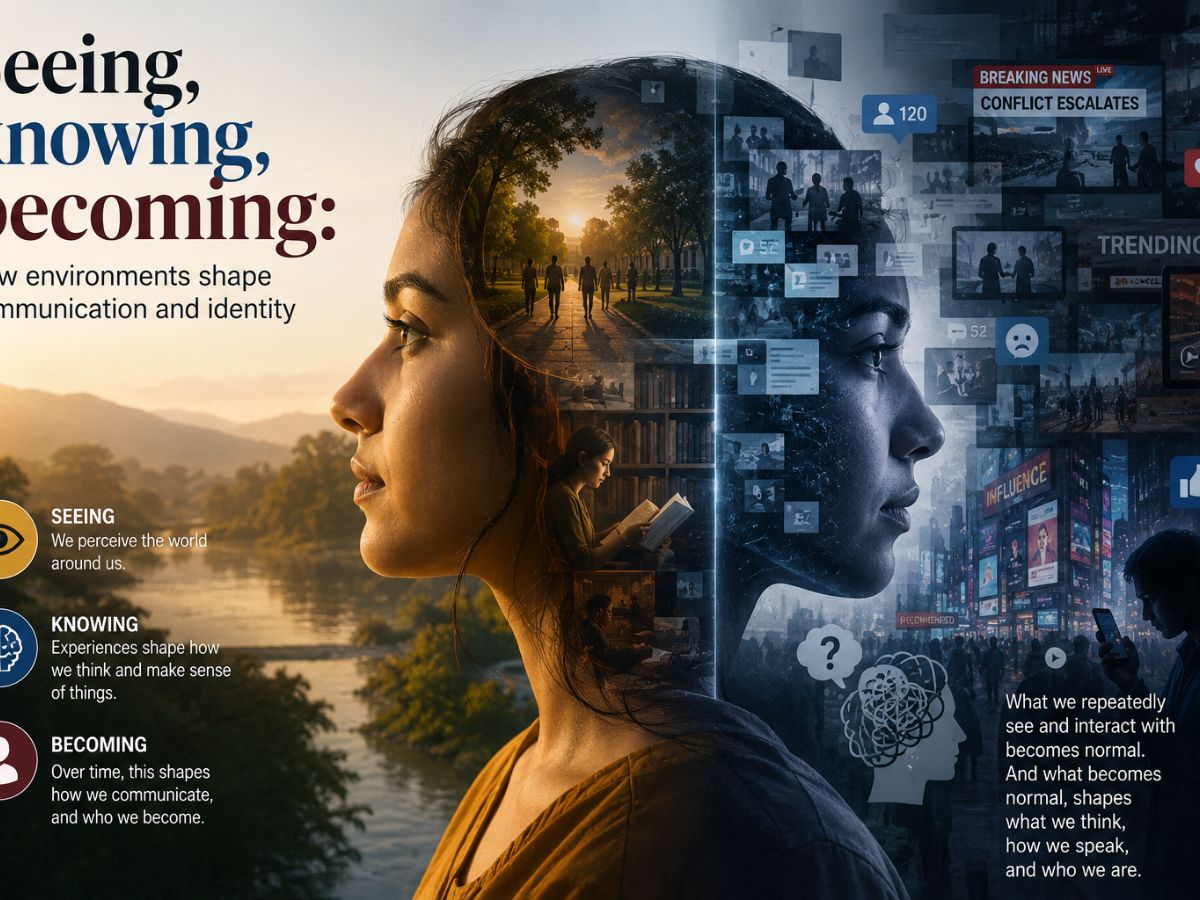)
The Nyaya Sutra, a seminal text in Indian logic and epistemology, posits pratyaksha – perception – as the primary conduit for valid knowledge. It asserts that knowledge originates from the direct contact between our senses and the external world. What we see, hear, and experience forms the bedrock upon which we construct our inferences, judgments, and reasoning. This sequence is fundamental: stimulus precedes cognition, and cognition, in turn, informs articulation.

Extending this understanding into the realm of mental formation, the Yoga Sutra introduces the concept of vrittis, or mental fluctuations. These fluctuations, as eloquently stated in the sutra "yogahchittavrittinirodhah" (Yoga Sutra 1.2), arise from the impressions (samskaras) forged through sensory engagement and lived experience. Over time, repeated exposure to specific stimuli deepens these imprints, shaping our inherent tendencies, preferences, and habitual patterns of response. In this light, identity is not a static, self-originated entity but rather an accumulated construct, a tapestry woven from the threads of our environmental encounters.
)
The Amplifying Echo Chamber: Media’s Pervasive Influence
The core insight offered by these philosophical frameworks is the profound impact of external environments on our internal states. They elucidate a clear progression: what we repeatedly encounter becomes what we recognize; what we recognize becomes what we deem valid; and what we deem valid becomes what we express. Communication, therefore, transcends a simple outward projection of thought; it emerges as the sophisticated outcome of a layered process where the external world plays an indispensable formative role.
)
This dynamic holds direct and critical relevance in our contemporary landscape. Individuals today are immersed in environments saturated with an unprecedented density of stimuli. Digital platforms, social media feeds, algorithmically curated content, and a relentless stream of information create a constant barrage of sensory input. These environments are far from neutral. They actively privilege certain forms of expression, amplify specific types of language, and normalize particular ways of interpreting and framing the world.
)
Over extended periods, repeated exposure to these patterns exerts a subtle yet powerful influence on both how individuals communicate and how they perceive themselves. A compelling example can be observed in the increasing standardization of language across various digital platforms. Words, phrases, and expressions circulate with remarkable speed, rapidly acquiring shared meanings and serving as markers of belonging. What begins as a descriptive term often evolves into a component of identity. Words that once signified a mere preference or activity can now function as definitive markers of self-definition.
)
This linguistic evolution is not incidental; it is a direct reflection of the pervasive influence of repeated exposure to specific linguistic patterns. Over time, these patterns cease to feel like external constructs and instead become internalized, perceived as natural, expected, and even essential for effective participation within the communicative ecosystem.
)
The Contraction of Perspective: When Exposure Narrows Thought
The same underlying mechanism is readily observable in the formation of opinions and ideological stances. When individuals are exposed to a limited range of perspectives, it can foster the illusion of widespread consensus. Conversely, constant engagement with specific, often pre-selected narratives can powerfully shape what individuals consider credible, legitimate, or even factual.
)
The Nyaya Sutra’s emphasis on perception as the foundational element of knowledge offers a critical lens through which to understand this phenomenon. When the scope of what is perceived narrows, the potential for reasoned thought also contracts. The principle is simple: thought follows exposure. If our sensory input is confined to a restricted set of viewpoints, our capacity to engage with diverse ideas and form nuanced conclusions is inherently limited.
)
The Yoga Sutra’s insights into the role of impressions add another crucial layer to this analysis. Repetition, it highlights, deepens impact. While a single exposure might provide information, sustained exposure actively forms and solidifies patterns of understanding. Over time, the cumulative residue of repeated interactions leaves cognitive and emotional imprints that subtly influence our behavior and decision-making. Preferences that feel deeply ingrained and intrinsic may, in fact, be the product of accumulated environmental exposure. Similarly, identity can appear remarkably stable, even when it is in a continuous state of subtle reconfiguration.
)
Institutional Responsibility: Crafting Environments for Deeper Engagement
This profound understanding of how environments shape cognition and expression raises a critical question for institutions, particularly those at the forefront of education and communication. If our thought processes and our ability to articulate them are so intrinsically linked to the environments we inhabit, then the deliberate design of these environments becomes a matter of paramount importance. What is made visible, what is emphasized, and what is repeatedly presented will not only influence what individuals know but also how they think and how they choose to express that thinking.
)
Higher education institutions, for example, often prioritize content delivery and the development of specific skills. However, less attention is frequently paid to the communicative environment within which this learning takes place. If exposure is a key driver of cognition, then the quality of discourse, the intentional cultivation of diverse perspectives, and the nature of intellectual engagement become central to the efficacy of the educational process. A sterile or homogenous communicative environment can inadvertently stifle critical thinking and limit the breadth of intellectual exploration.
)
The same imperative applies to the broader media and public communication spheres. The increasing compression of complex information into short, easily digestible formats may enhance accessibility, but it also carries the significant risk of reducing nuanced understanding. When exposure is primarily limited to simplified representations, the capacity for intricate and multi-faceted thought can inevitably diminish. Communication may become more efficient, but it may also become less substantive, sacrificing depth for brevity.
)
Navigating the Influenced Landscape: Cultivating Awareness and Deliberate Design
The challenge, therefore, is not to eliminate influence entirely – an impossible and arguably undesirable task in a social species. Instead, the imperative lies in cultivating a profound awareness of its pervasive nature. We must recognize that what we repeatedly see will inevitably shape what we think, and what we think will, in turn, shape what we say.
)
In a contemporary context where our environments are increasingly mediated and curated by powerful technological and social forces, this heightened awareness becomes absolutely essential. Communication and identity do not emerge in a vacuum. They are forged at the intricate intersection of exposure, interpretation, and repetition. The fundamental question is not whether we are influenced by the world around us, but rather, whether we are attentive to the subtle mechanisms through which that influence operates, and whether we are deliberate in shaping the environments that, in turn, shape us. This conscious engagement with our surroundings is the key to fostering more authentic, diverse, and critically informed communication and a more robust and self-aware sense of identity.
