

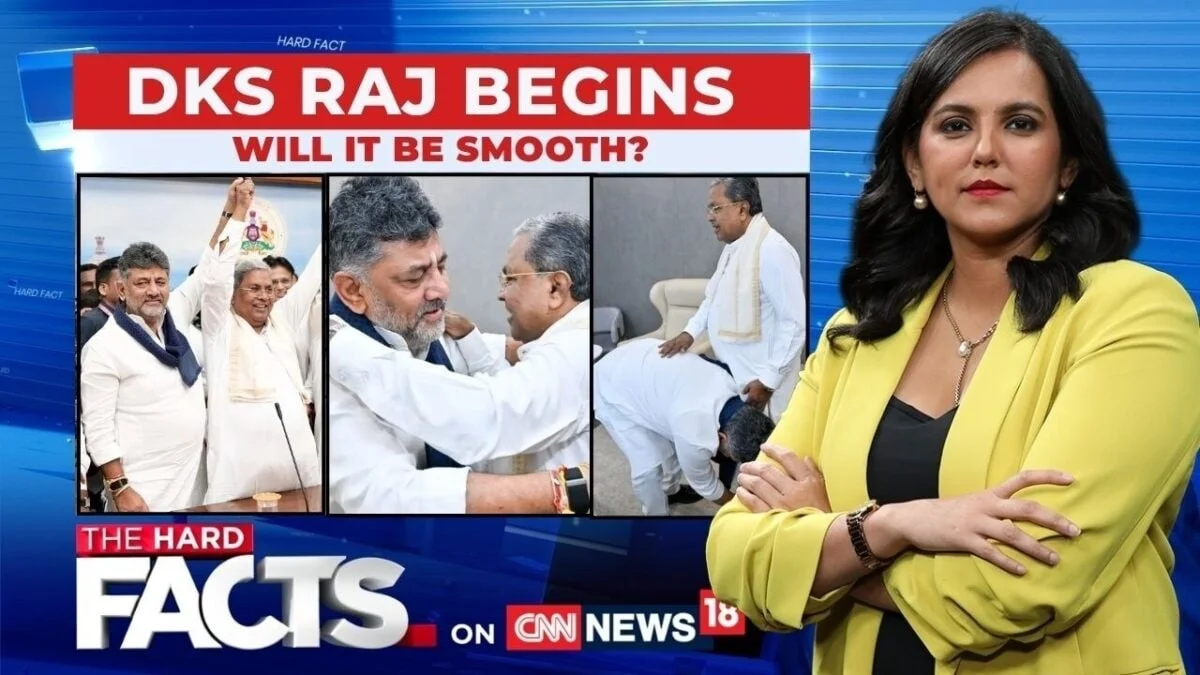
Bengaluru, Karnataka – May 28, 2026 – Karnataka, a state perennially at the heart of India’s vibrant political theatre, has once again witnessed a seismic shift in its corridors of power. After months of intense speculation, protracted internal negotiations, and decisive interventions from the Congress high command, Chief Minister Siddaramaiah has officially tendered his resignation, paving the way for Deputy Chief Minister D.K. Shivakumar to assume the state’s top executive post. This carefully orchestrated transition marks a new chapter in the state’s political narrative, setting the stage for a period of both anticipation and potential turbulence under Shivakumar’s leadership.
The change of guard, anticipated by many political observers, unfolded following a crucial breakfast meeting in Bengaluru where Siddaramaiah reportedly conveyed his decision to his cabinet colleagues before formally stepping down. The air was thick with emotion, as supporters of both leaders gathered, some expressing solidarity, others voicing their disappointment. Discussions around an imminent cabinet reshuffle have already begun, adding another layer of drama to this high-stakes political transition. The question now looms large: will the Congress party, often beleaguered by internal dissent, maintain unity under the formidable yet often controversial leadership of D.K. Shivakumar, or is Karnataka poised for another round of political upheaval?
Main Facts: A Carefully Orchestrated Power Transfer
The political landscape of Karnataka has undergone a significant realignment with the formal resignation of Chief Minister Siddaramaiah and the imminent elevation of his deputy, D.K. Shivakumar, to the state’s highest office. This transition, effective May 28, 2026, culminates a period of intense internal jockeying within the ruling Congress party, following its resounding victory in the 2023 Assembly elections.
Siddaramaiah, a seasoned political veteran and a prominent figure from the Kuruba community, has stepped down after completing a significant tenure, reportedly as part of a pre-agreed power-sharing arrangement brokered by the Congress central leadership. His resignation speech, delivered with characteristic composure, acknowledged the party’s collective decision and expressed gratitude to the people of Karnataka.
D.K. Shivakumar, widely regarded as the Congress’s chief troubleshooter in Karnataka and a dominant voice from the influential Vokkaliga community, is now set to take the reins. His ascent is viewed by many as a testament to his strategic acumen, organizational prowess, and unwavering loyalty to the party, particularly during moments of crisis. However, it also brings to the forefront questions regarding past controversies and the challenges of uniting disparate factions within the state Congress.
The immediate aftermath of the announcement saw a mix of reactions. While Shivakumar’s supporters erupted in celebratory demonstrations across parts of the state, particularly in the Old Mysuru region where Vokkaligas hold sway, pockets of Siddaramaiah’s loyalists expressed sorrow and, in some instances, mild protest, highlighting the underlying factional currents within the party. The Congress high command, having played a pivotal role in mediating this transition, has reiterated its commitment to party unity and good governance in Karnataka. The focus now shifts to the formation of the new cabinet and the articulation of the Shivakumar administration’s immediate priorities.
Chronology of Events: The Road to Transition
The journey to D.K. Shivakumar’s ascension has been a protracted and often tumultuous one, tracing back to the very moment of the Congress party’s emphatic victory in the 2023 Karnataka Assembly elections.
May 2023: The Initial Power Tussle: Following the Congress’s unexpected landslide win, securing 135 out of 224 seats, an immediate leadership crisis emerged. Both Siddaramaiah and D.K. Shivakumar, instrumental in the electoral success, staked their claim to the Chief Minister’s post. Siddaramaiah, with his vast administrative experience and popularity among OBCs and minorities, and Shivakumar, with his strong organizational base and financial backing, presented compelling arguments. The Congress high command, recognizing the need to balance aspirations and maintain unity, intervened. After several days of intense deliberations in Delhi, a compromise was reached: Siddaramaiah would be sworn in as Chief Minister, with Shivakumar as his sole Deputy Chief Minister. Reports at the time, though unconfirmed officially, strongly suggested a power-sharing agreement, often speculated to be a 2.5-year tenure for each leader. This initial settlement, while bringing temporary calm, sowed the seeds for future transitions.
Mid-2023 to Early 2026: Months of Intense Speculation and Internal Pressure: The alleged power-sharing deal became an open secret and a constant source of political chatter. Media reports frequently highlighted perceived tensions between the two leaders, though both publicly maintained a facade of unity. Various factions within the Congress began to align themselves with either Siddaramaiah or Shivakumar, leading to subtle but persistent lobbying efforts directed at the high command. Public statements from loyalists often hinted at the impending change, keeping the political pot simmering. Shivakumar, in particular, was seen to be patiently biding his time, focusing on his ministerial portfolios and party organizational work, while subtly reminding the leadership of his contributions and claims.
March-April 2026: Escalation of Pressure and High Command Intervention: As the speculated halfway mark of the government’s term approached, the internal pressure mounted significantly. Reports of meetings between Shivakumar and senior Congress leaders in Delhi became more frequent. Regional leaders and influential MLAs began openly advocating for Shivakumar’s elevation, citing the "agreement" and the need for a change in leadership style. The high command, keen to avoid open rebellion and ensure a smooth run-up to the upcoming Lok Sabha elections (if applicable) or local body polls, initiated a series of confidential discussions with both Siddaramaiah and Shivakumar. These talks reportedly focused on the modalities of the transition, timing, and the future roles for all key stakeholders.
May 27, 2026: The Crucial Breakfast Meeting: The penultimate step in the transition occurred on the morning of May 27. Chief Minister Siddaramaiah convened a breakfast meeting with his cabinet colleagues in Bengaluru. It was during this emotionally charged gathering that he reportedly informed his ministers of his decision to step down, effectively honoring the understanding reached years prior. Sources close to the Chief Minister described the atmosphere as somber but respectful, with Siddaramaiah emphasizing the party’s larger interests.
May 28, 2026: Formal Resignation and Announcement: Later that day, Siddaramaiah formally submitted his resignation to the Governor of Karnataka. Concurrently, the Congress high command issued an official statement, confirming the leadership change and appointing D.K. Shivakumar as the new Chief Minister-designate. The announcement was met with mixed public reactions – jubilation among Shivakumar’s supporters and a sense of wistful farewell for Siddaramaiah, whose populist schemes had garnered him considerable public goodwill. Emotional scenes unfolded outside the CM’s residence and the party office, with some supporters protesting the decision, while others celebrated the new era. Discussions regarding the imminent cabinet reshuffle, ministerial portfolios, and the oath-taking ceremony for the new Chief Minister immediately commenced, signaling the rapid pace of events.
Supporting Data and Context: Decoding Karnataka’s Political DNA
To fully comprehend the significance of this leadership transition, it is imperative to delve into the intricate socio-political fabric of Karnataka and the unique profiles of the key protagonists.
The Power-Sharing Precedent: While never officially confirmed, the narrative of a "2.5-year power-sharing formula" has been a pervasive and influential element in Karnataka politics since the 2023 elections. This unwritten agreement, reportedly brokered by the Congress high command, was a pragmatic solution to manage the competing ambitions of Siddaramaiah and D.K. Shivakumar. Such arrangements, though fraught with potential for instability, are not uncommon in Indian politics, often employed to placate powerful regional leaders and maintain party cohesion. Its successful (or at least managed) implementation in Karnataka could set a precedent for future coalition or intra-party power dynamics across the country.
Siddaramaiah’s Legacy and Political Persona: Siddaramaiah, often described as a socialist by conviction, leaves behind a mixed but impactful legacy. His first full term (2013-2018) was marked by a focus on welfare schemes like "Anna Bhagya" (subsidized food grains) and "Ksheera Bhagya" (milk for schoolchildren), which endeared him to the poor and marginalized. A leader from the Kuruba community (an OBC group), he successfully consolidated the AHINDA (Alpasankhyataru, Hindulidavaru, Dalitaru – Minorities, Backward Classes, Dalits) vote bank, which was crucial to the Congress’s electoral fortunes. In his most recent tenure, he continued to champion social justice and pro-poor policies. However, his administrative style was sometimes perceived as centralized, and he faced criticism for occasional policy paralysis and internal dissent. His decision to step down, while honoring an agreement, also reflects the pragmatism of a leader who understands the changing dynamics within his party.
D.K. Shivakumar’s Ascent: A Blend of Power and Pragmatism: D.K. Shivakumar, a seven-time MLA, is a political heavyweight from the dominant Vokkaliga community, primarily concentrated in the Old Mysuru region. His political journey is characterized by his role as the Congress’s "troubleshooter," adept at crisis management, resource mobilization, and electoral strategy. He has consistently demonstrated his ability to keep the party flock together, particularly during critical moments of defection or political poaching. His organizational skills and financial muscle are legendary within the party. However, Shivakumar’s career has also been marred by allegations of corruption and investigations by central agencies, which his supporters claim are politically motivated. His leadership style is expected to be more assertive and results-oriented, potentially bringing a new dynamism to the administration but also posing challenges in managing diverse interests. His Vokkaliga identity is a double-edged sword: it offers a strong community base but could also be perceived as alienating other dominant groups like the Lingayats or the numerically significant AHINDA bloc cultivated by Siddaramaiah.
Caste and Regional Dynamics: Karnataka’s politics is deeply intertwined with its complex caste and regional dynamics. The shift from a Kuruba Chief Minister (Siddaramaiah) to a Vokkaliga Chief Minister (Shivakumar) has significant implications. The Vokkaligas and Lingayats are the two dominant communities, historically vying for political power. Shivakumar’s elevation is expected to consolidate the Vokkaliga vote bank for the Congress, crucial in several southern districts. However, the challenge for him will be to retain the support of the AHINDA communities and build bridges with Lingayat leaders, many of whom have traditionally leaned towards the BJP. Regionally, while Shivakumar has a strong base in Old Mysuru, he will need to demonstrate broad appeal across North Karnataka, Central Karnataka, and the Coastal regions.
The Role of the Congress High Command: The central leadership of the Congress, particularly figures like Mallikarjun Kharge, Rahul Gandhi, and Sonia Gandhi, played a decisive role in brokering the initial power-sharing deal and ensuring its eventual implementation. Their intervention underscores the party’s efforts to project unity and manage internal conflicts, especially in a crucial southern state where the Congress holds significant power. The high command’s decision also reflects a strategic calculation to reward loyalty and ensure that all prominent leaders feel adequately represented, thereby preventing potential fragmentation.
Challenges for the New Government: Shivakumar inherits an administration with a robust mandate but also faces several formidable challenges. Economically, Karnataka grapples with issues of agricultural distress, urban infrastructure demands, and the need to attract further investment. Socially, the government must address issues of inequality, communal harmony, and the implementation of its ambitious pre-poll guarantees. Politically, Shivakumar will need to navigate the immediate task of forming a cohesive cabinet, balancing regional and caste representations, and managing the expectations of his diverse party members. The upcoming Lok Sabha elections (if scheduled in 2024 or 2029 depending on the reference point) and subsequent local body polls will serve as early litmus tests for his leadership.
Official Responses and Party Statements: A Chorus of Unity and Resolve
The transition of power in Karnataka has elicited a carefully curated set of responses from the Congress party leadership, aiming to project an image of seamless unity and shared vision. Opposition parties, meanwhile, have wasted no time in offering their critical assessments.
From the Congress Camp:
- Siddaramaiah’s Farewell: In his public statements following the resignation, Siddaramaiah maintained a dignified posture. He thanked the people of Karnataka for their support and expressed his unwavering commitment to the Congress party. "I have always been a loyal soldier of the Congress," he reportedly stated, "and I will continue to serve the party and the people of Karnataka in whatever capacity the high command deems fit. This decision is in line with the party’s collective wisdom and our commitment to an inclusive administration." His remarks aimed to quell any speculation of discontent and reinforce the narrative of a planned, amicable handover.
- D.K. Shivakumar’s Vision: The Chief Minister-designate, D.K. Shivakumar, struck a conciliatory yet determined tone. In his initial address, he extended his gratitude to Siddaramaiah for his leadership and vowed to build upon the foundations laid. "I accept this immense responsibility with humility and a firm resolve," Shivakumar declared. "My primary focus will be to ensure good governance, fulfill all our electoral promises, and work tirelessly for the welfare of every Kannadiga. We will function as a united team, under the guidance of our high command, and take Karnataka to new heights of progress and prosperity." He emphasized collaboration and unity, a direct response to concerns about factionalism.
- Congress High Command’s Endorsement: Senior leaders from the Congress high command, including party president Mallikarjun Kharge and prominent figures like Rahul Gandhi, issued statements endorsing the transition. Kharge stated, "The Congress party believes in collective leadership and respecting the agreements made. This transition in Karnataka reflects our commitment to democratic principles and ensuring a stable, progressive government. Both Siddaramaiah and D.K. Shivakumar are invaluable assets to our party, and we are confident that under Shivakumar’s leadership, Karnataka will continue its path of development." Rahul Gandhi reportedly congratulated both leaders, stressing the importance of unity to deliver on the party’s mandate. The central leadership’s consistent message has been one of managing aspirations for the greater good of the party and the state.
From the Opposition:
- Bharatiya Janata Party (BJP): The principal opposition, the BJP, was quick to criticize the transition, labeling it a manifestation of internal squabbles and an outcome of an "unstable power-sharing deal." State BJP president B.Y. Vijayendra commented, "This leadership change is a clear indication of the Congress party’s inherent instability and its preoccupation with power politics rather than governance. The people of Karnataka voted for stability, but what they are getting is a game of musical chairs. We will closely monitor the new government’s performance and hold them accountable for every promise they fail to keep." The BJP’s narrative aims to highlight perceived disunity within the Congress and question the legitimacy of a government formed on such an arrangement.
- Janata Dal (Secular) (JDS): The JDS, a regional player, also weighed in, with former Chief Minister H.D. Kumaraswamy stating, "The Congress has finally revealed its true colors. This ‘agreement’ was always about individual ambitions, not the welfare of the state. It remains to be seen how long this new arrangement will last. Karnataka deserves a government that is focused on its people, not on internal adjustments." The JDS, having been part of coalition governments in the past, often uses such opportunities to underscore the fragility of multi-leader arrangements.
The official responses, while predictable, set the tone for the coming months, with the Congress attempting to project strength and unity, while the opposition seeks to exploit any perceived cracks in the new leadership.
Implications and Future Outlook: Navigating the Turbid Waters
The political shift in Karnataka, with D.K. Shivakumar taking the helm, carries profound implications not just for the state but also for the Congress party’s national strategy and the broader Indian political landscape.
For Karnataka: Governance, Development, and Stability:
The immediate implication for Karnataka is a potential shift in administrative style and policy focus. Shivakumar is known for his assertive and proactive approach, which could lead to a more decisive implementation of government schemes and infrastructure projects. However, he also faces the formidable challenge of maintaining administrative stability and policy continuity. The new cabinet, expected to be reshuffled, will need to quickly coalesce and deliver on the Congress’s ambitious poll guarantees, such as "Gruha Lakshmi" (financial assistance to women) and "Yuva Nidhi" (unemployment allowance), which have been critical to the party’s popularity.
The balance between regional development and addressing urban issues will be crucial. Shivakumar, with his strong base in the Old Mysuru region, will need to demonstrate an inclusive vision that encompasses the development needs of North Karnataka, coastal areas, and other diverse regions. Furthermore, the state faces challenges ranging from agricultural distress, climate change impacts (like potential droughts or floods), and the need to attract further industrial investment. His ability to navigate these complex issues while managing the expectations of various caste and community groups will define his tenure.
For the Congress Party: Unity, Precedent, and Electoral Prospects:
Internally, the transition is a critical test for the Congress party’s ability to manage powerful regional satraps and implement complex power-sharing arrangements. If Shivakumar successfully unites the party and delivers effective governance, it could strengthen the Congress’s organizational structure in Karnataka and provide a template for resolving leadership disputes in other states. Conversely, any overt factionalism or perceived injustice could lead to internal unrest, potentially weakening the party’s standing.
The performance of the Shivakumar government will undoubtedly have a significant bearing on the Congress’s prospects in upcoming elections. This includes potential Lok Sabha elections (if applicable, depending on the article’s effective date) and local body polls, which serve as crucial barometers of public sentiment. A strong showing under Shivakumar’s leadership would bolster the Congress’s national narrative as a viable alternative, while a faltering performance could undermine its efforts to revive its fortunes across the country. The party’s ability to keep both Siddaramaiah and Shivakumar engaged and working in tandem, even after the power transfer, will be paramount. Siddaramaiah, despite stepping down from the CM’s post, remains a popular and influential figure, and his continued support will be vital for the new government’s stability.
For National Politics: A Model for Coalition and Opposition Unity:
The Karnataka experiment in power sharing and managed transition could offer valuable lessons for national politics, particularly for opposition parties contemplating future alliances against the BJP. The ability of the Congress to orchestrate a relatively smooth transfer, even if born out of internal pressure, demonstrates a degree of strategic foresight. This could inspire other regional parties or multi-party coalitions to consider similar arrangements to present a united front.
However, the national implications also hinge on the stability and perceived effectiveness of the new government. If the Shivakumar administration proves to be stable and progressive, it could project the Congress as a party capable of providing strong regional leadership. Conversely, any significant political turbulence or governance failures could be exploited by the BJP nationally to criticize the Congress’s internal management and its capacity to govern.
Potential Challenges and Turbulence:
Despite the official narrative of unity, the path ahead for D.K. Shivakumar is fraught with potential challenges:
- Factional Management: Balancing the aspirations of MLAs loyal to Siddaramaiah with those who supported Shivakumar will be a constant tightrope walk, especially during cabinet expansion and portfolio allocation.
- Fulfilling Guarantees: Delivering on the ambitious pre-poll guarantees, many of which involve significant financial outlays, while managing state finances, will be a critical test.
- Opposition Scrutiny: The BJP and JDS will relentlessly scrutinize every move of the new government, ready to capitalize on any missteps or internal dissent.
- Corruption Allegations: Shivakumar’s past legal battles and allegations of corruption, even if unproven, could be resurrected by the opposition to tarnish his image.
- Caste Balancing Act: While a Vokkaliga leader, Shivakumar must ensure representation and address the concerns of other dominant and marginalized communities to avoid alienating key vote banks.
Conclusion: A Critical Juncture
Karnataka stands at a critical juncture. The transition from Siddaramaiah to D.K. Shivakumar marks not just a change in leadership but a recalibration of political power and strategy within the Congress party. The coming months will reveal whether this carefully engineered shift will lead to a period of stable governance and renewed development, or if the inherent complexities of Karnataka’s political landscape will usher in fresh turbulence. The eyes of the nation will be firmly fixed on Bengaluru, watching closely as D.K. Shivakumar embarks on his journey to lead one of India’s most dynamic states.
