

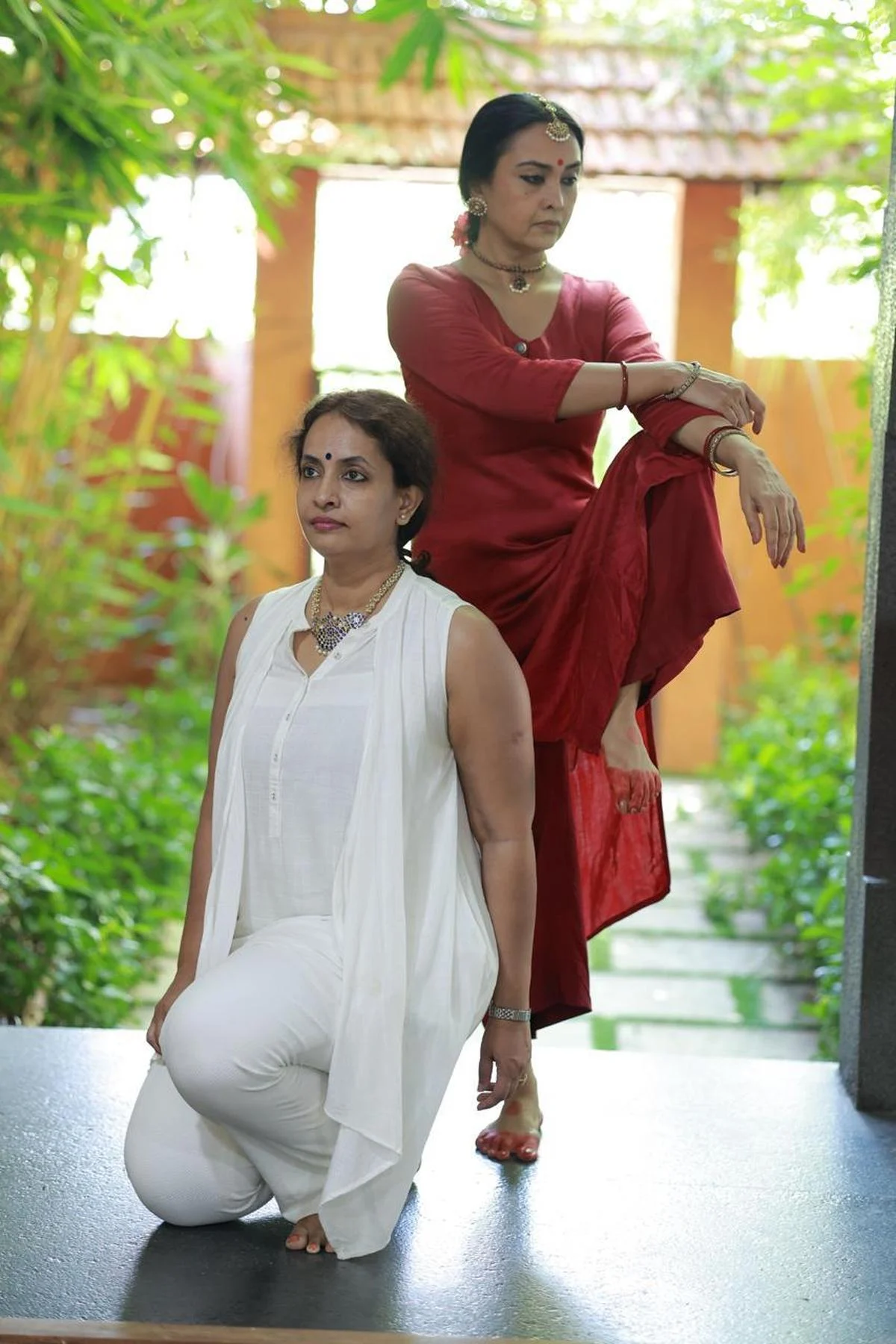
Bengaluru, India – A decade ago, writer Anupama Raju embarked on an ambitious literary endeavor: to reinterpret the Navarasa, the nine fundamental emotions codified by Bharatamuni in his seminal treatise, the Natyashastra. Her innovative approach, presented in the poetry collection Nine, transformed these ancient emotional archetypes into a series of intricately structured triolets. Now, this profound exploration of human feeling has found a powerful new dimension through a captivating collaboration with Bharatanatyam exponent Rajashree Warrier. The resulting production, "NINE – Our Circle of Lines," a mesmerizing fusion of poetry, movement, music, and space, seeks to offer audiences a fresh perspective on these potent emotions. The production premiered to critical acclaim at the annual Kerala Literary Festival (KLF) in Kozhikode in January 2025, followed by a subsequent staging in Kolkata in December. This weekend, the artistic duo brings their unique creation to the stage at the Bengaluru Poetry Festival, promising an immersive experience for attendees.
The Genesis of a Collaborative Vision
The germ of "NINE – Our Circle of Lines" was sown during the unprecedented stillness of the pandemic. Anupama Raju, a celebrated writer and poet, and Rajashree Warrier, a multifaceted Bharatanatyam artist, both based in Thiruvananthapuram, found their paths converging through a shared appreciation for literary and cultural events. Chance encounters at literary festivals paved the way for conversations, and it was during one such discussion that Raju mused about the potential of her Navarasa series to transcend the written word and find expression through dance.
“We are both based in Thiruvananthapuram and used to run into each other at literary festivals,” Anupama Raju explains. “I felt it would be nice to work together someday.” The initial spark ignited a creative fire, leading to the conception of a production that would weave together their distinct artistic languages.
Rajashree Warrier was immediately drawn to Raju’s poetic interpretations. “I liked the poems,” Warrier states. “But usually when I take up a poem, I go off on my own tangent, and the poet may not approve of it. However, once we started interacting, I realized that there wouldn’t be any such problem. We both connected over the emotions that ran through the poems.” This shared emotional resonance became the bedrock of their collaboration, ensuring a harmonious interplay between their individual artistic visions.
The journey from conception to realization was not without its challenges. “It took over a year to start working on it since I was held up with other productions,” Warrier recalls. The timing, however, proved fortuitous. The return of the Kerala Literary Festival after a pandemic-induced hiatus presented an ideal platform for their premiere. “It was when we heard that KLF is back after a break due to the pandemic, we decided to find a stage there,” Warrier adds.

A Dialogue of Words and Movement
"NINE – Our Circle of Lines" delves into three out of the nine classical rasas: Shringaram (love/beauty), Bibhatsa (disgust/aversion), and Bhayanakam (fear). The production unfolds as an intimate dialogue between the two artists. Anupama Raju recites her evocative verses, each poem a carefully crafted exploration of a specific rasa. In response, Rajashree Warrier translates these poetic narratives into a language of movement, her Bharatanatyam vocabulary imbued with a contemporary sensibility. As Warrier’s dance unfurls, Raju often responds with new verses, creating a dynamic, improvisational exchange.
“It is like a dialogue between us, with me using words and Rajashree, movements,” says Raju, encapsulating the essence of their collaborative process. This interplay ensures that the production is not merely an illustration of poetry through dance, but a true synthesis where each art form informs and enriches the other.
Deconstructing Form: A Contemporary Approach to Bharatanatyam
Rajashree Warrier’s interpretation of Bharatanatyam in "NINE – Our Circle of Lines" marks a significant departure from conventional practice. While deeply rooted in the classical tradition, her choreography demonstrates a willingness to push boundaries and redefine the expressive potential of the form.
“When you talk about Bharatanatyam, the structure is treated as the form. For me, it is about the language; structure constitutes the language, which in turn becomes the form,” Warrier explains. “I have used the language but placed it in a different mould. Basically, I have broken the existing form – classical art forms dictate specific movements of the limbs. I have recycled it.” This “recycling” involves a nuanced understanding of the classical grammar, allowing Warrier to adapt and recontextualize movements to serve the emotional arc of Raju’s poetry.
The musical score, also composed by Warrier, further underscores this innovative approach. It is a rich tapestry woven from diverse sonic threads, incorporating the traditional sounds of the mridangam and mizhavu with the melodic strains of the violin and harp, alongside vocalizations. This eclectic blend creates an aural landscape that is both familiar and refreshingly new, mirroring the production’s thematic fusion.

Thematic Explorations: Unpacking the Rasas
The chosen rasas – Shringaram, Bibhatsa, and Bhayanakam – are explored with a depth and complexity that challenges traditional interpretations. Anupama Raju’s poetic lens offers a perspective that can be perceived as “a little dark,” as she herself admits.
Shringaram: Beyond Conventional Romance
In Raju’s conception, Shringaram transcends the idealized portrayal of romantic love. It is presented as a stage where one individual becomes "tamed by the other," a sentiment captured in the line, "…when each day ends up as a chore.” This perspective highlights the potential for dependency and the erosion of self within a relationship.
Rajashree Warrier amplifies this nuanced understanding. “In her view, the woman becomes so dependent that her every emotion is controlled by the other,” Warrier elaborates. “I elaborated upon that observation. She has a realization about her subjugation when she stands in front of a mirror and scratches its surface. From being restrained, she reaches a stage where she feels that shringara is about loving herself.” This transformation, from a state of external validation to internal self-love, is a powerful testament to the complexity of human relationships and the journey towards self-discovery. Raju’s ability to respond to Warrier’s choreographic interpretation with new verses further enriches this thematic exploration, showcasing the seamless dialogue between their artistic disciplines.
Bhayanakam: The Fear of Shifting Identities

The exploration of Bhayanakam (fear) delves into a disquieting scenario of swapped emotional identities between a man and a woman. “When the swap happens, it becomes a tussle between the characters, you and me,” Warrier explains. “It is a frightening situation when one becomes other, as you have to swallow what you once said or believed.” This powerful depiction of Bhayanakam taps into the primal fear of losing oneself, of confronting the uncomfortable reality of having one’s deeply held beliefs and sentiments challenged by an altered perspective. The choreographic representation of this emotional upheaval is likely to be as profound as the poetic articulation.
Bibhatsa: The Lingering Disgust
While the segment on Bibhatsa (disgust/aversion) could not be included in the Bengaluru Poetry Festival performance due to time constraints, Warrier emphasizes its personal significance. “I built different contexts with Anupama’s words,” she states. “I based the whole thing around a dream, that disgusting dream we all might have had at some point of time, which gets stuck in the head and makes you uncomfortable.” This intimate connection to the emotion, drawing from universal yet deeply personal experiences of unsettling dreams, suggests a potent and potentially visceral portrayal of Bibhatsa.
The Significance of the "NINE – Our Circle of Lines"
The title itself, "NINE – Our Circle of Lines," carries layers of meaning that encapsulate the production’s core philosophy. Anupama Raju explains, “A circle is an ongoing thing. At the same time there are lines within that circle, which could be lines of poetry or movement. There is a constant symbiosis happening there.”
The circle symbolizes continuity, the cyclical nature of emotions, and perhaps the encompassing human experience. The lines within represent the distinct artistic expressions – the poetic verses and the choreographic movements – that coexist and interact within this larger framework. The "symbiosis" highlights the organic and interdependent relationship between Raju’s words and Warrier’s dance, a dynamic interplay that forms the very essence of the production.

A Meeting of Minds and Artistic Universes
The success of "NINE – Our Circle of Lines" is a testament to the profound synergy between Anupama Raju and Rajashree Warrier. Their collaboration is characterized by mutual respect, a shared artistic vision, and a deep understanding of each other’s creative processes.
“Collaboration is a lovely space. You get to communicate with another individual, get a peek into that person’s universe,” Raju reflects. “There is mutual respect, and we don’t interfere in each other’s spaces. That boundary is also important, along with the chemistry.” Raju’s previous experience collaborating with French photographer Pascal Bernard on Indo-French projects further attests to her openness to cross-disciplinary artistic endeavors. Her established literary career, marked by acclaimed poetry collections like Bitter Gourd and the novel C, showcases her versatility and depth as a writer.
Warrier echoes this sentiment, expressing immense satisfaction with the collaborative experience. “The collaboration has made me immensely happy. It is extremely gratifying when the other person understands you exactly the way you wanted to be understood,” she shares. Warrier’s own illustrious career as a Bharatanatyam exponent, marked by innovative choreographies and critically acclaimed adaptations of classical texts, speaks to her artistic vision and commitment to pushing the boundaries of her chosen art form. Her recognition as a top-grade artist with Doordarshan and her empanelment with ICCR further solidify her standing in the Indian classical dance fraternity.
Future Implications and Artistic Legacy
"NINE – Our Circle of Lines" is more than just a performance; it is a bold assertion of the enduring relevance of classical Indian aesthetics in a contemporary world. By reinterpreting the Navarasa through a modern lens, Anupama Raju and Rajashree Warrier are not only breathing new life into ancient traditions but also inviting audiences to engage with profound human emotions in novel and insightful ways.
The production’s successful staging at literary festivals in Kerala and Kolkata, and its upcoming performance at the Bengaluru Poetry Festival, underscore the growing appetite for interdisciplinary art forms that bridge the gap between literature, dance, music, and theatre. This collaborative spirit has the potential to inspire future generations of artists to explore uncharted creative territories, fostering a richer and more dynamic cultural landscape.

The choice of literary festivals as venues for the production is deliberate. As Raju notes, “We wanted those viewers who could look into the layers in the work, and that’s why we chose a literary festival.” This indicates a desire to connect with an audience that is receptive to intellectual depth and artistic nuance, further solidifying the production’s position as a significant artistic intervention.
As "NINE – Our Circle of Lines" continues its journey, it leaves an indelible mark on the perception of classical arts and the enduring power of human emotion. The production serves as a powerful reminder that the ancient wisdom of the Natyashastra, when approached with creativity and insight, can resonate profoundly with contemporary audiences, offering a timeless exploration of the human heart.
The production "NINE – Our Circle of Lines" is scheduled to be staged at the Indira Nagar Sangeetha Sabha, Indira Nagar, Bengaluru, on August 1st at 12 noon.
