

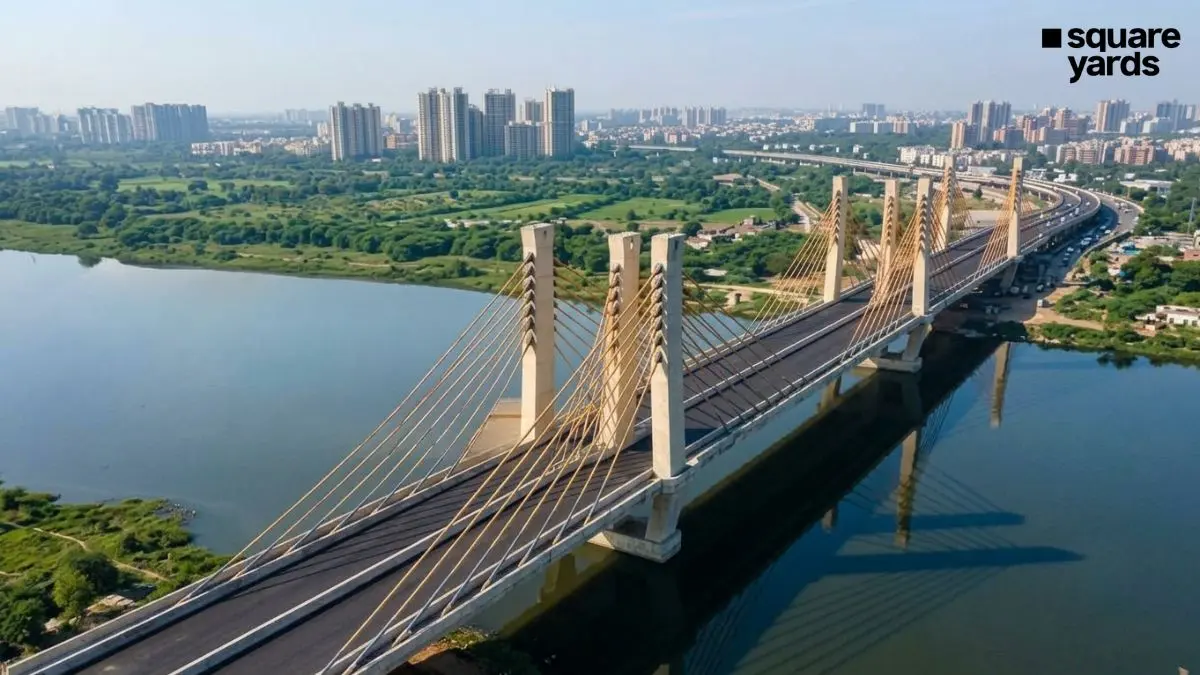
NOIDA — In a move that signals a paradigm shift for the National Capital Region’s (NCR) urban mobility, the long-awaited Barapulla Phase 3 elevated corridor was officially inaugurated on September 29, 2026. The infrastructure project, spanning approximately 9 kilometers, has immediately transformed the transit dynamics between East Delhi, Noida, and the heart of South Delhi. By slashing commute times from Mayur Vihar to AIIMS by a staggering 67%, the project is doing more than just moving vehicles; it is recalibrating property valuations and investor sentiment across Noida’s most prominent residential and commercial sectors.
As of October 1, 2026, early traffic data suggests that the "signal-free" promise of the corridor is holding firm, providing a viable, high-speed alternative to the perennially congested DND Flyway and the Ring Road bottlenecks at Sarai Kale Khan. For Noida’s real estate market, which was already on an upward trajectory, this connectivity milestone acts as a powerful catalyst for a new era of capital appreciation.
1. Main Facts: The Infrastructure Breakthrough
The Barapulla Phase 3 project is the final, critical link in a multi-stage elevated highway system designed to bypass the traditional traffic chokepoints of South and East Delhi.
Key Project Specifications:
- Total Length: Approximately 9 kilometers of elevated roadway.
- Primary Connectivity: Extends from Mayur Vihar Phase I in East Delhi, crossing the Yamuna River to integrate with the existing Barapulla network at Sarai Kale Khan.
- Transit Efficiency: Travel time between Mayur Vihar and AIIMS has dropped from an average of 45 minutes to just 15 minutes.
- Strategic Objective: To provide a signal-free corridor for traffic moving from Noida and East Delhi toward South Delhi destinations such as Safdarjung, INA, and AIIMS, thereby de-congesting the DND Flyway and the Ashram intersection.
The corridor’s opening marks a significant victory for the Public Works Department (PWD) and urban planners who have envisioned a seamless cross-river connection. By removing the "friction of distance," the project effectively brings the premium residential hubs of Noida closer to the institutional and commercial nerve centers of Delhi.
2. Chronology: From Blueprint to Inauguration
The journey of Barapulla Phase 3 has been one of technical ambition and logistical endurance.
- Phase 1 & 2 Legacy: The first two phases of the Barapulla project successfully linked Sarai Kale Khan to Jawaharlal Nehru Stadium and subsequently to INA/AIIMS. However, without Phase 3, the bridge remained underutilized by the massive commuter base residing in Noida and Mayur Vihar.
- The Construction Milestone: Over the last several years, the project faced unique engineering challenges, most notably the construction of high-span pillars across the Yamuna floodplains and the integration of the elevated loop at Mayur Vihar Phase I.
- September 29, 2026: The official ribbon-cutting ceremony took place, attended by senior officials from the Delhi Government and the Ministry of Road Transport and Highways.
- October 1, 2026: Forty-eight hours into operations, traffic flow reports indicate a significant easing of pressure on the DND Flyway, with commuters reporting "door-to-door" time savings of up to 30 minutes during peak morning hours.
3. Supporting Data: The Real Estate Surge
The impact of Barapulla Phase 3 on Noida’s property market is not merely theoretical; it is backed by robust data intelligence. According to recent reports from Square Yards Data Intelligence, the market was already warming up in anticipation of the corridor’s completion.
The Macro View: Citywide Growth
In September 2025, the average asking price for apartments in Noida was approximately Rs 12,000 per square foot (psy). By October 2026, that figure has climbed to Rs 12,650 psy, representing a 7.5% year-on-year increase.
Registration data further underscores the market’s liquidity. Between October 2025 and September 2026, Noida recorded 4,213 transactions with a total value of Rs 5,069 crore. While the average registered rate stands at Rs 9,100 psy, the gap between registered rates and asking prices suggests a high-demand environment where sellers hold significant leverage.
Micro-Market Analysis: The Winners
The "Barapulla Effect" is most visible in sectors with direct proximity to the new bridge and the Noida-Greater Noida Expressway.
-
Sector 44: The Connectivity King
- September 2025 Price: Rs 13,650 psy
- October 2026 Price: Rs 17,800 psy
- Analysis: As one of the sectors most directly exposed to the improved Delhi connectivity, Sector 44 has seen an aggressive price jump. Its status as a premium residential hub is now cemented by the fact that residents can reach South Delhi in under 20 minutes.
-
Sector 128: The Expressway Premium
- September 2025 Price: Rs 13,600 psy
- October 2026 Price: Rs 18,100 psy
- Rental Market: Rents in this sector average around Rs 34 psy, yielding approximately 2.25%.
-
The Luxury Benchmarks (Sectors 15A, 20, and 39)
- Established, mature sectors are already trading at massive premiums. Sector 15A leads the pack at Rs 37,300 psy, followed closely by Sector 20 at Rs 37,150 psy. This suggests that proximity to Delhi was already "priced in" for these elite neighborhoods, and the new corridor will likely enhance liquidity rather than cause an abrupt price spike.
-
Sector 94: Volatility and Recovery
- This sector experienced a volatile year, with prices dipping from Rs 21,150 in late 2025 to Rs 13,600 in early 2026, before recovering to Rs 15,000 psy following the Barapulla inauguration news.
4. Official Responses and Market Perspectives
While official government statements have focused on the "de-congestion" of the national capital, real estate analysts are looking at the socio-economic integration of the two cities.
Urban Planning Experts suggest that the Barapulla Phase 3 is a "psychological bridge." One senior planner noted, "For a decade, Noida was seen as a distant suburb. With a 15-minute commute to AIIMS, Noida is no longer ‘outside’ Delhi; it is an extension of the South Delhi lifestyle at a more competitive price point."
Real Estate Analysts from Square Yards emphasize that while capital values are rising, rental yields remain modest. The citywide rental yield stands at 2.56%. In premium locations like Sector 44 (1.96%) and Sector 150 (1.95%), the yields are even lower.
"The data tells us that Noida is currently a capital-appreciation play, not a high-yield rental play," an analyst stated. "Investors are buying into the future growth and the lifestyle upgrade provided by infrastructure like Barapulla and the upcoming Aqua Line extension, rather than immediate rental returns."
5. Strategic Implications: Synergy and Future Growth
The opening of Barapulla Phase 3 does not exist in a vacuum. It is part of a broader "Connectivity Matrix" that includes the planned 11.56-km Botanical Garden to Sector 142 Aqua Line extension.
The Multi-Modal Effect
The Aqua Line extension will serve Sectors 96, 44, 105, 93, 97, 108, and 91. When combined with the Barapulla corridor, these sectors become "dual-threat" locations—offering both high-speed road access to South Delhi and seamless metro connectivity to the Blue and Magenta lines.
Commercial Real Estate Shift
Noida’s commercial profile is also evolving. General office space rates have risen by 6.2% to Rs 10,950 psy, while IT/SEZ office spaces are commanding a premium at Rs 28,100 psy. Retail spaces (shops) are averaging Rs 31,650 psy. The ease of access for South Delhi-based executives and talent is expected to drive higher occupancy rates in Noida’s Grade-A office spaces along the Expressway.
6. Outlook: What the Next 5 Years Hold
The long-term impact of Barapulla Phase 3 is expected to ripple through the market in stages. Market forecasts suggest a tiered premium for different residential zones:
- Directly Exposed Sectors (15A, 16, 18, 37, 44, 94): These areas are expected to see an additional 2-5% capital value premium over the next 12-24 months. Over a five-year horizon, this could accumulate to a 5-10% incremental gain above the standard market growth, provided the travel-time savings remain durable and the corridor is well-maintained.
- Mid-Expressway Premium Sectors (93, 100-108, 128): These sectors are projected to see a 1-4% initial incremental effect, growing to 4-8% over the longer term.
- Wider Noida Market: For the rest of the city, the "Barapulla effect" will be more diluted, contributing a modest 0-2% in the short term and 2-5% over five years.
Conclusion
The inauguration of Barapulla Phase 3 is a watershed moment for Noida. By effectively shrinking the distance between the residential tranquility of Noida and the institutional core of South Delhi, the project has redefined the value proposition of the region. For homebuyers, it offers a drastically improved quality of life; for investors, it provides a clear roadmap for capital appreciation. As the city continues to integrate with Delhi via such high-impact infrastructure, the distinction between the two is becoming increasingly blurred, to the benefit of Noida’s burgeoning real estate market.
