

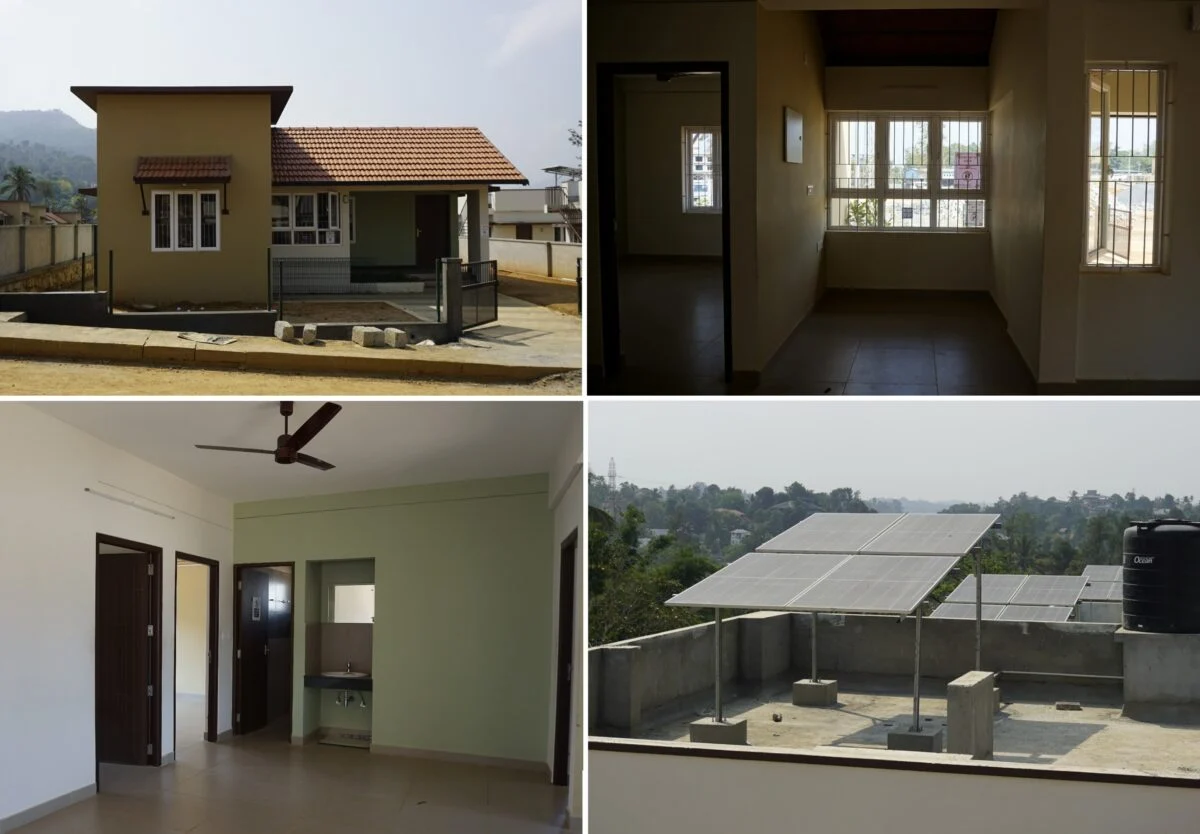
KALPETTA, Wyanad — Nearly two years have passed since the mountainside above the Punnapuzha river gave way, yet for Bushara Mujeeb, the roar of the earth remains a persistent echo. In the early hours of July 30, 2024, a catastrophic cascade of rocks, slurry, and debris decimated the wards of Chooralmala, Punchirimattam, and Mundakkai. Bushara lost 24 family members that night. Today, her life is a delicate balancing act of mourning the dead while anchoring the survivors.
"Since the landslide, organizing food, shelter, and clothing has been my biggest preoccupation," Bushara said, speaking from a community center in Kalpetta in April 2026. "We’ve just been living moment to moment, trying to get past that trauma."
However, a glimmer of stability is finally on the horizon. Bushara is among the hundreds of survivors preparing to move into a pioneering township at Elstone Estate—a project designed not just to provide roofs, but to redefine the gold standard for post-disaster rehabilitation in India.

Main Facts: A Disaster of Unprecedented Scale
The 2024 Wayanad landslide remains one of the deadliest geological disasters in Kerala’s history. Triggered by days of relentless, heavy rainfall, the landslide destroyed 1,500 homes and claimed 266 lives. Beyond the human toll, the ecological and economic devastation was profound: 25 hectares of forest were wiped out, and 600 hectares of prime agricultural land—predominantly coffee, tea, and cardamom plantations—were buried under meters of silt and rock.
In response, the then-Left Democratic Front (LDF) government, led by Pinarayi Vijayan, announced an ambitious ₹350-crore rehabilitation project. The centerpiece of this effort is a 64-acre state-of-the-art township located at the defunct Elstone Tea Estate in Kalpetta. Designed to house 410 families who lost everything, the project emphasizes "Build Back Better" (BBB) principles, integrating disaster-resilient engineering with sustainable urban design.
As of April 2026, the project has reached a critical milestone, with over 100 families receiving keys and land titles. However, the transition has not been without hurdles, as a change in state leadership and legal battles over land acquisition have created a complex backdrop for the survivors’ journey home.

Chronology: From Catastrophe to Construction
The path to rehabilitation has been a grueling 21-month marathon, marked by legal scrutiny and administrative shifts.
- July 30, 2024: Massive landslides strike Chooralmala and surrounding areas, necessitating a state-wide emergency response and a massive search-and-rescue operation.
- Late 2024: A scientific committee under the Kerala State Disaster Management Authority (KSDMA) evaluates 31 potential sites for a new township. Elstone Estate is selected for its central location and low vulnerability to future floods or landslides.
- Early 2025: The government invokes the Disaster Management Act to acquire Elstone Estate. The move is challenged in court by the estate’s owners.
- April 11, 2025: The Kerala High Court rules in favor of the government, allowing possession of the land upon payment of compensation.
- April 15, 2025: Construction officially begins under the execution of the Uralungal Labour Contract Cooperative Society (ULCCS).
- Late 2025: A state election leads to the induction of a Congress-led government. The new administration pledges to continue the project without delays.
- April 2026: The first phase of the township is inaugurated. Keys are handed over to the first batch of 100 families.
- October 2026 (Projected): Expected completion of all 410 houses and community infrastructure, including healthcare and waste management centers.
Supporting Data: Engineering Resilience and Sustainability
The Elstone Estate township is a departure from traditional low-cost government housing. Each of the 178 two-bedroom homes completed thus far represents an investment of approximately ₹2.6 million (₹26 lakhs). To put this in perspective, the central government’s flagship housing scheme, PM Awas Yojana, typically provides subsidies of up to ₹1.8 lakh, while reconstruction aid following the 2001 Gujarat earthquake was roughly ₹90,000 per family.
Disaster-Resilient Design
The houses are built to withstand the specific geological challenges of the Western Ghats. Key features include:

- Concrete Sheer Walls: Providing structural rigidity against seismic tremors and high-impact debris flows.
- Reinforced Framing: Wide plinth beams and integrated framing structures ensure the buildings remain stable even if the soil shifts.
- Solar Integration: Each unit is equipped with rooftop solar panels, ensuring energy self-sufficiency for the community.
Urban Planning and Community
The township employs a "shared street" approach. Rather than traditional grids, houses are grouped into blocks that face communal gardens and parks. This design, conceptualized by Think Land consultancy, aims to facilitate social interaction—a critical component in healing the fractured sense of community inherent in disaster survivors.
The project is also seeking certification from the Indian Green Buildings Council (IGBC). If successful, it will be India’s first housing colony for disaster victims to meet international sustainability standards, featuring an integrated sewage treatment plant (STP) and a dedicated material recovery facility for waste management.
Official Responses: Navigating Political Transitions
The project’s progress has been a focal point of political discourse in Kerala. While the LDF government laid the groundwork, the current Congress-led administration has taken the mantle of completion.

Agriculture Minister and Wayanad MLA T. Siddique recently convened a sub-committee to oversee the final stages of the township. Addressing concerns over potential delays following the change in government, Siddique told the press: "We will clearly define, step by step, everything that needs to be done. No delays will happen. So many delays have already happened; no further delays will be tolerated."
The administrative challenge lies in managing the 232 houses still under construction while ensuring the first 178 families can integrate into their new environment. Chief Operating Officer Arun J.O. emphasized that the government’s goal is to avoid the "ghettoization" seen in previous Indian relocation projects, such as those following the 2005 tsunami in Chennai, where survivors were moved to low-lying, isolated peripheries.
"Throughout our consultations, the survivors expressed a desire to live together as a community," Arun noted. "We are establishing a new gold standard for rehabilitation."

Implications: The Long Road to Socio-Economic Recovery
While the township is a marvel of engineering, the human implications of the relocation are multifaceted.
The Psychological Toll
Research indicates that prolonged displacement compounds the risk of Post-Traumatic Stress Disorder (PTSD), depression, and anxiety. For many in Wayanad, the two-year wait in rented accommodation—often far from their original social circles—has been a period of "limbo." Bushara Mujeeb notes that her mother continues to struggle with deep depression. The hope is that the communal design of the Elstone township will act as a form of social therapy.
The Livelihood Gap
One of the most significant challenges remains the loss of income. The landslide wiped out tea and coffee plantations that provided steady work for generations. While the township is centrally located in Kalpetta to provide access to commercial activity, many survivors are elderly or injured and cannot easily transition to new sectors.

K.G. Mohammed, a 48-year-old survivor now living in an alternative housing project built by the Indian Union Muslim League (IUML), highlights this struggle. Mohammed fractured his leg while fleeing the landslide, an injury that has never fully healed. "We are grateful for the house, but the next worry is stable employment," he said. "I’ve not been able to work in our seafood business due to my injury."
The "Glitz" of Rehabilitation
Interestingly, the township has become an accidental tourist attraction. Its "state-of-the-art" reputation draws visitors from across Kerala, curious to see the expensive, self-sustaining colony. Tour guides in Wayanad have even included the Elstone Estate in their circuit packages. While this speaks to the project’s success as a landmark, it creates a strange dynamic for residents who are still processing their trauma under the gaze of curious onlookers.
A Model for the Future?
The Wayanad township serves as a critical case study for India’s disaster management strategy. By moving away from "disaster management" (reactive) toward "disaster mitigation" (proactive and resilient), Kerala is attempting to break the cycle of recurring loss in high-risk zones.

However, the "buffer zone" dilemma remains. Survivors like Vinita Keyan, who lives just outside the designated landslide buffer zone, remain in their original homes, ineligible for relocation but living in constant fear. Her situation underscores the difficulty of drawing hard lines in a landscape where climate change is making weather patterns increasingly unpredictable.
Conclusion
As Bushara Mujeeb prepares to move into her new home, she represents the resilience of a community that has lost nearly everything. The Elstone Estate township is more than a collection of concrete sheer walls and solar panels; it is an experiment in whether a government can truly "rebuild" a life.
For the 410 families of Wayanad, the project offers stability, but it cannot offer closure. The October 2026 completion date will mark the end of a construction project, but for the survivors, the journey of reclaiming their sense of peace in a changing climate is only just beginning. The success of this township will ultimately be measured not by the IGBC certification on its walls, but by whether the "shared streets" can truly mend the hearts of those who walk them.
