

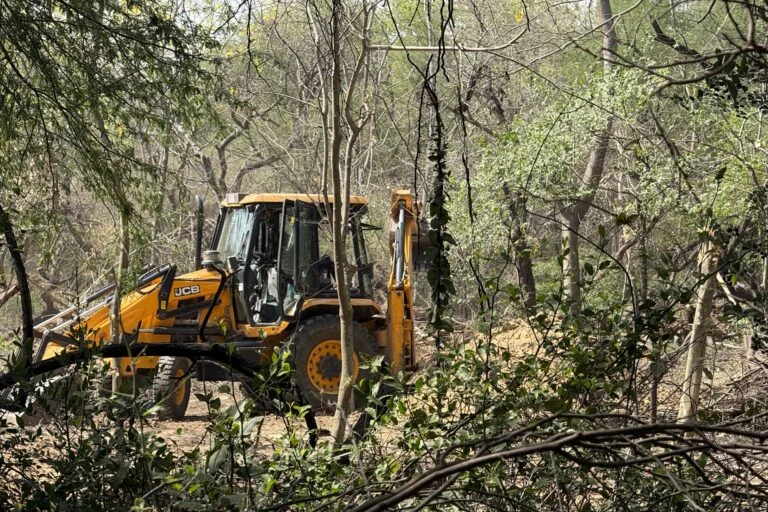
NEW DELHI – Spanning over 850 hectares in the heart of one of the world’s most polluted megacities, Delhi’s Central Ridge is often described as the capital’s "green lungs." A rugged remnant of the ancient Aravalli Range, this landscape is a complex mosaic of forest and open savannah. However, for over a century, this ecological treasure has been the site of a slow-motion environmental crisis—one born of colonial-era mismanagement and exacerbated by modern, heavy-handed restoration attempts.
Today, the Ridge stands at a precarious crossroads. While the Delhi government and forest authorities have embarked on an ambitious decade-long plan to rid the area of invasive species, ecologists warn that the "cure"—involving heavy machinery and rapid land clearing—may be causing more damage to the fragile ecosystem than the invasive plants themselves.
Main Facts: An Ecosystem Under Siege
The Central Ridge is not merely a collection of trees; it is a vital ecological buffer that regulates local temperatures, recharges groundwater, and provides a sanctuary for native flora and fauna. Yet, its current state is a shadow of its former self.
The Invasive Dominance
The primary antagonist in this ecological drama is Neltuma juliflora (formerly Prosopis juliflora), locally known as Vilayati Keekar. Introduced by British planners in the early 20th century to provide a quick green cover for the burgeoning capital, this South American native has proven too successful. It is an aggressive colonizer that outcompetes native species for water and nutrients.
![Delhi witnesses a travesty of ecological restoration [Commentary]](https://imgs.mongabay.com/wp-content/uploads/sites/30/2026/07/01141654/2_EarthMovers-1200x800.jpg)
Accompanying the Keekar are other invasive "aliens":
- Gaajar Ghaas (Parthenium hysterophorus): An accidental traveler likely introduced through imported food grains.
- Lantana (Lantana camara): Once an ornamental hedge plant, now a suffocating thicket-former.
- Subabool (Leucaena leucocephala): Introduced for agroforestry, it now edges out native woody plants.
The Restoration Conflict
The Delhi Forest Department’s latest "Working Plan" (2026-27 to 2036-37) aims to uproot these invaders. However, the use of earth-moving equipment—bulldozers and excavators—has sparked a heated debate. Critics argue that these mechanised methods destroy the "biocrust" of the soil and kill ancient native shrubs that have survived the Keekar invasion for decades.
Chronology: A Century of Misunderstanding
To understand the current crisis, one must look back at a hundred years of ecological intervention.
1912 – 1930: The Colonial "Green" Vision
As the British moved the capital from Calcutta to Delhi, planners sought to transform the "barren" rocky outcrops of the Ridge into a lush, forested backdrop for the Rashtrapati Bhavan (then Government House). They attempted to plant various species, but most failed in the harsh, semi-arid conditions of the Aravallis. Vilayati Keekar was the only species that thrived, leading to mass plantations across the Ridge.
![Delhi witnesses a travesty of ecological restoration [Commentary]](https://imgs.mongabay.com/wp-content/uploads/sites/30/2026/07/01145626/4_Undisturbed-768x512.jpg)
1963: The First Warning Signs
By the time botanist J.K. Maheshwari published The Flora of Delhi in 1963, the ecological shift was already evident. He noted that the aggressive spread of Keekar was driving native species, such as Hibiscus surattensis, to local extinction. The Ridge was no longer an Aravalli scrubland; it was becoming a monoculture.
1970s – 1980s: The Ornamental Invasion
During these decades, further invasive species like Lantana were introduced to the city’s gardens and road dividers. Aided by birds that ate their fruit and dispersed the seeds, these plants migrated into the Ridge, creating dense, impenetrable thickets that altered the light and soil chemistry of the forest floor.
2010s: The Failed "Strangulation" Experiment
A decade ago, an attempt was made to kill Keekar trees by "strangling" them with lianas (climbing vines). Unfortunately, the project used non-native climbers like Bougainvillea and Rangoon Creeper. Not only did the Keekar survive through vigorous coppicing (regrowing from the stump), but the native understory was cleared to make room for the vines, causing significant collateral damage.
2024 – Present: The Mechanized Push
The current administration has shifted toward physical removal. While the plan calls for a "phased" approach, the reality on the ground involves heavy machinery clearing large swathes of land, leading to the current outcry from the scientific community.
![Delhi witnesses a travesty of ecological restoration [Commentary]](https://imgs.mongabay.com/wp-content/uploads/sites/30/2026/07/01145254/Parthenium_hysterophorus-768x512.jpg)
Supporting Data: The Hidden Cost of Machinery
The ecological impact of using heavy machinery on the Ridge cannot be overstated. According to plant ecologists like Ankila Hiremath, the damage occurs at both the surface and the microscopic level.
1. Destruction of Biocrusts
Arid and semi-arid soils are covered by a "biocrust"—a thin, living layer composed of lichens, cyanobacteria, mosses, and specialized grasses like Oropetium.
- Function: This "skin" binds the soil together, prevents erosion, traps moisture, and fixes nitrogen.
- Recovery Time: Biocrusts can take decades to form.
- The Data: Mechanised excavation destroys this layer instantly, making the soil vulnerable to erosion and reducing the success rate of any new native saplings planted in the area.
2. Soil Compaction and Groundwater
The Ridge serves as a primary recharge zone for Delhi’s depleting water table. The heavy weight of earth-movers compacts the soil, closing the fissures and cracks in the underlying Aravalli rock. This reduces the rate of rainwater infiltration, meaning more runoff and less groundwater replenishment for a city already facing a water crisis.
3. Loss of "Mother" Shrubs
While the focus is on removing Keekar trees, the machinery is also clearing native shrubs like Heens (Capparis sepiaria), Gangeti (Grewia tenax), and Kair (Capparis decidua).
![Delhi witnesses a travesty of ecological restoration [Commentary]](https://imgs.mongabay.com/wp-content/uploads/sites/30/2026/07/01150258/1_GroundCleared-768x512.jpg)
- These shrubs are often decades old and represent the last remaining genetic reservoir of the original Aravalli flora.
- They provide critical breeding grounds for wildlife; for instance, the Pioneer butterfly relies exclusively on the Heens plant to lay its eggs.
Official Responses: The Policy Perspective
The Forest Department of the National Capital Territory (NCT) maintains that the current plan is the most viable way to meet ambitious greening targets.
The Forest Department’s Rationale
Officials argue that manual removal of Vilayati Keekar is too slow and labor-intensive given the sheer scale of the invasion (850 hectares). They contend that to see a "Native Aravalli" forest within the next two decades, aggressive intervention is necessary. The 2026-2037 Working Plan emphasizes:
- Phased Removal: Clearing sections of the Ridge over time to allow for gradual transition.
- Native Reintroduction: Planting species like Dhok (Terminalia pendula) to recreate the original canopy.
- Ecological Reference: Using sites like Mangar Bani—a sacred grove in the nearby Haryana Aravallis—as a blueprint for what the Ridge should look like.
The Scientific Rebuttal
Ecologists argue that "phased removal" is being ignored in practice in favor of speed. They advocate for "patient, humble tinkering"—targeted manual removal that protects the existing native understory. They point to successful models like the Rao Jodha Desert Rock Park in Jodhpur, where invasive species were removed carefully over years, allowing the native landscape to heal without the use of heavy tractors.
Implications: The Future of Delhi’s Climate Resilience
The stakes for the Central Ridge extend far beyond the survival of a few plant species. As Delhi faces increasingly severe heatwaves and erratic monsoon patterns, the health of the Ridge is a matter of public safety.
![Delhi witnesses a travesty of ecological restoration [Commentary]](https://imgs.mongabay.com/wp-content/uploads/sites/30/2026/07/01150427/3a_PioneerEggsOnHeens-768x512.jpg)
The Risk of "Green Desertification"
If the restoration is botched—resulting in compacted soil and the loss of biocrusts—the Ridge could become a "green desert." Even if new native trees are planted, they may struggle to survive in the degraded soil, leading to a landscape that looks green on a map but fails to provide the cooling and water-retention services of a functional ecosystem.
A Call for Ecological Humility
The history of the Ridge is a cautionary tale of "hubris." The British thought they could "improve" the landscape with foreign trees; the 2010s planners thought they could "strangle" nature into submission. The current danger is the belief that industrial speed can fix a century of ecological decline.
The Path Forward
For the Central Ridge to truly thrive, restoration experts suggest:
- Halting Mechanized Clearing: Moving back to manual or semi-manual removal to protect soil integrity.
- Continuous Monitoring: Ensuring that cleared areas aren’t immediately recolonized by Parthenium or Lantana.
- Community and Scientific Oversight: Creating a transparent monitoring body to ensure the "Working Plan" is followed as intended, not just as a clearing exercise.
In the words of ecologists Ankila Hiremath and Vikram Iyer, "Ecosystems can take much longer than decades to develop the complex inter-linkages that constitute functioning systems." The Central Ridge took a century to degrade; the city must now find the patience to restore it correctly, or risk losing this ancient Aravalli heritage forever.
