In an era defined by pervasive media saturation, the ancient philosophical insight that our external environments profoundly shape our internal worlds has never been more relevant. From the subtle cues of social media feeds to the carefully curated narratives presented by institutions, what we repeatedly see, hear, and experience is not merely informing us; it is actively constructing our understanding of reality, influencing our reasoning, and ultimately, defining who we become.
Introduction: The Unseen Architects of Self
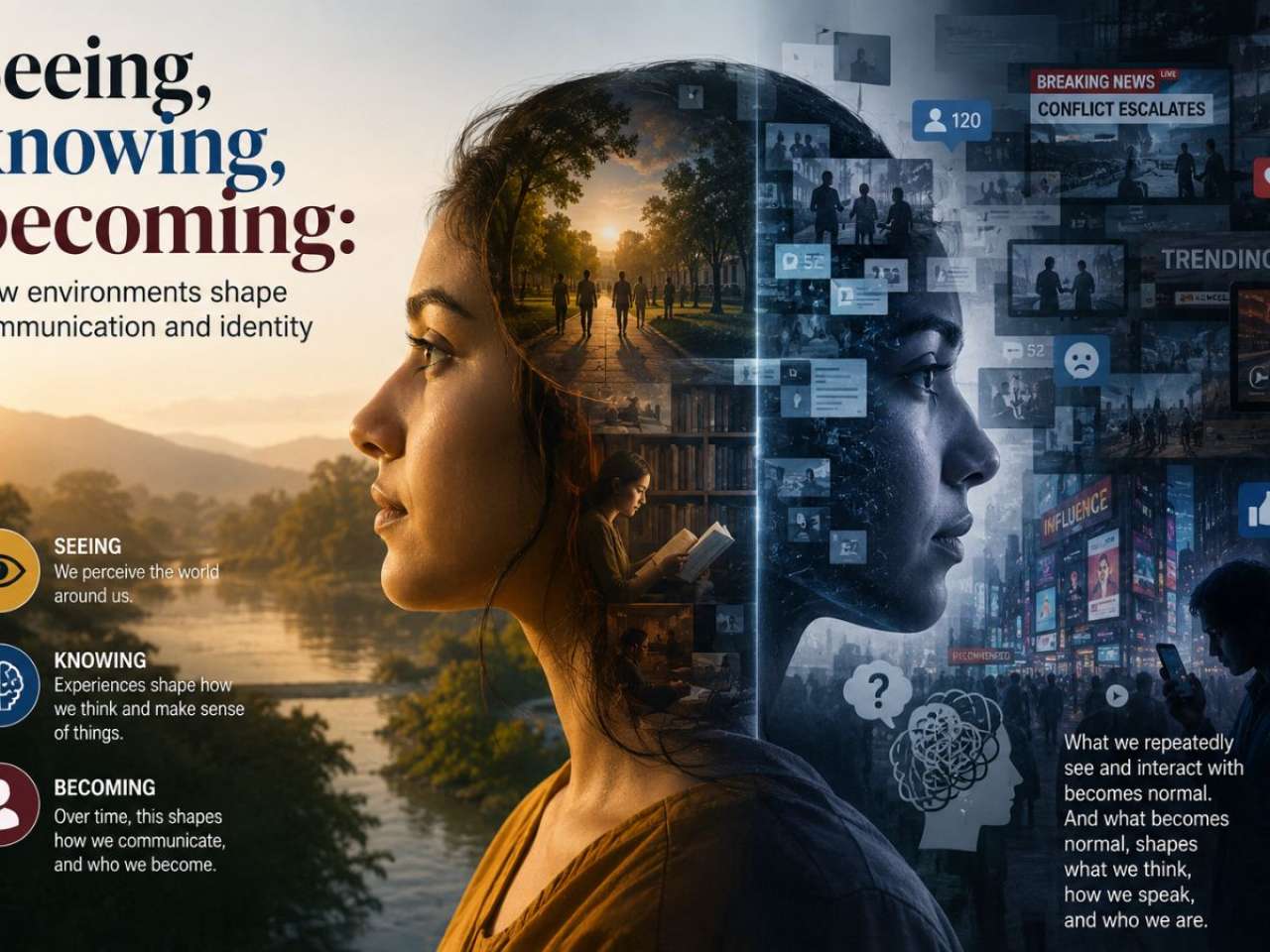
For centuries, Western thought has often posited identity as an intrinsic, self-generated construct, and communication as a direct outpouring of pre-existing thoughts. However, a deeper examination, echoed in both ancient philosophical traditions and modern psychological research, reveals a far more nuanced reality. Our sense of self, our communication patterns, and our very ways of thinking are not forged in a vacuum. Instead, they are continuously molded, often unconsciously, by the environments we inhabit. In today’s hyper-connected world, where digital landscapes and curated content dominate our sensory input, this environmental influence has been amplified to an unprecedented degree, raising critical questions about agency, perception, and the very nature of individuality.
This article delves into the profound connection between our surroundings and our internal states, exploring how consistent exposure to certain stimuli shapes our beliefs, our language, and our identities. Drawing upon foundational principles from classical Indian philosophy, we will examine how perception forms the bedrock of knowledge and how repeated impressions solidify into ingrained patterns of thought and behavior. We will then transpose these insights to the contemporary context, analyzing the impact of the modern media environment, the standardization of language, the formation of opinions, and the implications for educational and communicative institutions. Ultimately, we aim to foster a greater awareness of these shaping forces and encourage a more deliberate approach to constructing environments that nurture critical thinking and authentic self-expression.

H2: Ancient Wisdom in a Modern World: The Philosophical Roots of Environmental Influence
The notion that our external experiences are fundamental to our internal development is not a new one. It is a concept deeply embedded in ancient philosophical traditions, offering a timeless perspective on the human condition.

H3: The Nyaya Sutra: Perception as the Genesis of Knowledge
The classical Indian philosophical tradition, particularly the Nyaya school, provides a rigorous framework for understanding how we acquire knowledge. The Nyaya Sutra, a seminal text in logic and epistemology, identifies pratyaksha (perception) as the primary and most reliable source of valid knowledge. This principle underscores a fundamental truth: our initial understanding of the world begins with the direct contact between our senses and the external reality. What we see, what we hear, what we touch, and what we experience forms the raw material upon which all subsequent cognitive processes are built.
The sequence is elegantly simple yet profoundly impactful: stimulus precedes cognition, and cognition informs articulation. The external world, through sensory input, provides the initial "data." This data is then processed by our minds, leading to understanding and judgment. Finally, this internal understanding is translated into external expression – our communication. This highlights that communication is not merely an act of projecting pre-formed thoughts, but rather the culmination of a process deeply influenced by what we have perceived.

H3: The Yoga Sutra: Impressions, Tendencies, and the Accumulation of Identity
Extending this insight into the realm of mental formation, the Yoga Sutra offers further depth. Patanjali’s seminal work defines the mind (chitta) as a dynamic entity characterized by vrittis – fluctuations or thought waves. The famous aphorism, "yogahchittavrittinirodhah" (Yoga Sutra 1.2), states that the cessation of these fluctuations is yoga. These vrittis, or mental modifications, are not spontaneous but arise from samskaras – deep-seated impressions formed through sensory engagement and cumulative experience.
The Yoga Sutra posits that repeated exposure to certain stimuli leaves increasingly profound imprints on the mind. Over time, these samskaras develop into ingrained tendencies, preferences, and habitual patterns of response. This perspective radically reframes our understanding of identity. Instead of being a fixed, inherent essence, identity, in this view, is something that is accumulated through a continuous process of interaction with the environment. Our preferences, our reactions, and our self-perceptions are, to a significant extent, the product of what we have consistently encountered.

H2: The Amplification Effect: Contemporary Media and the Intensified Shaping of Self
While the philosophical underpinnings of environmental influence are ancient, their manifestation in the contemporary world has been dramatically amplified. The digital revolution and the proliferation of media have created an unprecedented level of constant, curated, and often unexamined exposure.

H3: The Ubiquitous Stimulus: Navigating the Digital Landscape
Modern individuals exist within environments saturated with stimuli. Digital platforms, social media feeds, algorithmically curated content, and ceaseless streams of information bombard our senses daily. These environments are far from neutral. They are designed to capture attention, promote engagement, and often, to subtly guide our perceptions and preferences.
Algorithms, in particular, play a crucial role in shaping our exposure. By prioritizing content that aligns with our past interactions, they create personalized "echo chambers" that can reinforce existing beliefs and limit exposure to diverse perspectives. This constant, often passive, consumption of information can lead to a subtle but powerful reshaping of our cognitive frameworks and our understanding of the world.

H3: The Standardization of Language and the Birth of New Identities
One of the most visible impacts of this pervasive media environment is the increasing standardization of language. Words, phrases, and expressions circulate rapidly across digital platforms, acquiring shared meanings and becoming signals of belonging within specific online communities. What might have once been a descriptive term or a casual preference can, through repeated exposure and association, morph into a powerful marker of self-definition.
For example, terms that once denoted a specific hobby or interest can now function as foundational elements of identity. This shift is not accidental. It reflects the potent influence of repeated exposure to particular linguistic patterns, which, over time, begin to feel natural, expected, and even necessary for full participation in certain social or cultural spheres. Communication, in this context, becomes not just an expression of self but also a tool for constructing and signaling that self.

H3: The Narrowing of Perception and the Contraction of Thought
The Nyaya emphasis on perception as the starting point of knowledge offers a critical lens through which to view the impact of curated media environments on our reasoning abilities. When the range of what we are exposed to—what we perceive—narrows, the capacity for critical thought and nuanced reasoning can also contract.
Consider the effect of consuming information from a limited set of sources or perspectives. This can create an illusion of consensus, leading individuals to believe that a particular viewpoint is more widely held or more valid than it actually is. Constant engagement with specific narratives can shape what is considered credible or legitimate, potentially marginalizing alternative viewpoints and hindering the development of a well-rounded understanding of complex issues. In essence, thought processes begin to follow the contours of our exposure.

H3: The Deepening Imprint: Samskaras in the Digital Age
The Yoga Sutra’s concept of samskaras is particularly relevant in understanding the lasting impact of our digital interactions. Repetition is the key to deepening these impressions. A single exposure might offer information, but sustained exposure, especially to emotionally charged or ideologically consistent content, forms deeply ingrained patterns.
These patterns manifest as cognitive and emotional residues that influence our behavior, our decision-making, and our overall outlook. Preferences that may have initially been shaped by external factors can begin to feel intrinsic and self-generated. Our identity can appear stable and unchanging, even as it is continuously being subtly reshaped by the constant stream of information we consume. This creates a feedback loop where our perceived identity then influences the content we seek out, further solidifying the established patterns.

H2: Implications for Institutions: Architects of Our Cognitive Environments
The profound influence of environments on thought and expression places a significant responsibility on institutions, particularly those involved in education and communication. If our cognitive landscapes are sculpted by what is made visible, emphasized, and repeated, then the design and curation of these environments become paramount.

H3: Education: Beyond Content Delivery to Cultivating Communicative Ecosystems
Higher education institutions, while often excelling in content delivery and skill development, can sometimes overlook the crucial role of the communicative environment within which learning takes place. If exposure fundamentally shapes cognition, then the quality of discourse, the diversity of perspectives, and the nature of intellectual engagement become central to the educational process.
Creating an environment that encourages open dialogue, respectful debate, and exposure to a wide spectrum of ideas is not merely an add-on; it is foundational to fostering critical thinking and intellectual growth. Institutions must consider how their physical and digital spaces, their pedagogical approaches, and their institutional culture contribute to the formation of their students’ minds and identities.

H3: Media and Public Communication: The Peril of Simplification
The media landscape, driven by the need for accessibility and engagement, often favors the compression of information into short, easily digestible formats. While this can enhance reach, it carries the significant risk of reducing complexity and nuance. When exposure is limited to simplified representations, the capacity for deep, analytical thought can diminish.
Communication becomes efficient, perhaps even entertaining, but not necessarily substantive. The challenge for media and public communicators is to find ways to convey information effectively without sacrificing depth, to encourage critical engagement rather than passive consumption, and to present a diverse range of perspectives that reflect the complexity of the real world.

H2: Towards Conscious Cultivation: Embracing Awareness and Deliberate Design
The central challenge is not to eliminate influence altogether—an impossible and perhaps undesirable feat—but to cultivate a profound awareness of its mechanisms. Recognizing that what we repeatedly encounter shapes what we think, and what we think ultimately shapes what we say, is the first step towards reclaiming agency.

In an age where our environments are increasingly mediated and curated, this awareness is not just beneficial; it is essential for maintaining intellectual autonomy and authentic selfhood. Communication and identity do not emerge in a vacuum. They are forged at the dynamic intersection of exposure, interpretation, and repetition.
The crucial question is not whether we are influenced by what surrounds us, but rather how we engage with that influence. Are we passive recipients, or are we active participants in shaping the environments that, in turn, shape us? By fostering a deliberate and critical approach to our exposure, we can move beyond being mere products of our surroundings to becoming conscious architects of our own minds, our own communication, and our own identities. This journey requires a commitment to seeking out diverse perspectives, questioning dominant narratives, and actively cultivating environments that foster intellectual curiosity, critical inquiry, and a rich, multifaceted understanding of ourselves and the world.