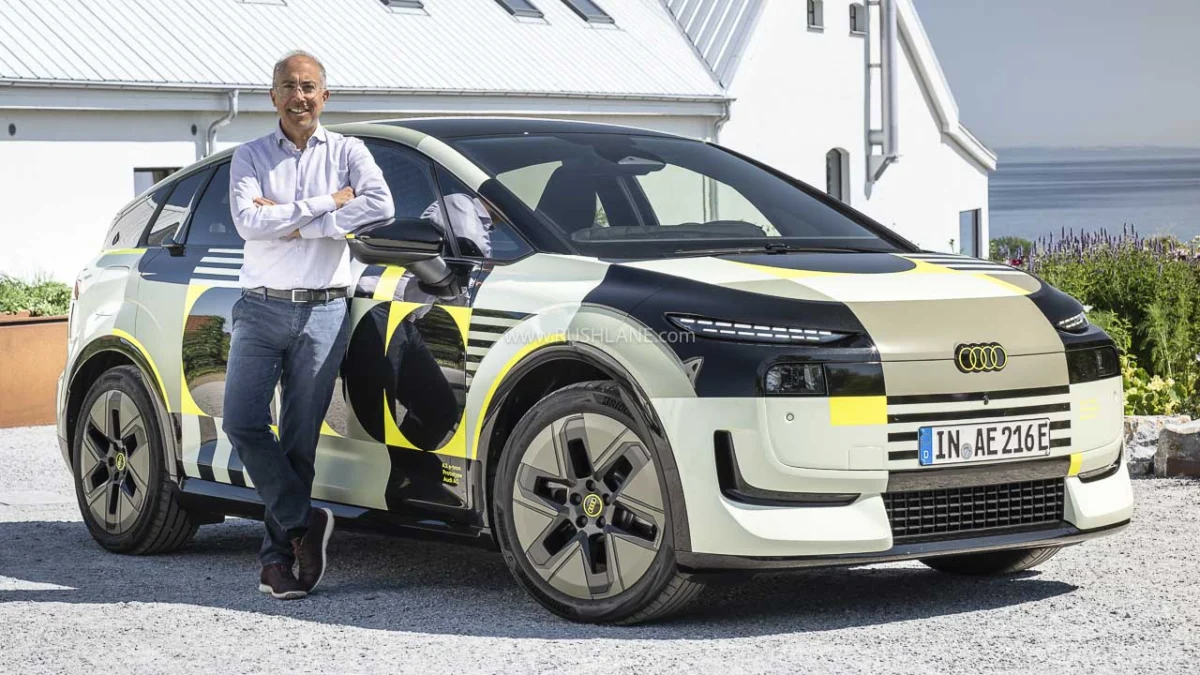
INGOLSTADT, GERMANY – In an era where electric vehicle manufacturers have largely prioritized battery size and raw range to combat "range anxiety," Audi is pivoting back to its roots of engineering-led minimalism. The German luxury automaker has officially pulled back the curtain on the technical specifications of the upcoming Audi A2 e-tron, a vehicle destined to become the brand’s most affordable electric offering and, more significantly, the most efficient model in its history.
Scheduled for a global debut in the autumn of 2026, the A2 e-tron is more than just a new entry-level hatchback; it is a spiritual successor to the visionary, albeit misunderstood, original A2 of the late 1990s. With a preliminary WLTP energy consumption rating of just 12.8 kWh/100 km when equipped with its specialized Efficiency Package, Audi is setting a new industry benchmark for how much work a single kilowatt-hour can perform.
Main Facts: The Blueprint of Modern Efficiency
The Audi A2 e-tron represents a strategic shift for the Four Rings. Positioned below the Q4 e-tron and the upcoming A3 e-tron, the A2 e-tron utilizes a rear-wheel-drive architecture designed to maximize cabin space within a compact footprint.
Key specifications confirmed by Audi include:
Powertrain: A rear-mounted APP350 permanent magnet synchronous motor producing 140 kW (190 hp).
Battery Technology: A 61 kWh Lithium Iron Phosphate (LFP) battery pack with a usable capacity of 58 kWh.
Efficiency Benchmark: 12.8 kWh/100 km (WLTP) with the optional Efficiency Package.
Aerodynamics: A drag coefficient ($C_d$) of 0.24, the lowest in Audi’s compact segment.
Charging Capabilities: Support for 800V-adjacent efficiencies (though specifics on peak kW are pending) and bidirectional charging (V2L and V2H).
Market Launch: Global debut in Autumn 2026, with sales commencing in late 2026/early 2027.
By focusing on a smaller, more sustainable battery chemistry (LFP) and extreme aerodynamic optimization, Audi aims to deliver a "real-world" range that rivals competitors with much larger, heavier, and more expensive battery packs.
Chronology: From Aluminum Pioneer to Electric Icon
The path to the A2 e-tron is rooted in a legacy of daring engineering that began over a quarter-century ago.
1999–2005: The Original Visionary
The original Audi A2 was a marvel of its time. Utilizing the Audi Space Frame (ASF) all-aluminum construction, it was incredibly light and aerodynamic. The "3-liter" version of the A2 was famously capable of consuming only 3 liters of diesel per 100 kilometers. However, high production costs and a design that was perhaps "too far ahead of its time" led to its discontinuation in 2005.
2021–2024: The Rumors and the Pivot
As the Volkswagen Group began its aggressive push into electrification via the MEB platform, rumors circulated about an "ID.2" equivalent for Audi. In late 2023, Audi leadership confirmed that an entry-level EV was a priority to replace the aging A1 and A3 combustion models.
August 2024: Technical Revelation
Audi released the first comprehensive technical dossier and camouflaged prototype images of the A2 e-tron. This announcement shifted the narrative from "if" the A2 would return to "how" it would redefine efficiency.
2026 and Beyond: The Global Stage
The A2 e-tron is slated for its world premiere in Autumn 2026. Following the debut, production is expected to ramp up at one of Audi’s European facilities, with a phased rollout starting in Germany, Austria, and Switzerland before expanding globally.
Supporting Data: The Engineering Behind the 12.8 kWh Figure
Achieving a consumption rate of 12.8 kWh/100 km is not the result of a single "silver bullet" technology but rather a "marginal gains" approach across four critical pillars: Aerodynamics, Drivetrain, Battery Chemistry, and Thermal Management.
1. Aerodynamics: Sculpting the Wind
The A2 e-tron’s silhouette is a modern homage to the original’s "teardrop" shape. With a $C_d$ of 0.24, it slices through the air with minimal resistance.
Active Cooling Intake: A shutter system behind the front grille remains closed to smooth airflow. It only opens when sensors detect a need for battery cooling during rapid charging or high-stress driving.
Air Curtains and Underbody: The front bumper features integrated ducts that channel air around the front wheels, reducing turbulence. Meanwhile, a fully enclosed, flat underbody prevents "drag-inducing" air pockets beneath the chassis.
Efficiency Package Gains: Audi notes that these aerodynamic refinements alone account for a reduction of 0.9 kWh/100 km compared to the standard trim.
2. Drivetrain Optimization: Silicon Carbide and Thinner Laminations
The APP350 motor is approximately 10% more efficient than previous units found in the early e-tron models.
Semiconductors: The power electronics utilize Silicon Carbide (SiC) semiconductors. SiC chips lose significantly less energy as heat during the switching process, especially under partial load (typical city/suburban driving).
Magnetic Losses: The motor’s rotor and stator use thinner steel laminations to reduce eddy current losses.
Transmission: A revised single-speed gearbox uses lower-friction oil and a taller 10.2:1 gear ratio, optimized to keep the motor in its most efficient RPM band during highway cruising.
3. Battery Chemistry: The LFP Advantage
The 61 kWh battery marks a departure from the Nickel Manganese Cobalt (NMC) chemistry used in higher-end e-trons.
Cell-to-Pack (CTP): By eliminating traditional modules and integrating cells directly into the housing, Audi has improved energy density by volume and reduced weight.
Durability: LFP batteries are inherently more stable. This allows owners to charge to 100% daily without the accelerated degradation typical of NMC batteries, effectively making more of the battery "usable" for daily commuting.
4. Bidirectional Capability: The Car as a Grid Asset
The A2 e-tron will debut with advanced Vehicle-to-Home (V2H) and Vehicle-to-Load (V2L) capabilities.
V2L: Offers a 2.3 kW output, enough to power camping equipment, power tools, or laptops.
V2H: In markets like Germany, the A2 e-tron can act as a buffer for home solar systems, discharging stored energy back into the house during peak tariff hours, further increasing the "ecosystem efficiency" of the vehicle.
Official Responses: A Vision for Sustainable Premium Mobility
Audi’s leadership has been vocal about the A2 e-tron’s role in the company’s "Vorsprung durch Technik" (Progress through Technology) mantra.
Gernot Döllner, CEO of Audi, emphasized the philosophical connection to the original A2:
"The new A2 e-tron continues the vision of the original A2—combining outstanding efficiency with everyday practicality. We are not interested in a ‘range war’ fueled by oversized batteries. We are interested in an efficiency war. By reducing consumption to 12.8 kWh, we provide the customer with more usable range per charge while using fewer raw materials."
Audi’s engineering team also highlighted that the A2 e-tron is a critical component of the company’s goal to be carbon-neutral by 2050. By focusing on LFP chemistry, which avoids the use of cobalt and nickel, Audi is addressing the ethical and environmental concerns of the supply chain in the entry-level premium segment.
Implications: A Paradigm Shift for the EV Market
The arrival of the Audi A2 e-tron carries significant implications for the automotive industry and the consumer landscape.
1. Challenging the "Bigger is Better" Narrative
For the last decade, the EV market has been dominated by the pursuit of 400+ mile ranges, necessitating heavy 100+ kWh batteries. The A2 e-tron proves that through superior aerodynamics and drivetrain engineering, a modest 61 kWh battery can provide ample range for most consumers. This reduces the vehicle’s weight, improves handling, and lowers the environmental footprint of production.
2. Market Positioning and Competition
The A2 e-tron will enter a burgeoning "compact premium" EV space. It will face stiff competition from the production version of the Volkswagen ID.2all, the Renault 5 E-Tech, and rumored entry-level models from Tesla and BMW. Audi’s "efficiency-first" branding allows it to maintain a premium price point by offering lower "fueling" costs and higher technological sophistication than mass-market rivals.
3. Urban Infrastructure and Charging
With a high wallbox charging efficiency of 89.6%, the A2 e-tron is designed for the European urbanite who may rely on home or curbside charging. High efficiency means the car gains more miles per hour of charging, reducing the time spent tethered to a cable—a crucial factor for those without high-speed DC fast chargers at home.
4. A Template for Future Audis
The technologies debuting in the A2 e-tron—specifically the SiC semiconductors and CTP battery construction—will likely trickle up to the A4 e-tron and A6 e-tron models. The A2 serves as a high-volume laboratory for Audi’s most advanced efficiency hardware.
Conclusion
The Audi A2 e-tron is a calculated gamble that the market is ready to move past "range anxiety" and into an era of "efficiency awareness." By resurrecting a nameplate synonymous with innovation and applying the full weight of modern electrical engineering, Audi is positioning itself not just as a manufacturer of luxury cars, but as a leader in the sustainable use of energy. When it hits the streets in 2026, the A2 e-tron will likely be remembered as the car that proved that in the electric age, less is truly more.