


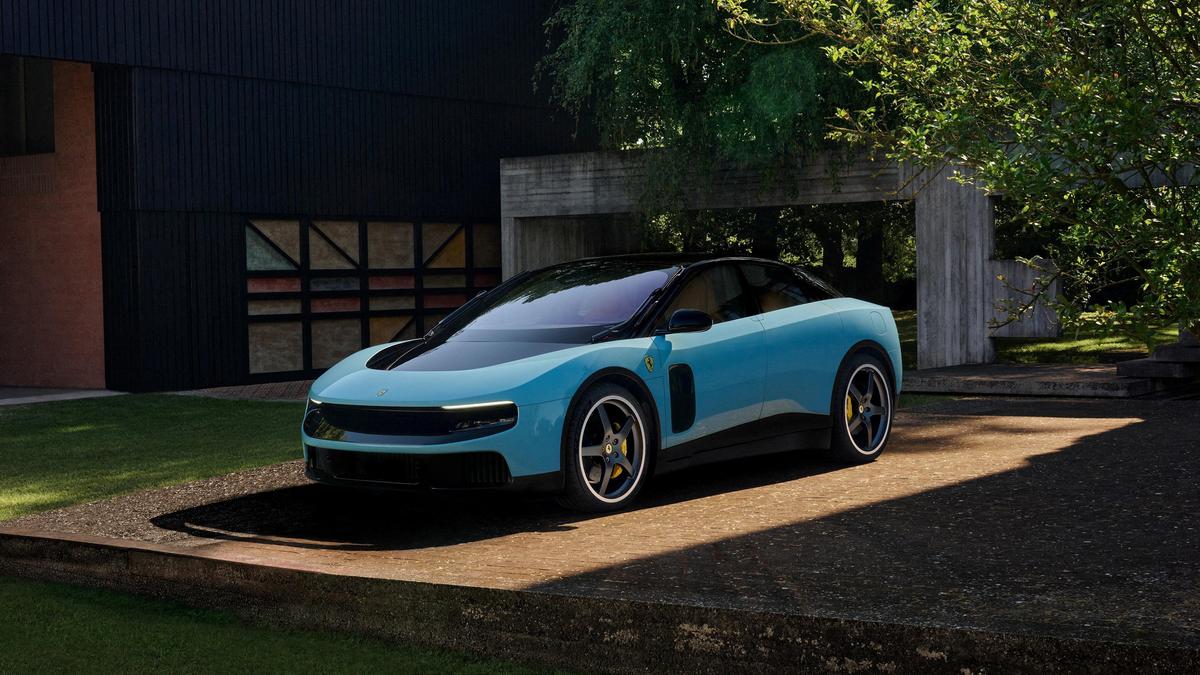
MARANELLO, ITALY — In a move that signals the definitive end of the internal combustion engine’s undisputed reign over the high-performance luxury sector, Ferrari has officially pulled the silk off its first fully electric vehicle (EV). Named the Luce—Italian for "Light"—the vehicle represents the most significant pivot in the company’s 79-year history.
Unveiled late Monday at the company’s newly inaugurated "e-building" in Maranello, the Luce is not merely a battery-powered supercar; it is a bold, four-door, five-seater statement of intent. As the automotive world grapples with a cooling global demand for electric vehicles, Ferrari’s entry into the space is being viewed by analysts as a litmus test for whether "soul" and "sound" can be successfully translated into the digital age.
I. Main Facts: Redefining the Prancing Horse
The Ferrari Luce arrives with specifications that challenge the traditional physics of the Italian marque. While Ferrari has long been synonymous with lightweight, mid-engine masterpieces, the Luce embraces a different set of superlatives.
Performance and Powertrain
The Luce is powered by a massive 122 kWh battery pack, integrated into the chassis to lower the center of gravity. This power plant drives a tri-motor setup—one on the front axle and two on the rear—delivering instantaneous torque. The results are staggering:
- 0-100 kph (0-62 mph): 2.5 seconds.
- Top Speed: In excess of 310 kilometres per hour (193 mph).
- Range: Over 530 kilometres (330 miles) on a single charge (WLTP cycle).
Architecture and Design
In a radical departure from the low-slung silhouettes of the 296 GTB or the SF90, the Luce is only the second four-door model in Ferrari’s history, following the Purosangue. Crucially, it is the brand’s first-ever five-seater.
The most controversial figure, however, is its weight. Tipping the scales at 2.26 tonnes (approx. 4,982 lbs), the Luce is the heaviest Ferrari ever produced. This weight is primarily a byproduct of the high-capacity battery required to maintain high-speed performance over long distances. To compensate, Ferrari engineers have deployed advanced active aerodynamics and a sophisticated "Side Slip Control" system specifically tuned for the instant torque of electric motors.
II. Chronology: The Road to Electrification
The path to the Luce has been a decade-long journey of cautious experimentation and strategic infrastructure investment.
- 2013: The Hybrid Prelude. Ferrari introduced the LaFerrari, its first mild-hybrid, proving that electric assistance could enhance performance rather than just fuel economy.
- 2019: The Plug-in Pivot. The launch of the SF90 Stradale marked Ferrari’s first Plug-in Hybrid Electric Vehicle (PHEV), allowing for short bursts of silent, electric-only driving.
- 2022: The "e-building" Groundbreaking. Ferrari began construction on a dedicated facility in Maranello designed specifically for the production of electric motors, battery packs, and power inverters.
- 2024: Strategic Realignment. Amidst a global slowdown in EV adoption, Ferrari adjusted its long-term guidance. While previously aiming for 40% of its lineup to be fully electric by 2030, the company revised this target to 20%, opting for a "multi-energy" approach that keeps internal combustion and hybrids on the menu for longer.
- May 25, 2026: The Unveiling. The Luce is officially revealed to a global audience, marking the culmination of "Project F250E."
III. Supporting Data: Market Context and Engineering Challenges
Ferrari’s entry into the EV market comes at a precarious time for the industry. While the luxury segment has historically been insulated from broader economic downturns, the "electric fatigue" seen in mass-market brands has begun to seep into the high-end sector.
The Weight-to-Power Struggle
The 2.26-tonne weight of the Luce puts it in direct competition with the Porsche Taycan Turbo S and the Lucid Air Sapphire. However, Ferrari’s challenge is unique: its customers buy cars for "driving emotion," a metric often tied to the agility provided by light weight. To combat the 122 kWh battery’s heft, Ferrari has utilized a "carbon-cell" battery housing and a chassis composed of 15 different aluminum alloys.
The 2030 Target Shift
The decision to halve the 2030 EV sales target from 40% to 20% reflects a pragmatic reading of global infrastructure. According to data from the European Automobile Manufacturers’ Association (ACEA), high-speed charging infrastructure in key luxury markets—including parts of Southern Europe and the Middle East—remains insufficient for the high-voltage demands of cars like the Luce. By focusing on a lower volume of high-margin electric cars, Ferrari aims to maintain exclusivity while meeting increasingly stringent EU emissions regulations.
Comparative Landscape
| Feature | Ferrari Luce | Porsche Taycan Turbo S (2025) | Tesla Model S Plaid |
|---|---|---|---|
| Battery Size | 122 kWh | 105 kWh | 100 kWh |
| 0-100 kph | 2.5s | 2.4s | 2.1s |
| Top Speed | 310+ kph | 260 kph | 322 kph |
| Weight | 2,260 kg | 2,295 kg | 2,167 kg |
IV. Official Responses: A Vision for the Future
The leadership at Maranello has been quick to frame the Luce not as a compromise, but as a technological "New Frontier."
John Elkann, President of Ferrari, emphasized the brand’s legacy of disruption during the launch event. "We are inaugurating a chapter that turns our vision into reality," Elkann stated. "The Luce is the embodiment of Ferrari’s tradition of anticipating and shaping the future. We are not just changing the powertrain; we are redefining the luxury experience for a new generation of clients who demand both performance and a conscience."
Benedetto Vigna, Ferrari CEO, addressed the "sound" issue—a point of contention for many Ferrari purists. "A Ferrari must always be a Ferrari," Vigna said in a post-launch press briefing. "Our engineers have worked for years to develop an ‘acoustic signature’ for the Luce that is not a fake engine noise, but a genuine harmonic resonance of the electric motors. It provides the driver with the sensory feedback necessary for a true Maranello experience."
Vigna also defended the vehicle’s weight, noting that the "perceived weight" behind the wheel is significantly lower due to the low-mounted battery and four-wheel steering, which "virtually shortens" the wheelbase during cornering.
V. Implications: The "Luce" Effect on the Automotive Industry
The launch of the Luce carries implications that extend far beyond Ferrari’s balance sheet. It marks a cultural shift in how high-performance luxury is defined.
1. The Death of the "Garage Queen"?
Historically, many Ferraris were kept as low-mileage investments. However, the five-seater, four-door configuration of the Luce suggests Ferrari is chasing a "daily driver" market. By offering a range of 530km, Ferrari is encouraging owners to actually use the car for grand touring, potentially changing the brand’s secondary market dynamics.
2. Environmental and Regulatory Pressure
Despite the "slowdown" in EV demand mentioned in the company’s report, the Luce is a necessary hedge against future bans on internal combustion engines in major cities. London, Paris, and Milan have all proposed "Ultra Low Emission Zones" that could eventually exclude even the most prestigious V12 engines. The Luce ensures that the Prancing Horse remains welcome on the streets of the world’s fashion and financial capitals.
3. The Sound of Silence
The Luce will be the first Ferrari to navigate the streets of Maranello in near-silence. This has sparked a debate among the Tifosi (Ferrari fans). While the performance figures are undeniable, the emotional connection to a high-revving naturally aspirated engine is a core component of Ferrari’s brand equity. If the Luce succeeds in winning over the skeptics, it will pave the way for other boutique manufacturers like McLaren and Pagani to follow suit.
4. Supply Chain and Battery Sovereignty
By producing its own battery modules and motors in the "e-building," Ferrari is attempting to maintain its status as an "engine manufacturer" rather than just a car assembler. This vertical integration is crucial. In the EV era, the "engine" is the software and the battery management system. By keeping this in-house, Ferrari avoids becoming dependent on external suppliers like CATL or BYD, preserving its "Made in Italy" prestige.
Conclusion
The Ferrari Luce is a calculated gamble. It arrives at a time of technological transition and market uncertainty. By blending the utility of a five-seater with the raw acceleration of an electric tri-motor setup, Maranello is attempting to prove that the future of the supercar is not just "Light" in name, but bright in prospect. Whether the Luce can maintain the "soul" of its petrol-powered ancestors remains to be seen, but as of today, the electric era of the Prancing Horse has officially begun.
