

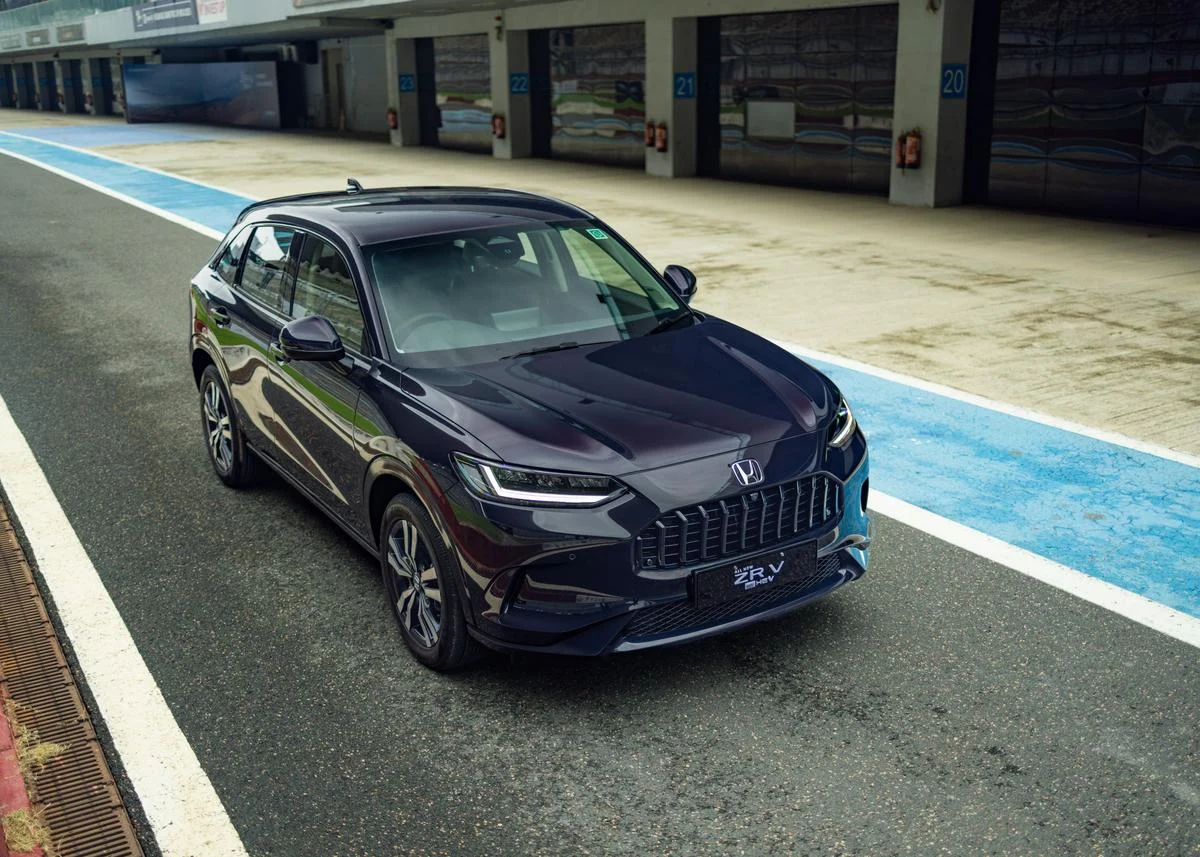
The Indian automotive landscape, particularly the premium SUV segment, has recently devolved into what industry analysts call a "battle of excess." In a bid to capture the attention of a burgeoning middle class with high disposable income, manufacturers have prioritized digital real estate—larger screens, panoramic sunroofs, and aggressive, chrome-heavy aesthetics—over mechanical purity. However, Honda’s latest entrant, the ZR-V, challenges this trajectory.
Priced at ₹47.99 lakh (ex-showroom) and imported as a Completely Built Unit (CBU), the ZR-V does not compete on the length of its feature list. Instead, it positions itself as a masterclass in "solid engineering," prioritizing the tactile and mechanical experience of driving over the superficial "marketing boxes" that have come to define the segment.
I. Main Facts: Substance Over Spectacle
The Honda ZR-V enters a crowded arena occupied by established players like the Hyundai Tucson, Jeep Compass, and the Volkswagen Tiguan. Yet, its proposition is fundamentally different. It is a five-seater SUV that focuses on the "ownership experience"—a nebulous term that Honda defines through three pillars: refinement, build quality, and mechanical longevity.
Key Specifications at a Glance:
- Price: ₹47.99 Lakh (Ex-showroom, India).
- Powertrain: 2.0-litre i-VTEC Atkinson-cycle engine paired with a dual-motor e:HEV strong hybrid system.
- Performance: 181 bhp of combined power and 315 Nm of peak torque.
- Acceleration: 0-100 km/h in a claimed 7.9 seconds.
- Efficiency: ARAI-tested 22 kmpl; real-world estimates at 17–18 kmpl.
- Safety: 8 airbags, Honda Sensing (ADAS), and a 4-star Euro NCAP rating.
While the price point may raise eyebrows—given that it borders on the territory of entry-level luxury brands like BMW or Audi—Honda argues that the "CBU quality" justifies the premium. The vehicle is built to international standards, featuring tighter tolerances and higher-grade materials than many locally assembled rivals.

II. Chronology: From Concept to the Indian Circuit
The journey of the ZR-V to Indian shores marks a significant pivot for Honda Cars India. After the discontinuation of the CR-V, the brand lacked a flagship SUV to anchor its premium aspirations.
- Global Debut & Strategy: The ZR-V was originally designed to bridge the gap between the HR-V and the CR-V globally. Its design language moved away from the boxy silhouettes of traditional SUVs toward a more "crossover-coupe" aesthetic.
- The Hybrid Transition: Recognizing the slow adoption of EVs and the declining popularity of diesel in India, Honda decided to lead with its e:HEV technology, which had already seen a positive reception in the City Hybrid.
- The Buddh International Circuit (BIC) Test: To prove that the SUV was more than just a "commuter in a suit," Honda recently conducted high-speed testing and slalom trials at the BIC in Greater Noida. This event served as the definitive proof of the car’s chassis balance and high-speed composure, marking its official "readiness" for the Indian enthusiast.
III. Supporting Data: The e:HEV Powertrain and Mechanical Nuances
At the heart of the ZR-V is the latest generation of Honda’s e:HEV (strong hybrid) system. To understand why this vehicle is priced at a premium, one must look at the complexity of its drivetrain.
The Three Pillars of e:HEV
Unlike "mild hybrids" that use a small motor to assist the engine, or "parallel hybrids" where the engine and motor work in tandem most of the time, Honda’s system is a series-parallel hybrid. It operates in three distinct modes:
- EV Drive Mode: The electric motor powers the wheels directly using energy from the lithium-ion battery. This provides an EV-like silence and instant torque for city crawls.
- Hybrid Drive Mode: The petrol engine powers a generator motor, which in turn provides electricity to the propulsion motor. This ensures the engine stays in its most efficient RPM range regardless of vehicle speed.
- Engine Drive Mode: At sustained highway speeds, a lock-up clutch connects the petrol engine directly to the front wheels. This is where the Atkinson-cycle engine is at its peak thermal efficiency.
Engineering "Easter Eggs"
The ZR-V’s value is hidden in details that are often overlooked in brochures:

- Integrated Wiper Jets: Rather than spray nozzles on the bonnet that obstruct vision and waste fluid, the ZR-V features jets integrated into the wiper arms. This ensures the glass is cleaned precisely without the "blind moment" typical of traditional sprays.
- The "Patient" Tailgate: Most powered tailgates begin closing immediately upon a button press. The ZR-V’s system incorporates a brief, intelligent pause, allowing the user to step away or grab a final bag without the door descending prematurely.
- Acoustic Engineering: The use of acoustic glass and extensive sound-deadening materials results in a cabin that remains eerily quiet even when the 2.0-litre engine is working under load.
IV. Official Responses: The "Honda Way"
While Honda executives have acknowledged that the ZR-V is a "niche product" due to its CBU status and five-seater configuration, their official stance remains focused on the "quality of the drive."
A spokesperson from the engineering team noted during the BIC trials: "We are not selling a tablet on wheels. We are selling a car that feels the same at year ten as it did on day one. The ZR-V is for the buyer who understands that ergonomics and visibility contribute more to safety and comfort than a 15-inch screen ever could."
Furthermore, Honda emphasizes that their 4-star Euro NCAP rating and the inclusion of eight airbags as standard across the range reflect a "no-compromise" approach to safety. The "Honda Sensing" suite—including Collision Mitigation Braking, Lane Keep Assist, and Adaptive Cruise Control—has been calibrated specifically to handle the unpredictable nature of Indian traffic.
V. Driving Dynamics: A Track-Tested Family SUV
Testing a family-oriented hybrid SUV at the Buddh International Circuit—the former home of the Indian Grand Prix—is a bold move. However, the data gathered from the track suggests the ZR-V possesses a chassis that is over-engineered for its segment.

High-Speed Composure
During high-speed runs on the back straight of the BIC, the ZR-V reached an indicated 150 km/h. Observers noted a distinct lack of "floating" or vertical movement, a common complaint in SUVs with softer suspension setups. The car remained planted, suggesting a damping frequency tuned for stability rather than just low-speed "pillowy" comfort.
The Slalom Test
In the 80 km/h slalom course, the ZR-V demonstrated impressive lateral grip. The steering, though light for city use, weights up progressively. Because the heavy battery pack is mounted low in the chassis, the center of gravity is significantly lower than that of a traditional ICE (Internal Combustion Engine) SUV. This reduces body roll and allows for crisp direction changes that feel more like a sedan than a tall crossover.
VI. Implications: The Future of the Premium Niche
The entry of the ZR-V has several implications for the Indian automotive market:
1. The "Feature Fatigue" Counter-Movement
The ZR-V may signal the beginning of a "counter-movement" where a subset of buyers begins to reject overly digitized interiors. With its 9-inch screen and physical knobs for climate control, Honda is betting that "tactile" is the new "premium."

2. The Hybrid vs. EV Debate
At nearly ₹48 lakh, the ZR-V competes with premium EVs like the Volvo XC40 Recharge or the Hyundai IONIQ 5 (after subsidies in some states). Honda’s implication is clear: for the long-distance traveler who does not want "range anxiety," a high-efficiency hybrid is currently a more pragmatic luxury than a pure EV.
3. The CBU Challenge
By bringing the car as a CBU, Honda is testing the waters. If the ZR-V finds a dedicated following, it could pave the way for local assembly (CKD), which would bring the price down to the ₹38–40 lakh bracket, making it a formidable competitor to the market leaders.
4. Critical Omissions
However, the ZR-V’s success is not guaranteed. In a market where "bragging rights" matter, the absence of ventilated seats, a panoramic sunroof, and powered lumbar support for the driver are significant hurdles. Indian summers make ventilated seats almost a necessity in the premium segment, and Honda’s decision to omit them in a ₹48 lakh car is a gamble on the buyer’s priorities.
Conclusion: A Connoisseur’s SUV
The Honda ZR-V is an outlier. It is a vehicle that requires a test drive to be understood, as its strengths—refinement, chassis balance, and engineering integrity—cannot be captured in a static brochure.

For the average buyer looking for the most "features per rupee," the ZR-V will likely seem overpriced. But for the buyer who values the way a door thuds, the way a hybrid system seamlessly transitions between power sources, and the peace of mind that comes with Honda’s reliability, the ZR-V offers a refreshing alternative to the "excess" of the current market. It is not just an SUV; it is a statement that engineering still matters in an age of digital gimmicks.
Honda ZR-V: INR 47.99 lakh (ex-showroom). Evaluation conducted in association with Motorscribes and The Hindu.
