The story of India’s forests is not merely a botanical record but a profound narrative of a civilization’s shifting relationship with its environment. From the "green glaciers" of the Himalayas to the spice-rich tracks of the Western Ghats, the transformation of India’s wilderness mirrors its journey from a land of sacred groves to an industrializing economy. A seminal new volume, India’s Forests: Revisiting Nature and History, edited by Arupjyoti Saikia and Mahesh Rangarajan, provides a comprehensive scholarly interrogation of this transition.
Comprising essays from eleven distinguished professors, authors, and field experts, the book serves as a critical bridge between environmental history and modern conservation challenges. It expands upon the foundational work of scholars like Ramchandra Guha, K. Sivaramakrishnan, and the editors themselves, offering a multi-disciplinary look at how India’s forests were perceived, managed, and exploited across millennia.
Main Facts: The De-Sacralization of the Wild
The central thesis of the volume revolves around the degradation of India’s forests from dense, biodiverse "jungles"—where forest communities coexisted in a delicate equilibrium with nature—to mere commodities within the global economic machinery. As India transitioned into the industrial era, the forest became a resource to be "harvested" rather than a landscape to be revered.
The contributors argue that the contemporary climate crisis cannot be understood without looking back at the historical policies that redefined the forest. Key takeaways from the research include:
- The Multi-Regional Perspective: The book covers a vast geographical sprawl, including the western Himalayan foothills, the central Indian highlands, Rajasthan, Jharkhand, the Deccan, and the Western Ghats.
- The Intellectual Lineage: The work builds upon classic texts like The Unquiet Woods (1989), providing updated insights into colonial and post-colonial forestry.
- Cultural Roots: As noted by historian Shekhar Pathak in the foreword, forests are more than just timber; they are the dwellings of deities, the source of community memory, and the "green glaciers" that regulate the subcontinent’s water and oxygen cycles.
Chronology: From Ancient Harappa to the Industrial Present
To understand the current state of India’s ecology, the authors trace a timeline that begins in the third millennium BCE and stretches to the present day.
![The importance and exploitation of Indian forests down the ages [Book Review]](https://imgs.mongabay.com/wp-content/uploads/sites/30/2026/05/27135518/AP22340443783720-1200x800.jpg)
The Ancient and Vedic Eras (3000 BCE – 300 BCE)
The relationship with the forest was established early. Shibani Bose’s research highlights the long-distance procurement of deodar wood from the Himalayas for Harappan sites in the third millennium BCE. This indicates that even in antiquity, the forest was part of a sophisticated supply chain. By the 10th to 8th centuries BCE, bhojpatra (birch bark) was being transported to the Ganga river basin.
The Arthashastra, dating back to the 3rd century BCE, reveals a highly structured approach to forest management. As Kumkum Roy explains, the state categorized forests into functional zones: gaja vana (elephant forests) for military resources and mriga vana (deer forests) for royal recreation. While the state sought to control "unreliable" forest dwellers, it also recognized the forest as a source of immense wealth, taxing animal products, timber, and meat.
The Early Modern and Medieval Transition (1400 CE – 1700 CE)
Before the heavy hand of British colonialism, India was described as "islands of cultivation in a sea of forests." However, global trade began to exert pressure. Meera Anna Oommen and Kathleen Morrison detail how the demand for Kerala’s spices—pepper, cardamom, and resins—integrated India into the world economy. The "War on the Pepper Coast" underscores how forest-dwelling chiefs (the Velir) controlled the high-elevation tracks that produced the "black gold" coveted by Rome, Egypt, and later, European powers like the Portuguese.
The Colonial and Post-Colonial Eras (1800 CE – Present)
The British era marked a seismic shift. Mayank Kumar’s analysis suggests that pre-modern societies largely lived in harmony with nature, but colonial policies prioritized economic extraction above all else. This period saw the "enclosure" of the commons and the systematic disenfranchisement of tribal communities. In the post-colonial era, these patterns largely persisted, as the focus remained on industrial development and the exploitation of natural resources by global corporations.
Supporting Data: Wildlife Populations and Resource Depletion
The book provides chilling and illuminating data regarding the decline and tentative recovery of India’s megafauna, illustrating the human impact on biodiversity.
![The importance and exploitation of Indian forests down the ages [Book Review]](https://imgs.mongabay.com/wp-content/uploads/sites/30/2026/05/27133647/33180657348_18e91b5201_o-768x512.jpg)
The Asiatic Lion (Gir, Gujarat)
Once ranging from the Arabian Peninsula to the Indian subcontinent, the Asiatic lion was decimated by hunting.
- 1990: The population stood at a precarious 284.
- 2020: Thanks to conservation efforts by the princely states of Gujarat and later the Indian government, numbers rose to 674 individuals spread across 30,000 sq km.
- Threats: Despite the recovery, geneticist Stephen J. O’Brien warns of severe inbreeding, manifested in reduced manes and lower sperm counts, making the population vulnerable to a single epidemic.
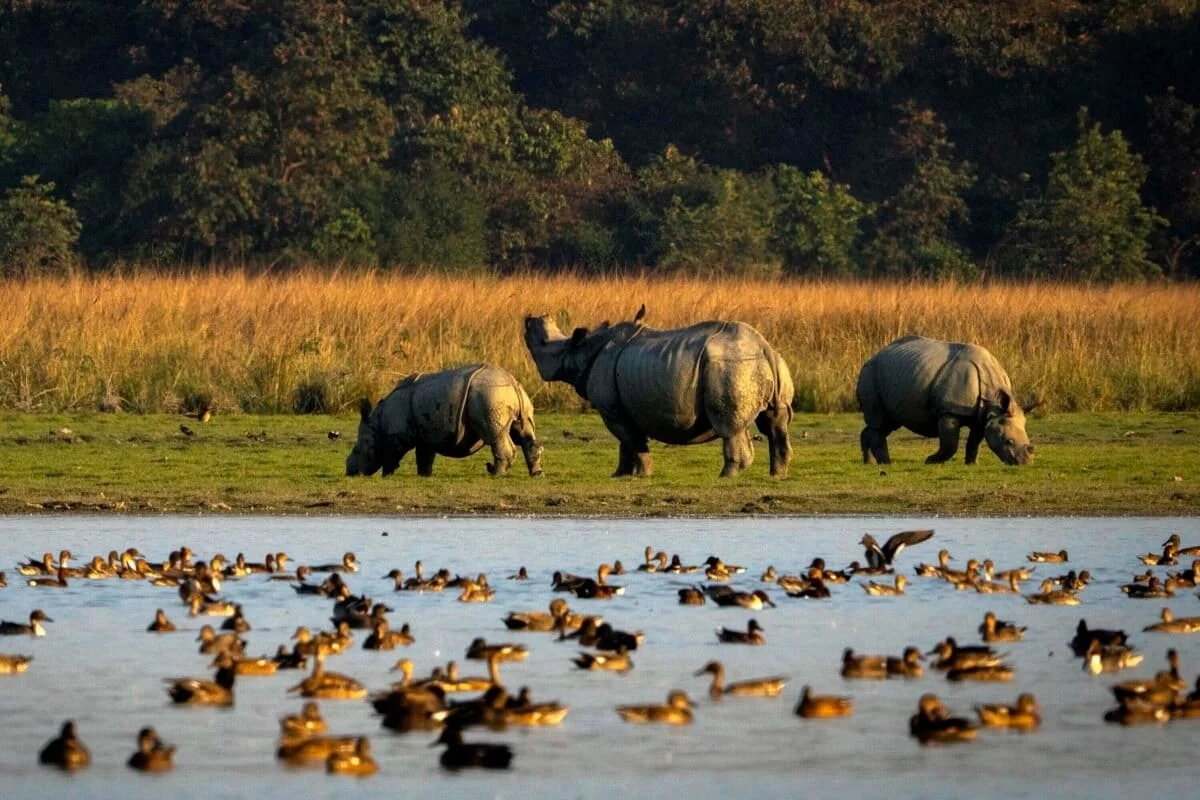
The One-Horned Rhinoceros (Assam and Nepal)
The rhino has been a symbol of the subcontinent since the Harappan civilization (found on 40 ancient seals).
- The Hunting Era: Between 1871 and 1907, Maharaja Nripendra Narain Bhup Bahadur alone shot 207 rhinos.
- 1954: The population in India and Nepal plummeted to just 600.
- 2022: Conservation measures in Kaziranga and other reserves brought the Indian population to 3,270. Nepal reported 752 rhinos in 2021.
Trade and Extraction
The historical scale of resource extraction is equally staggering. During the sack of Rome in 410 CE, the ransom demanded from the Romans included 3,000 pounds of pepper—much of it sourced from the forests of South India. This illustrates how Indian forests have been fueling global appetites for nearly two millennia.
Official Responses and Scholarly Perspectives
The volume acts as a platform for experts to challenge the prevailing "economic-first" narrative of forest management.
The Critique of "Greed vs. Need"
Shekhar Pathak and other contributors argue that modern policy is "blind" to the difference between renewable and non-renewable resources. The Chipko movement and similar grassroots protests were not merely about saving trees but about preserving a "peasant-pastoral wisdom" that understands the forest as a life-support system rather than a ledger entry.
![The importance and exploitation of Indian forests down the ages [Book Review]](https://imgs.mongabay.com/wp-content/uploads/sites/30/2026/05/27135839/38805167805_ecfdf5e58a_b-e1779870558811-768x512.jpg)
The Politicization of Sacred Groves
Mukul Sharma’s field work in Jharkhand provides a sobering look at "sacred groves" (Sarna). While traditionally seen as undisturbed pockets of biodiversity, Sharma notes that many have been degraded. They have become sites where modern hierarchies of gender and caste are played out, and their ecological value is often secondary to their role in regional political identity.
The Conflict of "Regional Asmita"
Conservationist Divyabhanusinh Chavda highlights a significant hurdle in modern conservation: regional pride (or asmita). Both Gujarat and Assam have been reluctant to relocate lions and rhinos to other states (like Madhya Pradesh or Uttar Pradesh) to create "insurance populations." This political gatekeeping of wildlife, the authors argue, places the survival of entire species at risk for the sake of regional branding.
Implications: The Forest as a Carbon Sink in the Climate Era
As India moves deeper into the 21st century, the implications of this historical analysis are clear. The book concludes that while modern technology has reduced our direct dependence on forest-based fuel, the ecological role of the forest has never been more vital.
- Climate Mitigation: In an era of rapid global warming, India’s forests serve as essential carbon sinks. The deterioration of these landscapes directly undermines India’s ability to meet international climate goals.
- Soil and Civilization: Saving the forests is synonymous with saving the soil. The well-being of the northern plains is inextricably linked to the health of the Himalayan forests.
- A Call for Integration: The scholars suggest that the way forward lies in integrating "ancient wisdom" with "modern science." This means moving away from the colonial model of "fencing the forest" and toward a model that respects the rights of forest communities while protecting biodiversity.
India’s Forests: Revisiting Nature and History serves as both a warning and a roadmap. It reminds us that the "unquiet woods" are not just a relic of the past but a living, breathing foundation of India’s future survival. To ignore their history is to jeopardize the very civilization they have nurtured for five thousand years.