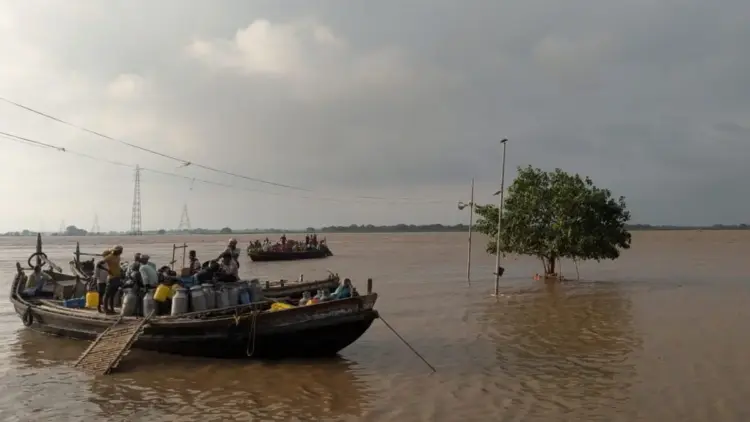
The 30-year landmark agreement between India and Bangladesh regarding the sharing of the Ganga’s waters is approaching its expiration. Signed in December 1996, the Ganga Water-Sharing Treaty has been a cornerstone of hydro-diplomacy in South Asia. However, as the deadline for renewal nears, the Indian state of Bihar has emerged as a vocal critic, demanding a radical overhaul of the agreement. For Bihar, the treaty is not merely a diplomatic document but a primary factor in the state’s recurring struggles with siltation, seasonal water scarcity, and agricultural stagnation.
Main Facts: A Transboundary Tug-of-War
The Ganga Water-Sharing Treaty governs the distribution of water at the Farakka Barrage, located in West Bengal, near the border with Bangladesh. The agreement was designed to ensure that during the "lean season"—the period from January to June when river levels are at their lowest—both nations receive a fair share of the flow.
The Mechanics of Sharing
The treaty employs a complex formula based on the availability of water at the Farakka Barrage:
- Below 70,000 cusecs: India and Bangladesh each receive 50%.
- 70,000 to 75,000 cusecs: Bangladesh is guaranteed 35,000 cusecs, with India receiving the remainder.
- Above 75,000 cusecs: India is guaranteed 40,000 cusecs, with the rest flowing to Bangladesh.
Furthermore, specific provisions ensure that Bangladesh receives a guaranteed flow during critical windows in April, such as 35,000 cusecs during the first and last ten-day periods of the month. If the flow drops below 50,000 cusecs, the two governments are mandated to enter emergency consultations.

The Core Grievance
Bihar’s political leadership argues that this bilateral arrangement ignores the "basin-wide" reality of the river. While the treaty focuses on the exit point at Farakka, Bihar—an upstream state—claims it bears a disproportionate burden. Political leaders in Patna assert that the state is forced to ensure high flow rates for international obligations while its own irrigation, drinking water, and industrial needs remain unaddressed.
Chronology: From Construction to Conflict
The history of the Ganga’s management is a decades-long saga of engineering ambitions and unintended environmental consequences.
- 1961: Construction begins on the 2,245-meter-long Farakka Barrage. The primary objective was to divert water into the Bhagirathi-Hooghly river system to flush out silt and maintain the navigability of the Kolkata Port.
- 1962: Early warnings emerge. Experts like A.T. Ippen and C.F. Wicker suggest that the diversion might actually worsen shoaling problems rather than solve them.
- 1975: The Farakka Barrage is completed and becomes operational.
- 1994: The Second Bihar State Irrigation Commission releases a report highlighting that while Bihar holds only 16% of the Ganga’s catchment area, it provides a massive portion of the flow via its tributaries.
- 1996: The Indo-Bangladesh Treaty is signed by Indian Prime Minister H.D. Deve Gowda and Bangladesh Prime Minister Sheikh Hasina, establishing a 30-year framework.
- 1997: The Bihar government formally demands that upstream states (like Uttar Pradesh and Uttarakhand) share the burden of maintaining the Ganga’s flow, rather than leaving the responsibility solely to Bihar’s tributaries.
- 2017: At the "Vision Ganga" program, Bihar’s leadership, including then-CM Nitish Kumar, calls for a "silt management policy" and criticizes the treaty’s impact on the state’s hydrology.
- 2022: Bihar launches the Ganga Water Supply Scheme to provide drinking water to Gaya and Rajgir, but the state is restricted to drawing water only during the monsoon months (July to October).
- 2024: As the treaty’s expiration looms, Sanjay Jha and other Bihar representatives raise the issue in the Rajya Sabha, urging the Central Government not to renew the treaty in its current form.
Supporting Data: The Hydrological Reality
The debate over the treaty is fueled by starkly different interpretations of hydrological data. Bihar’s claims of being "water-stressed" by the treaty are met with skepticism by some environmentalists, yet supported by sediment studies.
Flow Discrepancies
One of the most contentious points is the volume of water entering and leaving Bihar. According to the Bihar State Pollution Control Board, the Ganga’s flow at Chausa (where the river enters Bihar from Uttar Pradesh) can drop to as low as 400 cusecs during the lean period (February to April). By the time the river reaches Kahalgaon in eastern Bihar, the flow increases to approximately 1,600 cusecs due to contributions from Bihar’s own tributaries like the Kosi, Gandak, and Son.

However, the Bihar government has historically claimed that it is expected to ensure a delivery of over 52,000 cusecs at Farakka to satisfy the treaty. This disparity suggests that the state relies heavily on its internal river systems to meet a national diplomatic obligation.
The Siltation Crisis
The most tangible impact of the Farakka Barrage on Bihar is not just water volume, but sediment. A study by IIT Kanpur, led by Professor Rajiv Sinha, examined a 580-kilometer stretch of the river. The findings were startling:
- Sediment Accumulation: The Farakka Barrage triggers the siltation of an estimated 156 million tonnes (MT) of sediment annually.
- Backwater Effect: Because the barrage slows the river’s velocity, silt settles upstream, effectively "choking" the riverbed in Bihar. This raises the riverbed, leading to increased flood intensity and bank erosion.
- Agricultural Impact: While sediment carries nutrients, its stagnation in the main channel rather than distribution across floodplains renders it a liability rather than an asset.
Official Responses: A House Divided
The discourse surrounding the treaty renewal reveals a divide between political pragmatism, state-level advocacy, and environmental expertise.
The Political Stance
Sanjay Jha, a Member of Parliament from the Janata Dal (United), emphasized in the Rajya Sabha that Bihar’s long-term water security is at stake. "Renewing the treaty without adequately incorporating Bihar’s development needs and water resource requirements would harm the state’s broader interests," Jha argued. The Bihar government has requested an allocation of at least 2,000 cusecs for drinking and industrial use during the lean season, though reports suggest an internal committee has recommended only 900 cusecs.

The Expert Skeptics
Not all experts agree that the treaty is the primary source of Bihar’s woes. Himanshu Thakkar, coordinator of the South Asia Network on Dams, Rivers and People (SANDRP), points out a logical gap in the state’s argument. "Bihar possesses neither a dam nor any big storage facility where the state government could store Ganga water. Under these circumstances, the question of Bihar holding back or releasing water does not even arise," Thakkar noted. He suggests that the "pressure" Bihar feels is more political than physical.
Similarly, Professor Rajiv Sinha of IIT Kanpur argues that the issue is less about water sharing and more about "silt management." He contends that Bihar could have implemented sediment-clearing strategies independently of any international treaty.
The Call for Basin-Wide Management
Sunil Kumar Chaudhary, a former professor and Ganga ecology researcher, advocates for a middle ground. He argues that the treaty must evolve from a "bilateral release model" to an "inclusive basin-wide management approach." This would involve all states in the Ganga basin—Uttarakhand, Uttar Pradesh, Bihar, and West Bengal—sharing the responsibility for the river’s health and the nation’s international commitments.
Implications: Diplomacy in a Changing Climate
The renewal of the Ganga Water-Sharing Treaty is not happening in a vacuum. It is set against a backdrop of shifting geopolitical alliances and the escalating threat of climate change.

Geopolitical Stability
The Ganga is a transboundary river, and the treaty is a vital component of India’s relationship with Bangladesh. At a time when regional stability is precarious, any move by India to unilaterally alter or annul the treaty could be perceived as "hydro-hegemony," potentially pushing Bangladesh closer to other regional powers. Experts warn that failing to renew the treaty would have severe international consequences.
Climate Change and Variability
Climate models predict more erratic monsoon patterns and the melting of Himalayan glaciers, which feed the Ganga. This means the "lean season" could become even more unpredictable. A rigid treaty based on historical flow data may no longer be sustainable. Any new agreement will likely need to include "flexibility clauses" to account for year-to-year climate variability.
The Silt Management Mandate
There is a growing consensus that the next iteration of the treaty must address more than just cusecs of water. If a clause on silt management is not included, Bihar will continue to face "man-made" floods caused by a rising riverbed. Including silt management would force the central governments of both India and Bangladesh to invest in modern dredging technologies and ecological restoration, turning a source of friction into a point of cooperation.
Bihar’s Stakeholder Status
Perhaps the most significant implication is the changing role of Indian states in international diplomacy. Bihar’s demand to be a formal stakeholder in the treaty negotiations signals a shift toward "paradiplomacy," where sub-national entities demand a seat at the table when international agreements directly impact their local ecology and economy.

As the 2026 deadline approaches, the Indian government faces a delicate balancing act: it must uphold its reputation as a responsible neighbor to Bangladesh while addressing the legitimate hydrological and developmental grievances of one of its most populous and flood-prone states. The "Farakka Dilemma" remains a testament to the fact that in the management of great rivers, every engineering solution eventually creates a new set of human and environmental challenges.