

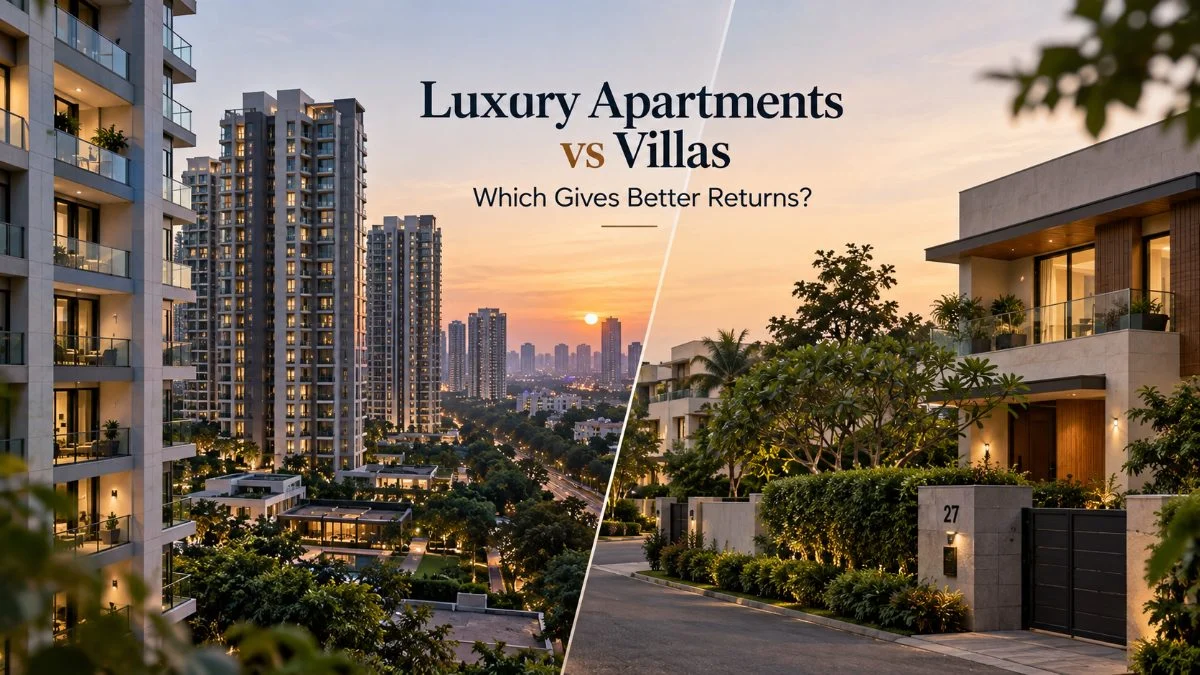
The Indian real estate landscape is currently witnessing an unprecedented transformation. Once dominated by the quest for basic square footage, the market has pivoted toward a "luxury-first" philosophy. As India’s High-Net-Worth Individual (HNWI) population continues to surge, the appetite for premium housing has moved beyond mere shelter to become a significant asset class for wealth preservation and growth.
For the modern investor, this evolution presents a critical fork in the road: should capital be deployed into high-rise luxury apartments or sprawling private villas? While both offer prestige, their financial trajectories—governed by rental yields, capital appreciation, and liquidity—are vastly different. This report provides an in-depth analysis of the luxury real estate sector in India, comparing these two dominant archetypes to determine which offers the superior return on investment.
1. Main Facts: The Current State of Luxury Housing
The luxury housing segment in India (typically defined as properties priced above INR 4 Crore) has outpaced the affordable and mid-segment categories in recent quarters. According to recent industry trends, luxury sales now account for nearly 20% of total residential sales in tier-1 cities, a significant jump from the 7-9% seen in the pre-2020 era.
The Core Comparison
At its heart, the debate between apartments and villas is a trade-off between convenience-driven cash flow and land-driven wealth accumulation.
- Luxury Apartments: These are typically part of high-rise complexes in central business districts or prime residential hubs (e.g., Golf Course Road in Gurugram, Worli in Mumbai). They offer "lifestyle-as-a-service," featuring concierge facilities, high-end security, and shared community infrastructure.
- Luxury Villas: These represent horizontal growth. Often located in the peripheries of major cities or exclusive gated enclaves, villas offer the "Undivided Share of Land" (UDS) advantage. The investor owns the structure and the earth beneath it, which is the primary driver of long-term value.
Key Investment Metrics
| Factor | Luxury Apartments | Luxury Villas |
|---|---|---|
| Rental Yield | Higher (typically 2.5% to 3.5%) | Lower (typically 1.5% to 2%) |
| Appreciation Source | Location & Brand Equity | Land Value & Scarcity |
| Liquidity | High (larger buyer pool) | Moderate to Low (niche buyers) |
| Maintenance | Shared & Managed | Individual & Intensive |
2. Chronology: The Evolution of the Indian Luxury Market
To understand the current investment climate, one must look at how the definition of "luxury" has shifted over the last two decades.
2000–2010: The Rise of the Gated Community
During the early 2000s, luxury was synonymous with "bungalows" in established old-city quarters. However, as urbanization accelerated, developers introduced the concept of the "luxury condominium." This era saw the birth of integrated townships where high-net-worth individuals could access amenities like swimming pools and clubhouses that were previously only available in five-star hotels.
2011–2019: Vertical Growth and Brand Recognition
As land in city centers became scarce, developers went vertical. This period was marked by the entry of international architects and interior designers. The "branded residence" emerged—apartments associated with luxury hotel chains or global fashion houses. Investment during this time was driven by the promise of a cosmopolitan lifestyle and central location.
2020–Present: The Post-Pandemic "Sanctuary" Effect
The COVID-19 pandemic was the ultimate catalyst for the current villa boom. The need for home offices, private outdoor spaces, and social distancing redefined luxury. Buyers began prioritizing privacy and "low-density" living. This led to a massive spike in demand for villas in suburban corridors like North Bengaluru, Sohna Road in Gurugram, and the ECR in Chennai. Simultaneously, luxury apartments evolved to include "wellness" features, such as advanced air filtration and touchless technology, to remain competitive.
3. Supporting Data: A Financial Deep Dive
When evaluating these assets, investors must look beyond the sticker price. The true return on investment (ROI) is a factor of three variables: Rental Income, Capital Appreciation, and the Cost of Ownership.
Rental Yields and Tenant Profiles
Luxury apartments consistently outperform villas in terms of rental yields. A 4-BHK luxury apartment in a prime hub like Powai (Mumbai) or Whitefield (Bengaluru) attracts corporate expats, C-suite executives, and high-earning professionals. These tenants value proximity to work and "plug-and-play" amenities.
Conversely, villas often face a "rental ceiling." While the capital value of a villa might be double that of an apartment, the rent rarely scales linearly. Tenants looking for villas are often families seeking long-term stays, which leads to lower turnover but also lower monthly yields relative to the massive initial investment.
The Land Component and Appreciation
The most compelling argument for villa investment is the Land-to-Building ratio. In an apartment, your ownership of the land is fractional and shared with hundreds of other owners. In a villa, the land often accounts for 60-70% of the property’s total value.
- Data Point: Over a 10-year horizon, land values in developing Indian corridors have historically appreciated by 12-15% CAGR, whereas apartment structures undergo physical depreciation, meaning their value is increasingly tied to the brand of the developer and the maintenance of the building.
Maintenance and "Hidden" Costs
Maintenance is the silent killer of real estate returns.
- Apartments: Expenses are streamlined through a Homeowners Association (HOA). Costs cover security, elevators, and common areas. While monthly maintenance can be high (INR 20,000 to 80,000), it is predictable.
- Villas: The owner is responsible for the roof, external painting, private gardening, plumbing, and individual security. These "lumpy" costs can significantly erode the annual ROI if the property is not managed meticulously.
4. Official Responses and Expert Perspectives
Market analysts and real estate consultants emphasize that the "better" investment is highly subjective and depends on the investor’s "Exit Strategy."
The Developer’s View:
Leading developers in the NCR and Mumbai regions suggest that luxury apartments are the "currency" of real estate. They are easier to buy and sell. "The velocity of transactions in the apartment segment is three times higher than in the villa segment," notes a senior executive from a Tier-1 development firm. "If an investor needs to liquidate an asset within 3 to 5 years, an apartment is the safer bet."
The Investment Consultant’s View:
Wealth managers often advise HNWIs to view villas as a "generational asset." According to data from real estate advisory firms, villas in gated communities have shown remarkable resilience during market downturns. Because they are scarce—developers can build 500 apartments on a plot that might only fit 40 villas—the supply-demand imbalance naturally pushes prices upward over the long term.
The Urban Planning Perspective:
Government initiatives like the expansion of Metro lines and the development of "Global City" projects (such as the one planned in Haryana) play a pivotal role. Experts suggest that a villa in a "developing" corridor with upcoming infrastructure will always outperform an apartment in a "saturated" central locality in terms of percentage growth.
5. Implications: Choosing the Right Path
The choice between a luxury apartment and a villa ultimately dictates the investor’s lifestyle and financial liquidity.
When to Choose a Luxury Apartment:
- Seeking Cash Flow: If the goal is to generate a steady monthly income to offset a mortgage or fund other ventures.
- Short-to-Medium Horizon: If the investor intends to exit the market within 5–7 years.
- Hands-Off Management: If the owner is an NRI (Non-Resident Indian) or a frequent traveler who cannot oversee the physical upkeep of the property.
When to Choose a Luxury Villa:
- Wealth Preservation: If the goal is to park capital in a "hard asset" that will grow in value over 10–20 years.
- Privacy and Autonomy: If the investor values the ability to modify the structure or expand the home in the future.
- Hedge Against Inflation: Land is the traditional hedge against currency devaluation; as the cost of raw materials and land increases, the replacement cost of a villa skyrockets, driving up the resale value.
The Impact of Location
The "Location Premium" can override all other factors. A poorly located villa in a region with no infrastructure will depreciate, while a luxury apartment on Gurugram’s Golf Course Road or Mumbai’s Altamount Road will likely see consistent demand regardless of market fluctuations.
Final Verdict: The Balanced Portfolio
For the sophisticated investor, the answer is rarely "one or the other." The trend among India’s ultra-wealthy is a diversified real estate portfolio: luxury apartments in the city for high-yield rentals and "lifestyle" villas in the suburbs or holiday destinations (like Goa or Alibaug) for long-term capital gains.
In the current Indian economy, luxury apartments offer the "Safety of Liquidity," while villas offer the "Power of Appreciation." As the Indian infrastructure story unfolds, the gap between these two will narrow, but the fundamental truth remains: the best investment is the one bought at a sensible entry price in a location where the future is already being built.
