

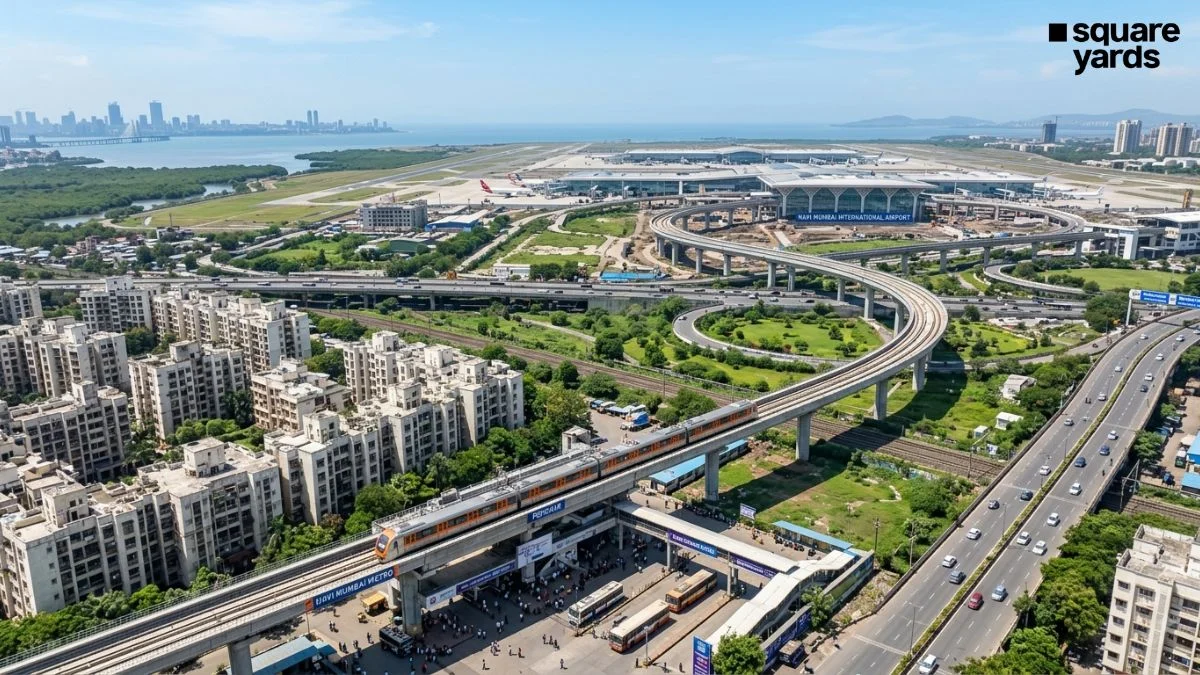
NAVI MUMBAI – In a move set to fundamentally alter the urban landscape of the Mumbai Metropolitan Region (MMR), the Maharashtra state government has officially sanctioned a massive ₹5,575-crore expansion of the Navi Mumbai Metro. This ambitious project aims to bridge the gap between established residential nodes and the burgeoning Navi Mumbai International Airport (NMIA), creating a seamless 28-kilometer transit corridor that promises to redefine the city’s economic and real estate trajectory.
The approval marks a pivotal moment for Navi Mumbai, transitioning it from a satellite town dependent on Mumbai’s aging suburban rail network into a self-sustaining "Aerotropolis" with world-class internal connectivity.
1. The Core Mandate: Connecting the Dots
The cornerstone of this expansion involves the development of Metro Line 1A and Metro Line 2. These segments are designed to integrate with the already operational Line 1, forming a continuous spine that stretches from Sagar Sangam to the heart of the Navi Mumbai International Airport.
Key Project Highlights:
- Total Investment: ₹5,575 Crore.
- New Infrastructure: 13 additional stations across two new lines.
- Total Network Length: An integrated 28-km corridor.
- Projected Ridership: Approximately 12 lakh (1.2 million) daily passengers upon full maturity.
- Primary Beneficiaries: Residents of CBD Belapur, Kharghar, Taloja, Pendhar, Kalamboli, Roadpali, and Kamothe.
By linking the existing metro infrastructure to the airport, the state government is addressing a critical infrastructure gap. The expansion ensures that the multi-billion dollar airport project is not an isolated island but a well-integrated hub accessible to the common commuter.
2. Chronology: From Local Transit to Regional Powerhouse
To understand the scale of this expansion, one must look at the evolution of the Navi Mumbai Metro project, which faced several delays before gaining its current momentum.
- November 2023: The 11.1-km Line 1 (CBD Belapur to Pendhar) was finally inaugurated. Developed by the City and Industrial Development Corporation (CIDCO) at a cost of approximately ₹3,063.63 crore, it served as the proof-of-concept for the city’s metro aspirations.
- August 2024 (Current Status): With Line 1 proving successful in easing local commutes between Belapur and Taloja, the state government moved to approve the extensions (1A and 2) to maximize the network’s utility.
- The 2026-2027 Vision: Construction for the newly approved lines is expected to move on a fast-track basis to align with the operational timelines of the Navi Mumbai International Airport.
- 2031 Horizon: By this time, the network is expected to be fully integrated with Mumbai Metro Line 8 (the Airport-to-Airport Express) and Line 12 (the Kalyan-Dombivli link), creating a massive interconnected web across the MMR.
3. Technical Breakdown: Lines 1A and 2
The expansion is not merely a single track but a strategic multi-phase engineering feat.
Metro Line 1A: The Southern Extension
Line 1A will bridge the gap between the current terminus at CBD Belapur and Sagar Sangam.
- Length: 3.02 kilometers.
- Structure: Elevated stretch.
- Stations: Two strategically placed stations to capture commuter traffic from the Belapur business district and the waterfront developments.
Metro Line 2: The Airport Link
This is the "crown jewel" of the expansion, extending the network from the current Pendhar station toward the airport.
- Length: 14.07 kilometers.
- Stations: 11 stations.
- Route: This line traverses through some of the fastest-growing residential and industrial belts, including Taloja and Kalamboli, before terminating at NMIA Terminal 4.
Regional Synergy: Lines 8 and 12
The expansion’s value is multiplied by its intersection with other major projects:
- Metro Line 12 (Kalyan to Taloja): This 23.57-km line will connect at Amandoot, allowing residents of the Kalyan-Dombivli belt direct access to the Navi Mumbai Airport.
- Metro Line 8 (The Gold Line): A high-speed, 34.9-km corridor designed to connect Chhatrapati Shivaji Maharaj International Airport (CSMIA) in Mumbai directly to NMIA. With an estimated cost of ₹22,862 crore, Line 8 will handle nearly 9.82 lakh passengers daily by 2031, with the Navi Mumbai Metro serving as a vital feeder to this express route.
4. Supporting Data: The Economic Engine
The financial and demographic projections for the Navi Mumbai Metro expansion suggest a significant return on investment for the state.
Passenger Projections
The network is designed for high-capacity transit. While Line 1 currently serves a local demographic, the integration of Lines 1A and 2 is expected to push daily ridership to 12 lakh. This shift is expected to take thousands of private vehicles off the Sion-Panvel Highway and the Palm Beach Road, significantly reducing the carbon footprint of the city.
Cost-Efficiency
While the ₹5,575-crore price tag is substantial, it is viewed as a necessary expenditure to unlock the "Airport Influence Zone" (NAINA). By providing mass transit, the government reduces the need for massive road expansions, which are often more expensive and environmentally damaging in the long run.
5. Official Responses and Strategic Vision
Government officials and urban planners have hailed the approval as a "masterstroke" for decentralizing Mumbai’s congested core.
A senior CIDCO official, speaking on the condition of anonymity, noted: "The goal is to create a 20-minute city. Whether you are in Taloja or Kharghar, the airport and the main business districts should be reachable within 20 minutes. This metro expansion is the skeletal structure that will support that muscle."
The Maharashtra government has also given in-principle approval for Transit-Oriented Development (TOD) along these corridors. This policy allows for higher Floor Space Index (FSI) near metro stations, encouraging developers to build denser, taller, and more mixed-use projects. This strategy is intended to ensure that more people live and work within walking distance of a metro station, thereby guaranteeing the project’s long-term financial viability through high ridership.
6. Real Estate Implications: Taloja’s "Catch-Up" Phenomenon
The most immediate and visible impact of the metro expansion has been on the real estate market. Data from Square Yards Data Intelligence highlights a significant shift in property valuations along the new corridor.
Taloja: The New Growth Frontier
Taloja has emerged as the biggest winner. Traditionally seen as an industrial outpost, its transition into a residential hub is accelerating.
- Price Surge: Average asking prices jumped from ₹8,900 per sq. ft. in June 2025 to ₹12,600 per sq. ft. by March 2026.
- Growth Rate: The locality recorded a staggering 14.44% quarter-over-quarter increase in early 2026.
- The "Why": Taloja offers the "sweet spot" for middle-income homebuyers—it remains significantly cheaper than Kharghar but will soon share the same level of connectivity to the airport and Mumbai.
Kharghar: The Premium Hub
Kharghar continues to command premium pricing due to its superior social infrastructure (schools, hospitals, and parks).
- Average Price: Currently hovering around ₹18,500 per sq. ft.
- Outlook: While the percentage growth may be lower than Taloja’s, the metro expansion solidifies Kharghar’s status as the "educational and lifestyle capital" of Navi Mumbai.
Kamothe and Kalamboli: The Stability Play
These areas have seen more stable growth, with Kamothe at ₹14,250 per sq. ft. and Kalamboli at ₹13,500 per sq. ft. Analysts suggest these nodes are "sleeping giants" that will see a secondary surge once the actual construction of the airport terminal reaches its final stages.
7. Implications: Challenges and the Road Ahead
Despite the optimism, the road to a fully connected Navi Mumbai is not without hurdles.
Construction Timelines
Historically, metro projects in the MMR have faced delays due to land acquisition and environmental clearances. The government will need to ensure that the ₹5,575-crore budget is utilized efficiently and that the 13 new stations are completed in tandem with the airport’s opening.
Last-Mile Connectivity
For the metro to reach its 12-lakh passenger target, the "last mile" remains crucial. The success of the expansion will depend on how well CIDCO integrates feeder bus services, cycling tracks, and pedestrian-friendly walkways around the new stations in Taloja and Kalamboli.
Socio-Economic Shift
The expansion is likely to trigger a gentrification process in areas like Taloja and Pendhar. While this brings modern amenities and higher property values, it also raises concerns about the availability of truly affordable housing for the industrial workforce that currently resides in these belts.
Conclusion: A City Transformed
The Maharashtra government’s approval of the ₹5,575-crore Navi Mumbai Metro expansion is more than just a transportation project; it is an economic catalyst. By weaving together the residential nodes of Kharghar and Taloja with the global gateway of the Navi Mumbai International Airport, the state is laying the groundwork for a new era of urban living.
As the lines between Mumbai and Navi Mumbai continue to blur, the metro will serve as the vital artery of a region that is fast becoming the preferred destination for global investors and homebuyers alike. The "Sagar Sangam to Airport" corridor is not just a 28-km track—it is the lifeline of a city that has finally found its rhythm.
