

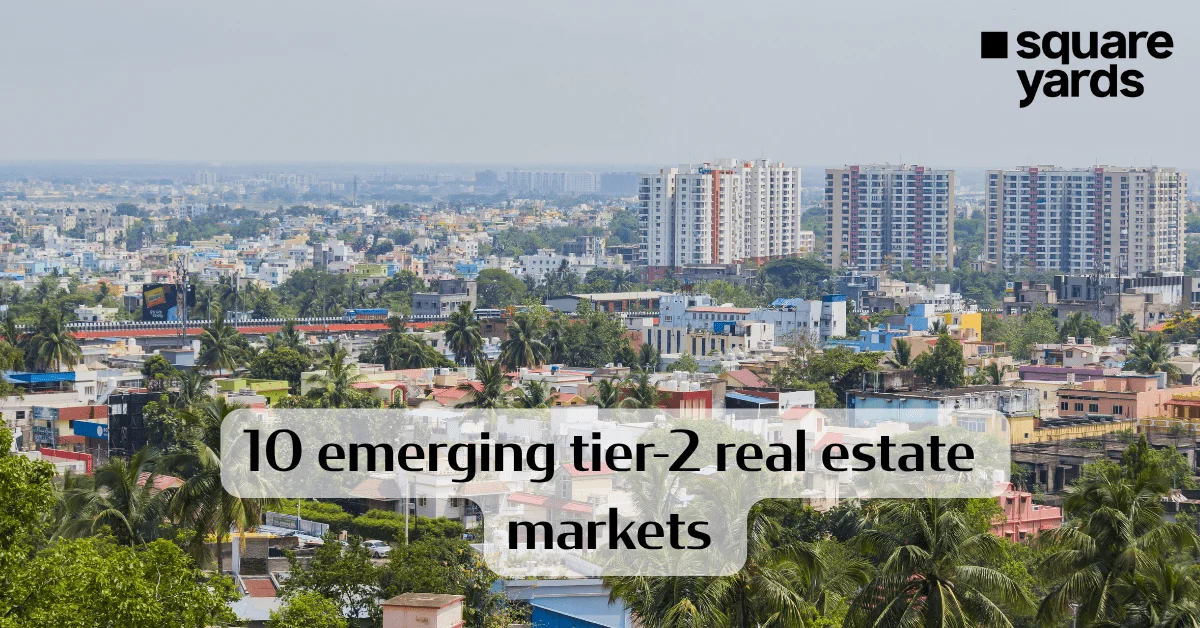
Executive Summary: The Decentralization of Indian Real Estate
For decades, the narrative of Indian real estate was dominated by the "Big Seven"—Mumbai, Delhi-NCR, Bengaluru, Pune, Chennai, Hyderabad, and Kolkata. However, a seismic shift is underway. Post-pandemic macroeconomic shifts, coupled with aggressive infrastructure tailwinds, have propelled Tier-2 cities into the spotlight. According to recent industry data from Square Yards and other market analysts, these emerging urban centers are now outperforming prime residential markets in terms of capital appreciation, rental yield potential, and overall investment velocity.
As property prices in Tier-1 metros reach saturation points and quality of life diminishes due to congestion, investors and homebuyers are pivoting toward cities that offer a "balanced" proposition: modern infrastructure, lower entry costs, and high growth potential. This report explores the ten most promising Tier-2 real estate hotspots in India, analyzing the catalysts driving their ascent.
Chronology of a Market Transformation: From Hinterlands to Hubs
The rise of Tier-2 cities did not happen in a vacuum. It is the result of a decade-long evolution in policy and social behavior:
- 2015–2019: The Foundation Phase. The launch of the "Smart Cities Mission" and the "Atal Mission for Rejuvenation and Urban Transformation" (AMRUT) began laying the groundwork for improved civic amenities in smaller cities.
- 2020–2021: The Pandemic Pivot. The COVID-19 pandemic acted as a catalyst. The "Work from Home" (WFH) culture triggered a reverse migration of skilled professionals from metros back to their hometowns. This created an immediate demand for high-quality housing in cities like Indore, Lucknow, and Kochi.
- 2022–Present: The Infrastructure Boom. The completion of major expressways (like the Samruddhi Mahamarg and Purvanchal Expressway) and the expansion of regional airports under the UDAN scheme have integrated these cities into the national economic grid, making them viable for corporate headquarters and logistics hubs.
The Top 10 Growth Corridors: Supporting Data and Insights
1. Nagpur: The Logistics Heart of India
Located at the country’s geographical center, Nagpur has transitioned from a quiet administrative town to a powerhouse of logistics and aviation.
- Key Drivers: The Multi-modal International Cargo Hub and Airport at Nagpur (MIHAN) is a game-changer, housing giants like Boeing and various IT firms. The Mumbai-Nagpur Samruddhi Mahamarg has reduced travel time to India’s financial capital to eight hours, unlocking massive commercial potential.
- Investment USP: A logistics-led market with high demand for warehousing and affordable residential units.
- Average Price: ₹3,500 – ₹4,500 per sq. ft.
2. Lucknow: The Northern Administrative Anchor
As the capital of Uttar Pradesh, Lucknow benefits from being the political and social nerve center of India’s most populous state.
- Key Drivers: The Shaheed Path corridor and the upcoming IT City are the primary magnets for investment. Modern connectivity via the Lucknow Metro and the Purvanchal Expressway has extended the city’s residential boundaries.
- Investment USP: A mix of institutional stability and rapid infrastructure expansion makes it a low-risk, high-reward market.
- Average Price: ₹5,500 – ₹8,500 per sq. ft.
3. Indore: The Cleanest City’s Economic Clean Sweep
Indore is no longer just a trading hub; it is a burgeoning IT and educational center, hosting both an IIT and an IIM.
- Key Drivers: The Super Corridor is the crown jewel of Indore’s real estate, connecting the airport to major commercial zones. The city’s consistent ranking as India’s cleanest city has significantly boosted its "liveability index."
- Investment USP: Industrial growth in Pithampur combined with a thriving startup ecosystem ensures a steady influx of high-income professionals.
- Average Price: ₹4,000 – ₹10,000+ per sq. ft.
4. Jaipur: Beyond Tourism to Technology
The "Pink City" is leveraging its proximity to the National Capital Region (NCR) to attract overflow investment.
- Key Drivers: Jaipur is a critical node on the Delhi-Mumbai Industrial Corridor (DMIC). Industrial zones developed by RIICO and the expansion of the Jaipur Metro have modernized the city’s footprint.
- Investment USP: Strong demand for plotted developments and luxury villas, fueled by both local demand and NCR-based investors.
- Average Price: ₹5,000 – ₹8,000 per sq. ft.
5. Visakhapatnam: The Blue Economy Powerhouse
Known as "Vizag," this coastal city is the industrial engine of Andhra Pradesh.
- Key Drivers: With two major ports and a thriving pharmaceutical and steel sector, Vizag offers a diversified economic base. The upcoming Bhogapuram International Airport is expected to trigger a real estate surge in the northern corridors.
- Investment USP: High demand for sea-facing premium properties and affordable housing for the industrial workforce.
- Average Price: ₹3,000 – ₹6,500 per sq. ft.
6. Bhubaneswar: The Smart City Success Story
The capital of Odisha is frequently cited as one of the best-planned cities in India.
- Key Drivers: The Infocity area has become a major IT hub in Eastern India. Government-led infrastructure projects, including the proposed Metro Rail, have kept investor sentiment high.
- Investment USP: High quality of life with excellent healthcare and education facilities, attracting a steady "end-user" market.
- Average Price: ₹4,500 – ₹11,000 per sq. ft.
7. Coimbatore: The Manchester of South India
Coimbatore is a rare example of an economy that is equally strong in manufacturing, textiles, and IT.
- Key Drivers: The presence of TIDEL Park and ELCOT IT Park has transformed the city’s employment landscape. Its proximity to hill stations like Ooty also makes it a preferred retirement destination.
- Investment USP: Resilient demand across residential and commercial sectors due to a diversified industrial base.
- Average Price: ₹4,000 – ₹12,000 per sq. ft.
8. Surat: The Diamond City’s Modern Facelift
Surat is consistently among the fastest-growing cities in the world, driven by its dominance in diamonds and textiles.
- Key Drivers: The Surat Diamond Bourse—the world’s largest office building—and the Surat Metro are redefining the city’s skyline. It serves as a major hub on the Delhi-Mumbai Industrial Corridor.
- Investment USP: Unparalleled commercial growth leading to a massive demand for high-end residential apartments.
- Average Price: ₹3,500 – ₹7,900 per sq. ft.
9. Kochi: The NRI Investment Magnet
Kochi is the gateway to Kerala’s global diaspora, which heavily influences its real estate market.
- Key Drivers: SmartCity Kochi and Infopark have established the city as a tech hub. The port-led development at Vallarpadam ensures long-term industrial relevance.
- Investment USP: Strong Non-Resident Indian (NRI) demand keeps the luxury and mid-segment markets buoyant even during national slowdowns.
- Average Price: ₹5,500 – ₹7,500 per sq. ft.
10. Nashik: The Golden Triangle’s Rising Star
Nashik forms the third vertex of Maharashtra’s "Golden Triangle" along with Mumbai and Pune.
- Key Drivers: As an automotive and engineering hub (MIDC), Nashik offers a more affordable alternative to the skyrocketing prices of Mumbai and Pune. Its climate and burgeoning wine industry have also made it a "second home" destination.
- Investment USP: Proximity to major metros ensures capital appreciation as the Mumbai-Nagpur expressway improves connectivity.
- Average Price: ₹4,500 – ₹8,500 per sq. ft.
Official Responses and Industry Outlook
Industry experts suggest that the trend toward Tier-2 cities is structural, not cyclical. Real estate consultants at Square Yards note that the "yield gap" between Tier-1 and Tier-2 is narrowing. Investors are finding that while Tier-1 cities offer stability, Tier-2 cities offer explosive growth.
"The decentralization of the Indian workforce is the biggest tailwind for Tier-2 real estate," says a senior market analyst. "Companies are following the talent. When an IT major opens a center in Indore or Bhubaneswar, it creates a localized ecosystem of housing, retail, and services. We are seeing a 15-20% year-on-year growth in inquiries for these markets."
Furthermore, government officials associated with the Smart Cities Mission emphasize that the focus has shifted toward "liveability." Improvements in waste management, 24/7 water supply, and public transport in these cities are making them more attractive to high-net-worth individuals (HNIs) who were previously tethered to metros.
Implications: A New Map for Wealth Creation
The rise of these Tier-2 cities has several long-term implications for the Indian economy and the real estate sector:
- Affordability as a Catalyst: While Tier-1 cities have become "investor-only" markets due to high entry costs, Tier-2 cities remain accessible to the middle-class and first-time buyers, ensuring a healthy, demand-driven market.
- Economic De-risking: By spreading industrial and tech growth across multiple cities, India is reducing its economic dependence on a few overcrowded metros.
- Standardization of Luxury: Developers who were previously active only in Tier-1 cities are now launching "premium" projects in cities like Lucknow and Coimbatore, bringing international construction standards to smaller markets.
- The Rise of Commercial Real Estate: It isn’t just residential growth; the demand for Grade-A office spaces in these cities is surging as MNCs look to optimize operational costs.
Tier-2 Real Estate Hotspots: Price Trends at a Glance
| City | Avg. Price Range (per sq. ft.) | Key Localities to Watch |
|---|---|---|
| Nagpur | ₹3,500 – ₹4,500 | Hingna, Manish Nagar, Tarodi |
| Lucknow | ₹5,500 – ₹8,500 | Gomti Nagar, Gosaiganj, Indiranagar |
| Indore | ₹4,000 – ₹10,000+ | Super Corridor, Vijay Nagar, AB Bypass Road |
| Jaipur | ₹5,000 – ₹8,000 | Ajmer Road, Jagatpura, Hardhyanpura |
| Visakhapatnam | ₹3,000 – ₹6,500 | Madhurawada, Bheemili, Kothavalasa |
| Bhubaneswar | ₹4,500 – ₹11,000 | Patrapada, Sijua, Kantbada |
| Coimbatore | ₹4,000 – ₹12,000 | Saravanampatti, Vadavalli, Kalapatti |
| Surat | ₹3,500 – ₹7,900 | Vesu, Katargam, Udhana |
| Kochi | ₹5,500 – ₹7,500 | Kakkanad, Edapally, Tripunithura |
| Nashik | ₹4,500 – ₹8,500 | Gangapur, Indira Nagar, Adgaon |
Source: Square Yards Research & Industry Aggregated Data
Conclusion
India’s real estate story is being rewritten in its "smaller" cities. For the strategic investor, the message is clear: the next decade of wealth creation lies in the growth corridors of cities like Nagpur, Indore, and Lucknow. As infrastructure bridges the gap between the periphery and the center, these Tier-2 cities are well on their way to becoming the primary engines of the Indian urban dream.
