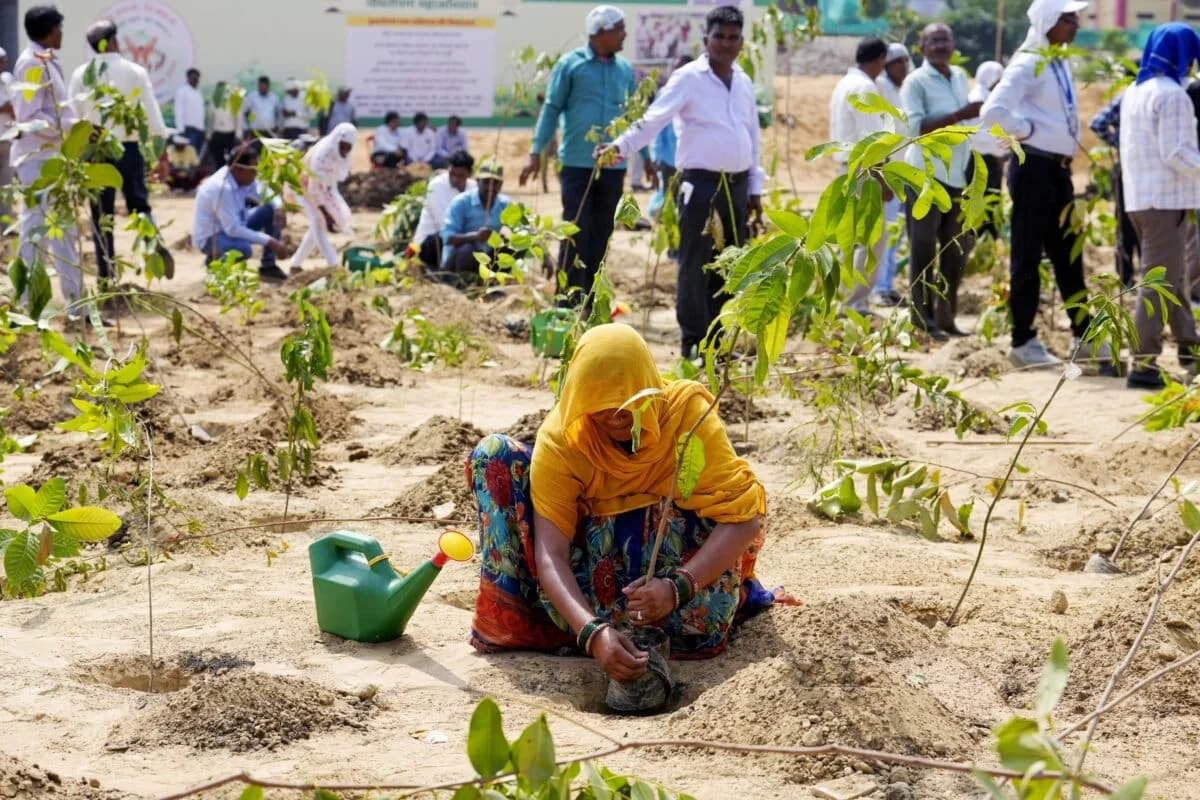
For decades, the image of a politician or a schoolchild planting a sapling has served as the quintessential symbol of environmental stewardship in India. Faced with the escalating threats of the climate crisis, the Indian government has pivoted toward massive afforestation as a cornerstone of its climate mitigation strategy. From the festive, record-breaking drives of Van Mahotsav to the multi-billion dollar allocations of the Green India Mission (GIM) and the Compensatory Afforestation Fund Management and Planning Authority (CAMPA), the nation is on a relentless quest to increase its tree cover.
However, a groundbreaking study published in the journal Environmental Research Communications suggests that this enthusiasm for planting may not be yielding the intended results. By analyzing eight major government policies and their impact on tree cover—specifically focusing on trees outside forests (ToF)—researchers have uncovered a stark disconnect between fiscal expenditure and ecological outcomes. While programs centered on agroforestry show promise, many of India’s flagship, high-budget initiatives are failing to move the needle on tree cover in the very areas they target.
Main Facts: A Disconnect Between Funding and Growth
The central premise of the research, led by Pooja Choksi, founder of Ficus Research Consulting, and her colleagues, is an evaluation of how taxpayer money translates into actual biological growth. India holds one of the world’s most ambitious land-based Nationally Determined Contributions (NDCs) under the Paris Agreement, aiming to create an additional carbon sink of 2.5 to 3 billion tonnes of CO2 equivalent through increased forest and tree cover by 2030.
The study’s findings are both illuminating and concerning:
- Agroforestry as a Success Story: The Sub-Mission on Agroforestry (SMAF) emerged as the most effective program, showing a strong positive correlation with increased tree cover.
- Flagship Failures: High-profile programs like the Green India Mission (GIM), the National Afforestation Programme (NAP), and CAMPA showed either no significant association or, in some cases, a negative association with tree cover increases outside of legally defined forest areas.
- The "Target" Trap: The research suggests that the "top-down" nature of these programs—focused on meeting numerical planting targets rather than ensuring survival or ecological suitability—is a primary driver of inefficiency.
- Data Gaps: A critical lack of fine-scale, publicly available data on species diversity and survival rates makes it nearly impossible for independent bodies to verify government claims of success.
Chronology: The Evolution of India’s Afforestation Policy (2013–2023)
To understand the current state of India’s greening efforts, the study tracked the timeline of funding and subsequent growth over a decade.

2013–2019: The Funding Phase
During this period, the Indian government funneled massive resources into various afforestation schemes. This included the maturation of the National Afforestation Programme (NAP) and the operationalization of the Green India Mission, one of the eight missions under the National Action Plan on Climate Change (NAPCC). Simultaneously, the Rashtriya Krishi Vikas Yojana (RKVY) began incorporating tree-planting components into agricultural subsidies.
2016: The Rise of SMAF
The Sub-Mission on Agroforestry (SMAF) was launched to encourage farmers to plant trees on their land. Unlike other programs, SMAF was designed to be demand-driven, requiring states to conduct a needs-based analysis before requesting funds from the central government.
2017–2023: The Observation Phase
The study utilized this period to measure the actual change in tree cover using remote sensing and satellite data. This six-year window allowed researchers to see which saplings survived to become part of the measurable canopy.
2023: Restructuring and Reporting
In a significant policy shift, SMAF was restructured and merged into the RKVY. Meanwhile, the 2023 India State of Forest Report (ISFR) claimed an overall increase in forest cover, though the study by Choksi and her team challenges the "coarse" nature of this data, arguing that it masks the failure of specific programs in non-forest lands.
Supporting Data: Why Some Programs Flourish and Others Falter
The research highlights a fundamental difference in how various programs engage with the land and the people.

The Success of Agroforestry (SMAF)
The Sub-Mission on Agroforestry works because it aligns ecological goals with economic incentives. Farmers are encouraged to plant trees that provide direct utility—timber, fruit, or fodder.
- Flexibility: SMAF allows for peripheral boundary planting, alley cropping, and horticulture.
- Economic Stake: Pushpendra Rana, a forest officer with the Himachal Pradesh Forest Department (not associated with the study), notes that when farmers see a five-to-ten-year path to profit, they ensure the trees survive.
- Short-term Impact: Evidence from Southeast Asia, cited in the study, confirms that agroforestry reduces the pressure on existing forests by providing alternative sources for timber on private land.
The Inefficiency of GIM and CAMPA
In contrast, the Green India Mission and CAMPA often operate in a vacuum. GIM, despite its massive budget, failed to show significant impact outside legally defined forests. This is particularly troubling as GIM is a core component of India’s international climate commitments.
The CAMPA policy faces a logistical nightmare known as "spatial mismatch." Under current rules, if a forest is cleared for a project in a biodiversity-rich area like the Andaman and Nicobar Islands, the compensatory planting might happen in a completely different ecological zone, such as Haryana. "It’s not going to work because they have different fauna and ecological requirements," Choksi explains.
The Grassland Problem
A significant portion of afforestation funding is directed toward "degraded" lands, which are often actually productive grassland ecosystems. Dhanapal G, an environmental researcher from the University of Manchester, warns that planting trees on grasslands destroys unique habitats. "Government reports claim success in tree cover, but don’t assess the damage to these distinct ecosystems," he says.
Official Responses and Expert Criticisms
While the Forest Survey of India (FSI) maintains that forest cover is increasing, experts argue that the metrics of success are dangerously narrow.

The Top-Down Critique
Pushpendra Rana points out that most programs suffer from a rigid, target-driven approach. "This often happens without flexibility or consideration of local conditions… or effective contributions from local forest resource-dependent communities," Rana says. In Himachal Pradesh, his own research showed that nearly 50% of afforestation expenditure was directed toward areas that already had tree cover or were unsuitable for planting.
The Transparency Gap
A recurring theme among researchers is the "black box" of government data. While the ISFR provides a national overview, it lacks fine-scale spatial data. "We don’t have access to data on what species were planted, their density, or species diversity," says Choksi. Without this, a monoculture of eucalyptus (which offers little biodiversity value) looks the same on a satellite map as a diverse native forest.
Monocultures vs. Livelihoods
Dhanapal G emphasizes that the government’s preference for fast-growing commercial species like teak and eucalyptus alienates local tribes. These communities depend on native species like Mahua, Tendu, and Sal. When a diverse landscape is replaced by a commercial monoculture, the "tree cover" may increase, but the community’s traditional livelihood is decimated.
Implications: Redesigning the Future of Indian Forests
The findings of this study suggest that India’s climate strategy needs a radical overhaul. If the nation is to meet its NDCs and foster genuine biodiversity, the focus must shift from quantity to quality.
1. From Planting to Survival
The current obsession with the number of saplings planted during festivals must be replaced by a focus on survival rates. This requires long-term monitoring and accountability for the funds spent.

2. Community-Centric Models
The success of SMAF proves that when local people have a stake in the trees, the trees survive. Future policies must prioritize community forest rights and ensure that afforestation efforts support, rather than undermine, local livelihoods.
3. Scientific Land Identification
Instead of viewing every open space as a site for a plantation, the government must adopt a scientific approach to identify suitable land. This includes protecting grasslands and allowing for "natural regeneration," which is often more effective and cheaper than active planting.
4. Transparent and Independent Monitoring
The researchers call for an unbiased, independent monitoring system. By making spatial and expenditure data public at the district level, the government can allow researchers to combine remote sensing with ground-level fieldwork to verify ecological outcomes.
5. Ecological Integrity over Carbon Accounting
While sequestering carbon is vital, it should not come at the cost of biodiversity. The practice of "compensatory" afforestation across different states must be reconsidered to ensure that ecological niches are preserved rather than just "replaced" on a spreadsheet.
As India moves toward its 2030 targets, the "Green India" of the future depends not on how many trees are planted today, but on how many are allowed to grow into a functioning, diverse ecosystem tomorrow. As Choksi concludes, "Some programs require a complete rethink… it is very difficult to compensate for the loss of fragile ecosystems." Without this rethink, India’s multi-billion dollar greening effort may remain an expensive illusion.