

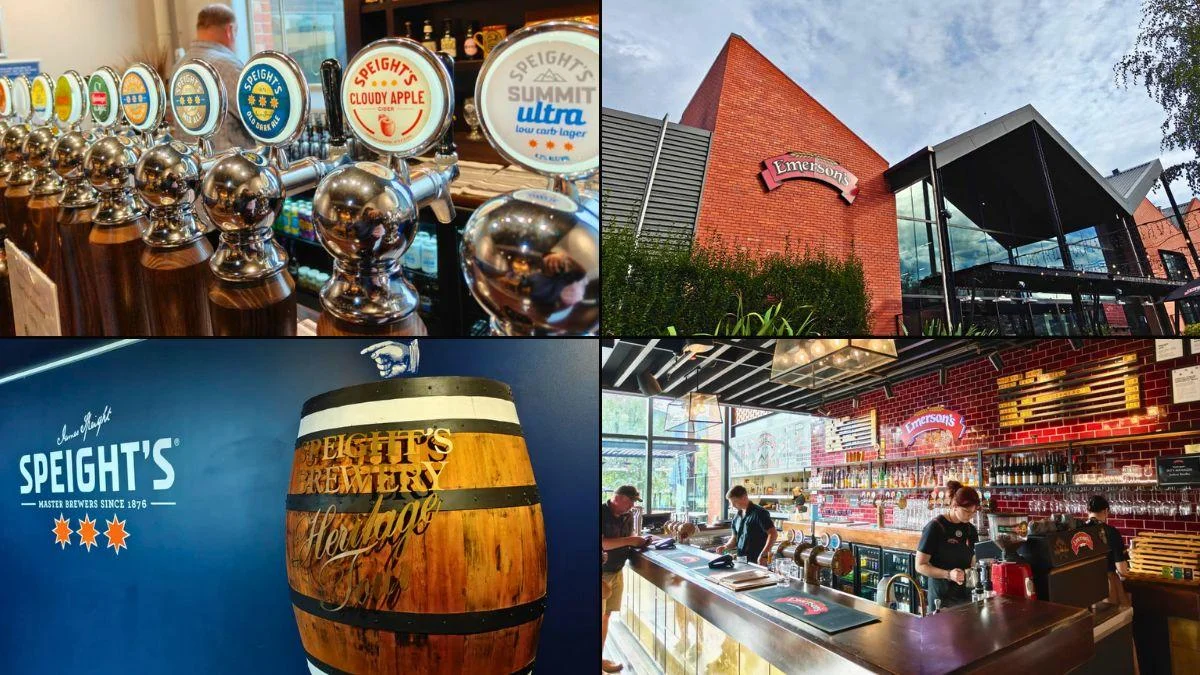
On Rattray Street, in the heart of Dunedin, New Zealand, a peculiar sight greets passersby. Amidst the steep, winding roads and the grey stone architecture of a city often called the "Edinburgh of the South," a public tap hums with constant activity. This is no ordinary municipal fountain. It is a direct conduit to an aquifer deep beneath the earth, pumping untreated, non-chlorinated, and non-fluoridated spring water straight to the surface.
For the residents of Dunedin, this tap is more than a curiosity; it is a ritual. People pull over in their cars with empty containers, filling jugs with the same pristine water that serves as the foundation for the city’s most famous export: beer. This tap is siphoned through Speight’s Brewery, an institution that has occupied this site since 1876. It is perhaps the most literal representation of how the act of brewing is not contained within factory walls but is woven into the very plumbing of the city itself.

In Dunedin, beer is not merely a commodity. It is a historical anchor, a social lubricant for the university’s "scarfie" culture, and a cornerstone of regional pride. Through the lens of two iconic breweries—the venerable Speight’s and the craft pioneer Emerson’s—one can trace the evolution of a city that has managed to remain fiercely local even while operating under the umbrella of global conglomerates.
Main Facts: A Tale of Two Breweries
Dunedin’s brewing landscape is dominated by a fascinating duality. On one side stands Speight’s Brewery, a 150-year-old operation that has outlived every local competitor to become a national titan. On the other is Emerson’s Brewery, founded in 1992, which spearheaded the craft beer movement in New Zealand by focusing on European-style ales and experimental small batches.

Despite their differing philosophies—one focusing on massive scale and "mainstream" appeal, the other on niche flavors and artisanal techniques—both breweries share a surprising corporate parentage. They are both owned by Lion, an Australasian beverage giant which is, in turn, a subsidiary of the Japanese brewing powerhouse Kirin.
This corporate overlap creates a unique market dynamic. The two breweries share distribution networks and supply chains, yet they cultivate distinct identities that appeal to different segments of the population. Speight’s remains the "Pride of the South," synonymous with rugby and the rugged "Southern Man" archetype, while Emerson’s serves as the city’s creative hub, drawing in students, families, and connoisseurs with its ever-rotating tap list and proximity to the University of Otago.

Chronology: From Gold Rush Gambles to Craft Revolutions
The Birth of a Titan (1876–1890s)
The story of Speight’s begins with a moment of "bracing recklessness" during the Otago Gold Rush. In 1876, three employees of the Well Park Brewery—James Speight, Charles Greenslade, and William Dawson—decided to strike out on their own. They moved into a disused bottling house on Rattray Street and began brewing their first batch before they had even secured a lease or a license.
The gamble paid off. By the 1890s, Speight’s had become the largest brewery in New Zealand. They were so successful that they operated their own merchant ship to transport beer to the North Island. While other local breweries faltered or were absorbed, Speight’s became the "Pride of the South," anchoring the social life of a city built on Scottish Presbyterian values and a burgeoning industrial economy.

The Craft Awakening (1992–Present)
For nearly a century, the New Zealand beer market was characterized by a lack of variety, dominated by standard lagers and draughts. This changed in the early 1990s when Richard Emerson, a local brewer who had discovered the richness of European beer styles while traveling in Scotland, returned to Dunedin with a mission.
Emerson began brewing in his kitchen and later moved to a makeshift setup using repurposed dairy equipment. At the time, the idea of a "London Porter" or a "New Zealand Pilsner" was foreign to many locals. However, as the global "craft" movement gained momentum, Emerson’s grew from a garage operation into a multi-million-liter powerhouse. In 2012, the brewery was purchased by Lion, a move that provided the capital needed to build its current state-of-the-art taproom and brewery near the Forsyth Barr Stadium.

Supporting Data: The Scale of Production
The sheer volume of beer flowing through Dunedin is a testament to the city’s drinking culture. Speight’s, as the "mainstream" heavyweight, operates on a scale that dwarfs almost any other local industry.
- Speight’s Production: A single day’s brew at Speight’s yields approximately 164,000 liters of beer. The facility operates 24/7 on three overlapping shifts. Modern automation has allowed the brewery to increase its output from a handful of batches a day to 6–8 brews every 24 hours.
- Emerson’s Production: While smaller than Speight’s, Emerson’s is no longer a "micro" brewery in the traditional sense. It produces roughly 2.7 million liters of beer annually. Its flagship Pilsner alone accounts for half of this total, with weekly volumes reaching up to 30,000 liters.
- Market Dominance: According to brewery representatives, Speight’s holds a commanding 75% market share against its primary competitors in the region.
The technical precision of these operations is aided by New Zealand’s agricultural prowess. The country is a major exporter of hops, and Dunedin’s brewers utilize these local ingredients to create specific flavor profiles. New Zealand-grown hops are prized for their citrus and "sauvignon blanc" notes, which Emerson’s often contrasts with tropical American hop varieties.

Official Responses: Voices from the Brew Floor
The cultural impact of these breweries is best articulated by those who walk their floors every day.
Marty McPate, a representative at Speight’s who leads public tours, views the brewery as an inseparable part of the New Zealand identity. "If you mention Speight’s, everybody knows it," McPate notes. He explains that the brand’s strategy has shifted from being a regional favorite to a national leader. "We don’t export our beer at all… we own a lot of other breweries in Australia, so we don’t want to be competing against that market." This strategic localization ensures that Speight’s remains a "Kiwi" icon, even under international ownership.

On the other side of the city, Ella Walker of Emerson’s describes a different kind of loyalty. She highlights how the brewery uses "backstories" to connect with the community. Their "Bookbinder" ale is named after a local friend of Richard Emerson, and their "Bird Dog" IPA is a tribute to a song by the iconic Dunedin band, The Verlaines.
"We definitely do see [Speight’s] as competition at times, but we sell different styles of beer," Walker says. She emphasizes that despite the rivalry, they are "sister breweries." This relationship allows them to share the city’s social calendar; Emerson’s often acts as the "finish line" for the Dunedin Marathon and becomes a sea of fans whenever a rugby match is held at the nearby stadium.

Implications: Beer as the Architect of Community
The dominance of Speight’s and Emerson’s in Dunedin offers a masterclass in how global brands can successfully "localise" their presence. In an era where multinational corporations often erase local flavor, the "Dunedin model" shows a different path. By maintaining production on the original historical sites and leaning into regional archetypes—like the "Southern Man" or the "Dunedin Sound"—these breweries have ensured that their product is more than just a liquid; it is a sense of place.
The implications of this culture are visible in the city’s social fabric:

- Economic Resilience: The brewing industry remains a major employer and a driver of tourism, with thousands of visitors taking brewery tours each year.
- Cultural Continuity: For the students at the University of Otago, the local pubs are a rite of passage. The "Speight’s vs. Emerson’s" debate is a fundamental part of the city’s social discourse.
- The "Commons" Philosophy: The free water tap on Rattray Street serves as a reminder that the resources of the land belong to the people. It is a gesture of goodwill that bridges the gap between a massive industrial operation and the private citizens who live in its shadow.
Ultimately, to drink a beer in Dunedin is to consume the city’s history. Whether it is a pint of Gold Medal Ale after a Highlanders rugby match or a London Porter shared in a quiet corner of a craft taproom, the beverage reflects the "Edinburgh of the South"—steeped in tradition, slightly rugged, and fiercely proud of its roots. As the saying goes in this part of the world, whichever pint you choose, it’s bound to be a "jolly good pour."
