CHENNNAI — As the global climate crisis accelerates, the traditional patterns of the Pacific Ocean are shifting with devastating precision. New data from the Indian National Centre for Ocean Information Services (INCOIS) has sent a wave of concern through the corridors of power in South India. According to the agency, there is now an 80% to 100% probability that the current El Niño phase will persist until at least April 2027. For the state of Tamil Nadu, a region already grappling with the volatile effects of global warming, this forecast represents more than a meteorological curiosity; it is a direct threat to the state’s agricultural backbone and water stability.
Main Facts: A Multiplier Effect on Climate Vulnerability
The El Niño-Southern Oscillation (ENSO) is a naturally occurring phenomenon characterized by the warming of sea surface temperatures in the central and eastern Pacific Ocean. However, in the 21st century, this cycle is no longer "natural" in the traditional sense. Climate change-induced global warming has significantly elevated baseline ocean temperatures, effectively "supercharging" El Niño events.
For India, and specifically the southern peninsula, El Niño often acts as a "multiplier effect." It takes existing climate stressors—such as erratic rainfall, depleting aquifers, and rising heat indices—and intensifies them. The INCOIS confirmation of a persistent phase through 2027 suggests that the usual 9-to-18-month cycle of El Niño is stretching into a multi-year marathon of climate stress.
Tamil Nadu finds itself at the epicenter of this crisis. Unlike many northern states that rely on Himalayan snowmelt, Tamil Nadu is almost entirely dependent on seasonal monsoons and groundwater. The state is currently staring at acute water stress, influenced by a "double whammy" of a deficient Southwest monsoon and an unpredictable Northeast monsoon, both of which are being warped by the El Niño signal.
Chronology: From Historical Trends to the 2026 Deficit
To understand the gravity of the current situation, one must look at the historical trajectory of El Niño’s impact on the Indian subcontinent. Between 1951 and 2025, India experienced 16 distinct El Niño events. While the correlation between El Niño and drought is not absolute, the historical record is sobering: India’s most severe drought years—1982, 1987, 2002, 2009, and 2015—all coincided with strong El Niño phases.

The timeline of the current crisis began to solidify in mid-2026:
- June – September 2026: The Southwest monsoon, which is critical for replenishing the catchment areas of the Western Ghats, performed poorly. By the official end of the season on September 30, the India Meteorological Department (IMD) recorded a 12.6% rainfall deficiency. This was the lowest recorded rainfall for this period since 2015.
- July 2026: Recognizing the impending threat, the Tamil Nadu Government constituted an expert committee under the Disaster Management Act, 2005, to draft a roadmap for El Niño preparedness.
- October 15, 2026: The Northeast monsoon officially commenced. While this season usually brings the bulk of Tamil Nadu’s annual rainfall, the presence of El Niño has introduced high levels of atmospheric uncertainty.
- Late 2026 – April 2027: The projected continuation of the El Niño phase suggests that the state will face a prolonged "dry tail," potentially impacting the 2027 summer and the subsequent planting seasons.
Supporting Data: A 52-Year Trend of Desiccation
The current crisis is backed by decades of longitudinal data. A landmark 52-year climate study (1971–2022) published in the International Journal of Climatology highlights a disturbing long-term trend: the south peninsular region, including Tamil Nadu, is becoming increasingly prone to chronic drought.
Monsoon Deficiencies and Reservoir Inflow
The 12.6% deficiency in the 2026 Southwest monsoon has had a direct impact on the state’s "water banks." Most of Tamil Nadu’s major reservoirs rely on inflows from the Western Ghats, which are shared with neighboring Karnataka. When the Southwest monsoon fails in the catchment areas, the resulting interstate water disputes often exacerbate local shortages. In previous strong El Niño years, the deficiencies were even more pronounced:
- 2002: 19.2% deficiency
- 2009: 21.8% deficiency
- 2015: 14.3% deficiency
The Groundwater Crisis
With surface water becoming unreliable, the state has turned aggressively to its aquifers. However, the Central Ground Water Board’s 2025 assessment provides a grim outlook. Out of 313 groundwater assessment units in Tamil Nadu, 103 are now classified as "over-exploited."
During El Niño years, the nature of rainfall changes. Instead of steady, percolating rains, the state often sees "short-period intense rainfall events." Meteorologists note that this type of precipitation is counterproductive for groundwater recharge; the water moves too quickly across the parched earth, resulting in surface runoff and flash floods rather than deep-soil infiltration.

The Coastal Threat
Tamil Nadu possesses India’s second-longest coastline, stretching 1,076 kilometers across 14 districts. As sea levels rise, coastal aquifers are suffering from seawater intrusion. When drought conditions persist, the lack of freshwater pressure allows salt water to seep further inland, ruining agricultural land and contaminating drinking water for millions.
Official Responses: Policy vs. Implementation
The Tamil Nadu government has not been idle, but experts argue that the pace of implementation is lagging behind the pace of climate change. The expert committee formed in July has provided a three-tiered recommendation strategy: short, medium, and long-term.
The Expert Committee’s Recommendations
Nambi Appadurai, Director of Climate Resilience Practice at World Resources Institute (WRI) India and a committee member, emphasizes a shift from "reactive relief to proactive preparedness." The recommendations include:
- Short-term: Immediate desilting of water bodies, establishment of localized early warning systems for farmers, and wildfire risk assessments for the state’s forest fringes.
- Mid-term (Pre-Summer 2027): Expanding heat action plans to protect outdoor workers, accelerated coral reef conservation to protect coastal buffers, and flood-risk mapping for urban centers.
- Long-term (3-5 Years): Institutionalizing climate-resilient infrastructure and establishing IMD observatories in every taluk (administrative block) to provide hyper-local weather data.
The ICAR Contingency Plan
The Indian Council for Agricultural Research (ICAR) has released a District-wise Contingency Plan for 2026. It identifies districts in western and central Tamil Nadu—such as Ariyalur, Perambalur, and Tiruchirappalli—as "highly vulnerable." The ICAR plan advocates for a radical shift in farming: moving away from water-intensive paddy toward drought-tolerant millets, pulses, and short-duration crop varieties.
However, environmental activists like G. Sundarrajan of Poovulagin Nanbargal warn that these recommendations remain largely on paper. "The government must restore and desilt water resources on a war footing," Sundarrajan says. "That is the only way to ensure that when it does rain, we actually keep the water."

Implications: Agriculture, Economy, and the Urban Deluge
The implications of a prolonged El Niño extending into 2027 are multifaceted, affecting everything from the price of food to the safety of urban residents.
Agricultural Productivity and Livestock
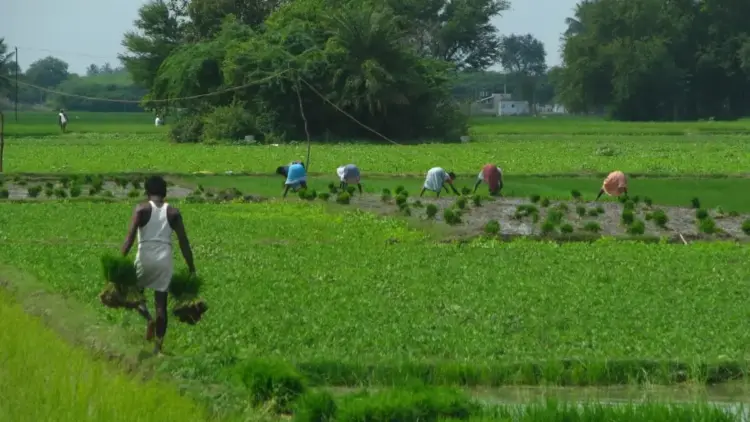
Agriculture in Tamil Nadu is the primary employer in rural areas. The uneven distribution of monsoon rains—a hallmark of El Niño—makes rainfed farming systems exceptionally fragile. Major crops like paddy, groundnut, maize, cotton, and sugarcane are seeing reduced yields due to moisture stress.
Beyond crops, the livestock sector is facing a quiet catastrophe. Water stress leads to fodder shortages, which in turn reduces milk yields and increases the mortality rate of cattle, further impoverishing small-scale farmers who rely on livestock as a secondary income source.
The "Drought-Flood" Paradox
One of the most dangerous aspects of El Niño in Tamil Nadu is its unpredictability. While it often causes drought in the interior, it can simultaneously trigger "severe deluge" in coastal areas. The 2015 El Niño is a haunting example: while the state faced seasonal deficiencies, the city of Chennai suffered from catastrophic flooding in December of that year.
Akshay Deoras, a senior research scientist at the University of Reading, notes that early indications suggest coastal Tamil Nadu might see intense rainfall in November and December 2026. This creates a policy nightmare: the state must prepare for a water shortage while simultaneously readying its disaster response teams for urban flooding.

Economic and Social Stability
The persistence of El Niño through April 2027 suggests a period of sustained inflation for food commodities. As yields for staples like pulses and vegetables drop, prices in urban centers like Chennai and Coimbatore are expected to rise. Furthermore, the continued over-exploitation of groundwater could lead to a "water migration," where rural families move to cities as their wells run dry, putting further strain on already overextended urban infrastructure.
Conclusion: A Test of Resilience
The confirmation by INCOIS that El Niño will remain a dominant force until 2027 is a clarion call for the state of Tamil Nadu. The "new normal" of climate change has rendered old agricultural calendars and water management strategies obsolete.
The coming months will be a "tough climate test." Success will not be measured by how the state reacts to a disaster, but by how it prepares for the predictable unpredictability of an El Niño year. Strengthening district-level contingency planning, adopting climate-resilient farming, and treating water conservation as a matter of national security are no longer options—they are necessities for survival in a warming world.