
In an era of rapid technological advancement and evolving economic priorities, the question of whether an MBA remains a worthwhile investment is more pertinent than ever. While the allure of prestigious business schools and lucrative career trajectories persists, a closer examination reveals a nuanced reality. The value proposition of an MBA is no longer universal; it is increasingly dependent on the institution, the individual’s career stage, and the burgeoning impact of artificial intelligence.
For many aspiring business leaders, the decision to pursue an MBA is a significant financial and temporal commitment, often involving substantial loans and a two-year hiatus from the workforce. The prevailing narrative, amplified by aspirational social media posts and the marketing efforts of coaching institutes, often paints a picture of guaranteed returns. However, a more sober assessment, grounded in data and objective analysis, suggests that the landscape has fundamentally shifted. While top-tier institutions continue to offer a compelling return on investment, newer business schools are grappling with rising fees and stagnating placement salaries, forcing prospective students to scrutinize the true cost and benefit.
This in-depth analysis delves into the critical factors shaping the MBA landscape today. We will explore the financial realities of different tiers of business schools, dissect the impact of Artificial Intelligence on entry-level corporate roles, examine global trends in MBA demand, and offer predictions for the future of the degree. Our aim is to provide a clear, data-driven perspective, free from marketing spin, to empower individuals making this crucial career decision.
The Shifting Tides of Financial Return: Where the MBA Still Shines and Where it Falters
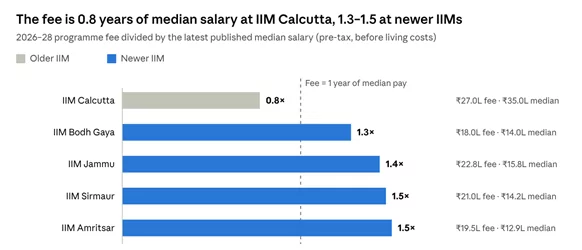
The financial viability of an MBA is now inextricably linked to the prestige and track record of the institution. For graduates of the Indian Institutes of Management (IIMs) at the pinnacle of the academic hierarchy, the investment continues to yield significant returns. For instance, IIM Calcutta, with fees for the 2026-28 batch hovering around ₹27 lakh, reported a median graduate salary of ₹35 lakh. This translates to a remarkably swift payback period, often under a year, even when accounting for taxes and living expenses. This rapid amortization allows graduates to quickly recoup their investment and begin leveraging the significant earning potential and networking opportunities that a top-tier MBA provides.
However, this optimistic financial outlook does not extend uniformly across all institutions. A stark contrast emerges when examining several of the newer IIMs. Here, a disquieting trend of sliding median salaries, coupled with persistent increases in tuition fees, has created a widening gap between the cost of the degree and its immediate earning potential. For graduates from these institutions, the payback period can stretch to 1.5 to 3 years or even longer, especially when factoring in forgone income during the two years of study and the interest accrued on loans.
It is crucial to acknowledge that even a median salary of ₹14-16 lakh, as observed in some of these newer institutions, represents a substantial step up for fresh graduates or career switchers from entry-level positions typically earning ₹5-7 lakh. However, the decision to pursue an MBA from these schools must be made with a clear understanding of these extended payback timelines and a realistic assessment of personal financial circumstances, rather than being swayed solely by headline-grabbing highest salary packages.
The data from Careers360’s analysis of National Institutional Ranking Framework (NIRF) data paints a clear picture of this divergence. Across nine "baby IIMs," six reported a decline in median salaries for their 2025 graduating cohort compared to previous batches. IIM Bodh Gaya, for example, witnessed a significant drop from ₹15.5 lakh to ₹12.12 lakh over two graduating classes, a decrease of approximately 22%. Similarly, IIM Amritsar saw its median salary slip by about 19% to ₹12.9 lakh. While not a universal decline, with institutions like IIM Sirmaur showing a healthy increase to ₹14.2 lakh and IIM Jammu edging up to ₹15.8 lakh, the overall trend underscores the need for meticulous due diligence.
Furthermore, placement reports from these newer institutions often omit crucial data points that are vital for an accurate assessment. For the 2024-26 batch, IIM Amritsar highlighted a highest CTC of ₹43 lakh but conspicuously withheld average or median salary figures. IIM Sirmaur’s latest summary provided an average but not a median. IIM Bodh Gaya’s reporting on an audited "MEP" (Mandatory Engagement Period) basis, while a commendable practice, is not directly comparable to schools that do not adhere to the same reporting standards. Prospective students are therefore urged to scrutinize placement reports with a critical eye, posing essential questions about median salaries, batch size, and the audited status of the reported figures before making any commitments.

The AI Revolution and the Erosion of Entry-Level Roles: A New Reality for MBA Graduates
The rapid advancement of Artificial Intelligence (AI) is no longer a distant theoretical concern; it is actively reshaping the employment landscape, particularly impacting the entry-level positions that have traditionally served as the launchpad for MBA graduates. While AI is not yet leading to wholesale job destruction, it is demonstrably thinning the ranks of junior roles, precisely the segment where many MBA freshers find their initial footing.
Compelling research from Stanford’s Digital Economy Lab, analyzing payroll data from millions of U.S. workers, provides significant insights. Their findings indicate that individuals aged 22-25 in occupations highly exposed to AI experienced a 13% relative decline in employment since late 2022. This trend has widened, with a subsequent update in August 2026 showing a 19% gap, while still not revealing a broad-based economy-wide displacement. Crucially, older workers in the same AI-exposed jobs saw their employment numbers remain stable or even increase.
Two key takeaways from this research are particularly relevant for MBA aspirants. Firstly, roles where AI serves as an augmentation tool, enhancing human capabilities rather than outright replacing tasks, have demonstrated stable or growing employment. Secondly, the employment gap associated with AI exposure narrows significantly when educational attainment is considered. In simpler terms, the codified and repetitive tasks often performed by junior analysts are susceptible to AI automation, while roles demanding judgment, client interaction, and the strategic direction of AI tools remain more secure.
This sentiment is echoed by employers. A 2026 survey conducted by GMAC, encompassing 621 recruiters across 39 countries, revealed that approximately one in three respondents planned to replace some entry-level roles with AI. Concurrently, 53% of these recruiters identified proficiency in using AI tools as the most critical skill for the next five years.
In the Indian context, the Naukri JobSpeak index for September 2026 provides a snapshot of this evolving market. While overall white-collar hiring saw a modest 2% increase and fresher hiring a mere 1% rise, roles related to AI/ML experienced a remarkable 20% surge. Within the IT sector, the demand for AI talent was most pronounced among professionals with 8-16 years of experience. This indicates a clear employer preference for seasoned specialists and experienced individuals, while a more cautious approach is being adopted towards generalist freshers.
The consulting industry, a dominant recruiter at most top IIMs, exemplifies this shift. McKinsey, after a period of contraction, has signaled a 12% hiring increase for 2026 and has integrated AI components into its final-round interviews in the U.S. Similarly, Boston Consulting Group (BCG) has been strategically tilting its hiring towards AI and tech specialists, moving away from generalist MBA profiles. While the firms are returning to recruitment, the profile of the candidates they seek has undeniably changed.
The honest implication for MBA aspirants is clear: AI is diminishing the value of a generic MBA while simultaneously amplifying the importance of a differentiated one. The traditional aspiration of obtaining an MBA followed by a generic analyst role, easily replicated by a well-prompted AI model, now carries a significantly shorter shelf life than it did just a few years ago.
The Global MBA Arena: Sustained Demand Amidst Shifting Preferences
Globally, the demand for MBA degrees remains robust, albeit with a discernible shift in preference towards fewer, more elite institutions and a growing interest in programs outside North America. GMAC’s latest survey data for the 2025-26 application cycle indicates a 2% increase in MBA applications, building on a substantial 13% surge in the preceding year. Full-time, two-year programs, in particular, witnessed a 4% growth.
This growth, however, is not evenly distributed. Among the most selective quarter of MBA programs, 52% reported an increase in applications, while only 28% of the least selective programs saw similar growth. This concentration of demand at the top tier highlights a growing selectivity among prospective students, who are increasingly prioritizing programs with proven track records and strong alumni networks.
Conversely, several U.S. business schools have recently paused or discontinued their full-time MBA programs. Notable examples include the University of Houston’s Bauer College of Business, which will cease its full-time MBA in 2025, and earlier decisions by schools in Illinois and Iowa to shift their focus towards online, part-time, or one-year formats. This trend suggests a recalibration of offerings by some institutions in response to evolving market demands and potentially, declining applicant pools for traditional formats.
Even highly prestigious institutions like Harvard Business School experienced a notable uptick in job-seeking graduates without offers three months post-graduation in its Class of 2024, more than doubling the historical norm. While the Class of 2025 showed a strong recovery, with 90% having offers at the three-month mark and nearly 94% by November, and Stanford GSB also reporting 90%, this brief dip served as a cautionary reminder. Importantly, salary outcomes remained resilient throughout this period.
Despite these fluctuations, the salary premium associated with an MBA degree continues to hold firm. GMAC’s 2026 recruiter survey projects a median starting salary of US$120,000 for new MBA hires in the United States, compared to US$107,500 for experienced professionals recruited directly from industry. This indicates that employers continue to value the skills and knowledge imparted by MBA programs. However, their selection criteria are becoming more discerning, with a greater emphasis on the specific capabilities graduates bring, particularly in the context of AI proficiency.
Five Predictions for the MBA’s Future: 2026-2031
Based on the discernible trends and emerging patterns, we offer five predictions for the trajectory of MBA programs between 2026 and 2031:
- Hyper-Specialization and AI Integration: MBA curricula will increasingly incorporate specialized tracks focusing on emerging fields like AI ethics, data analytics, sustainable business, and digital transformation. Core modules will see a deeper integration of AI tools and strategies, preparing graduates to leverage these technologies rather than be displaced by them.
- The Rise of Hybrid and Modular Formats: Traditional two-year full-time programs will likely coexist with a growing array of hybrid, online, and modular MBA offerings. These flexible formats will cater to experienced professionals seeking to upskill without significant career disruption and will allow institutions to reach a wider global audience.
- Emphasis on Experiential Learning and Soft Skills: With AI handling more routine analytical tasks, the focus of MBA education will shift further towards developing critical soft skills such as leadership, strategic thinking, complex problem-solving, emotional intelligence, and cross-cultural collaboration. Experiential learning, case studies, simulations, and international immersion programs will become even more paramount.
- Increased Scrutiny of ROI and Program Differentiation: Prospective students and employers will demand greater transparency regarding return on investment (ROI). Business schools will need to clearly articulate their unique value proposition, demonstrate strong placement outcomes for diverse career paths, and showcase how their programs equip graduates with future-proof skills.
- Geographic Diversification of Top Programs: While North America and Europe will remain significant hubs, we anticipate a notable rise in the prominence and application numbers for top-tier MBA programs in Asia, particularly in countries like India, Singapore, and China, driven by their growing economies and increasing demand for management talent.
The Crucial Question: Should YOU Pursue an MBA?
The MBA is no longer a monolithic product with a singular answer regarding its worth. The decision is deeply personal and contingent upon an individual’s unique circumstances. To guide this critical choice, we offer a framework for self-assessment:
| Your Situation | Our Honest Take | What to Check First |
|---|---|---|
| 99+ percentile CAT score, aiming for IIM A/B/C/L/K or equivalent | This remains one of the most valuable degrees in India. The payback period is swift, and the network effect significantly amplifies career growth. | Identify specific roles you aspire to, ensuring the two years of study are strategically aligned with your long-term career objectives. |
| Two-plus years of work experience with a clear career switch in mind (e.g., engineering to product management, operations to strategy) | A strong case exists. MBAs are ideally structured for such transitions, and AI poses the least threat to experienced professionals. | Evaluate if a one-year program could achieve your career transition goals more efficiently and cost-effectively. |
| Fresher with admits primarily from newer IIMs or Tier-2 schools | Proceed with caution. Fees approaching ₹18-23 lakh against median salaries of around ₹12-16 lakh translate to a protracted payback period. Furthermore, fresher roles are the most susceptible to AI displacement. | Thoroughly investigate the school’s audited median placement statistics and its historical record of placing fresh graduates. |
| Pursuing an MBA due to peer pressure or to escape a disliked job | It is advisable to reconsider. A year of focused skill development, acquiring AI-specific expertise, or seeking an internal role change within your current organization might offer a more impactful and less costly solution. | Clearly articulate what specific career advancements or opportunities you cannot access without an MBA. |
| Planning to take a substantial loan for a non-IIM, non-top-20 program | Exercise extreme prudence. This scenario presents the highest risk of a negative return on investment. The financial narrative of the MBA often unravels at this juncture. | Conduct a rigorous analysis of your loan EMIs against realistic, not aspirational, post-MBA salary expectations. |
Ultimately, the decision to pursue an MBA is a strategic one that requires careful consideration of individual goals, institutional quality, and the evolving economic landscape. By embracing a data-driven approach and critically evaluating the information available, aspiring students can navigate this complex terrain and make an informed choice that aligns with their long-term aspirations. Connecting with current students and alumni from target institutions can provide invaluable firsthand insights into the realities of the MBA experience and its aftermath.