

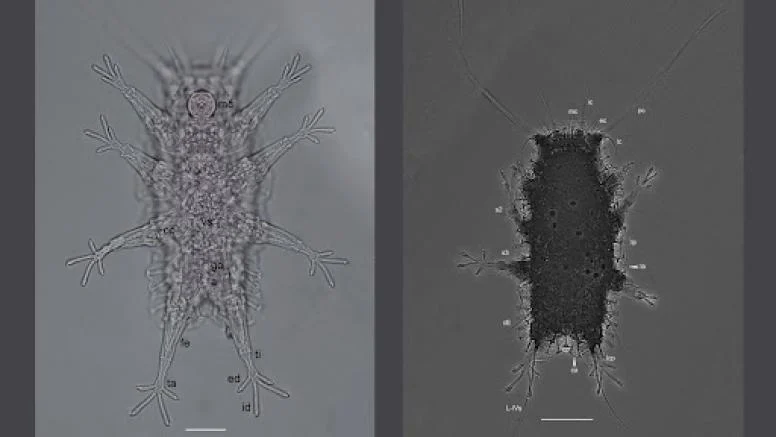
ODISHA, INDIA — In the invisible world that thrives beneath the waves of the Bay of Bengal, a tiny, alien-like creature has emerged from the silt to rewrite the records of marine biology. For the first time in over four decades, scientists have identified a new species within the elusive Actinarctus genus of tardigrades. Named Actinarctus odissi, this "marine water bear" represents a significant breakthrough in our understanding of the microscopic biodiversity inhabiting India’s coastal waters.
The discovery, made near the coastal town of Markandi in Odisha, is the result of a collaborative international effort involving the CSIR-National Institute of Oceanography (NIO), the University of Minho in Portugal, and the Academy of Scientific and Innovative Research (AcSIR). The finding not only adds a new member to the phylum Tardigrada but also highlights the vast, unexplored biological frontiers that exist within the sandy sediments of the ocean floor.
Main Facts: A New Resident of the Benthic Realm
Tardigrades, popularly known as "water bears" due to their pudgy, eight-legged gait, are legendary in the scientific community for their near-indestructibility. While most public attention focuses on terrestrial species found in moss or lichen—creatures capable of surviving the vacuum of space and extreme radiation—their marine cousins remain shrouded in mystery.
Actinarctus odissi is a marine tardigrade, a member of the meiofauna—the community of tiny organisms that live between sand grains. Measuring only a fraction of a millimeter, this species is distinguished by its extraordinary morphology. Unlike the typical "lumbering" appearance of land-based water bears, A. odissi possesses a dome-shaped body encased in transparent, wing-like structures known as "alae." These flaps are supported by internal, translucent pillars, giving the creature an ethereal, almost celestial appearance under high-power magnification.
The naming of the species is a tribute to the cultural heritage of the region where it was found. "Odissi" refers to the ancient classical dance form of Odisha, characterized by its fluid movements and intricate poses—qualities the researchers felt were mirrored in the delicate, graceful structure of the tardigrade’s lateral wings and sensory appendages.

Chronology: From the Ocean Floor to the Microscope
The journey to the discovery of Actinarctus odissi began with a routine sediment sampling expedition off the northeast coast of India. The timeline of the discovery underscores the meticulous nature of marine taxonomic research.
The Expedition at Markandi
In the shallow marine waters off Markandi, researchers deployed a local fishing trawler to reach a depth of approximately 14 meters. At this depth, the seafloor is composed of a complex mixture of sand, silt, and organic detritus. To capture this environment, the team utilized a Van Veen grab—a clamshell-like mechanical scoop designed to bite into the seabed and retrieve undisturbed sediment samples.
Extraction and Isolation
Once the samples were brought to the surface, the "needle in a haystack" search began. Meiofauna are too small to be seen with the naked eye and are often tightly adhered to sand grains. Back in the laboratory, the team employed a decantation method. This involved washing the sandy sediment with seawater and filtering the resulting liquid through a series of specialized microscopic sieves.
The finest sieves, with mesh sizes smaller than the width of a human hair, caught the tardigrades. Using extremely fine brushes made of a few individual hairs, researchers handpicked the specimens under a stereomicroscope. Each specimen was then carefully mounted on glass slides using specialized media to preserve their delicate structures for high-resolution imaging.
Identification and Validation
The process of confirming a new species is rigorous. The researchers spent months comparing the Markandi specimens with existing records of the Actinarctus genus. The genus was first established in the early 20th century, but discoveries within it are rare. In fact, no new species of Actinarctus had been described anywhere in the world since 1982. The formal description of Actinarctus odissi was recently published in a peer-reviewed scientific journal, marking the end of a 43-year hiatus for the genus.

Supporting Data: Anatomical Distinctions
The classification of Actinarctus odissi as a unique species rests on several specific morphological characteristics that differentiate it from its closest relatives, such as Actinarctus doryphorus.
The Alae (Wing Structures)
The most striking feature of the Actinarctus genus is the presence of alae—membrane-like expansions of the cuticle. In A. odissi, these lateral wings are notably shorter than those found in other species of the genus. These wings are not for flight but likely serve as a buoyancy or stability mechanism, allowing the creature to navigate the interstitial spaces between sand grains without being swept away by currents.
Trombone-Shaped Pillars
Under scanning electron microscopy, the back of A. odissi reveals a "heavily sculptured" surface. It is covered in minute, translucent pillars that the researchers described as "trombone-shaped." These pillars support the outer layer of the cuticle and provide a structural framework that is unique to this species.
Sensory Appendages
The sensory organs of tardigrades are vital for navigating their dark, pressurized environments. A. odissi features blunt-tipped sensory appendages on its head and body, contrasting with the sharp, needle-like tips seen in other marine tardigrades. Furthermore, the sensory organs on its fourth pair of legs are simple and un-split, a key taxonomic marker that helped the team confirm they were looking at a previously unknown organism.
Official Responses and Scientific Context
The discovery has been hailed by the marine biology community as a reminder of how much remains to be learned about the Indian Ocean’s ecology.

Dr. Vishwakalyan Cholleti, one of the lead researchers involved in the study, emphasized the rarity of the find. "Marine tardigrades are among the most understudied groups of animals on our planet," he noted. "While we have identified over 1,500 species of tardigrades globally, marine species account for only about 17% of that diversity. Finding a new species in a genus that hasn’t seen a new entry in over four decades is a momentous occasion for taxonomy."
Representatives from the CSIR-National Institute of Oceanography stated that this discovery underscores the importance of "meiofaunal studies" in India. Most marine research focuses on larger, "charismatic" megafauna like dolphins, turtles, or commercially viable fish. However, the health of the entire ocean ecosystem rests on the shoulders of microscopic organisms like Actinarctus odissi, which form the base of the food web and assist in nutrient cycling within the benthos.
International collaborators from the University of Minho pointed out that the presence of such specialized life forms indicates a stable and ancient marine environment. The intricate adaptations of A. odissi suggest that these creatures have evolved over millions of years to thrive in the specific conditions of the Bay of Bengal.
Implications: Biodiversity and the Future of Marine Research
The discovery of Actinarctus odissi carries profound implications for environmental science and conservation.
Bio-Indicators of Ocean Health
Tardigrades are often considered "bio-indicators." Because they are sensitive to drastic changes in their micro-environment, the presence (or absence) of specific tardigrade species can tell scientists a great deal about the levels of pollution, oxygenation, and sediment quality in a given area. The fact that A. odissi is thriving in the shallow waters of Odisha suggests a specific ecological balance that must be protected.

The "Taxonomic Gap"
This discovery highlights the "taxonomic gap" in the Global South. A significant portion of known marine species have been described from the waters of Europe and North America. The discovery of A. odissi suggests that the coastal waters of India, particularly the Bay of Bengal and the Arabian Sea, are likely home to thousands of undiscovered microscopic species.
Climate Change and Habitat Loss
As global sea levels rise and ocean temperatures increase, the delicate interstitial habitats of the meiofauna are at risk. Coastal erosion and industrial dredging can destroy the "sand-grain cities" where these water bears live. Scientists argue that we are currently in a race against time: we must identify these species before they are lost to environmental degradation.
A New Chapter for Indian Marine Biology
The naming of the creature after the Odissi dance is more than a poetic gesture; it is an attempt to bridge the gap between hard science and regional pride. By linking a microscopic discovery to a well-known cultural icon, researchers hope to inspire a new generation of Indian students to look closer at the natural world—perhaps through the lens of a microscope.
As Actinarctus odissi takes its place in the tree of life, it serves as a tiny, dome-shaped ambassador for the mysteries of the deep. It reminds us that even in an age of satellite mapping and deep-sea submersibles, some of the most significant biological secrets are still waiting to be found in a simple scoop of sand.
