

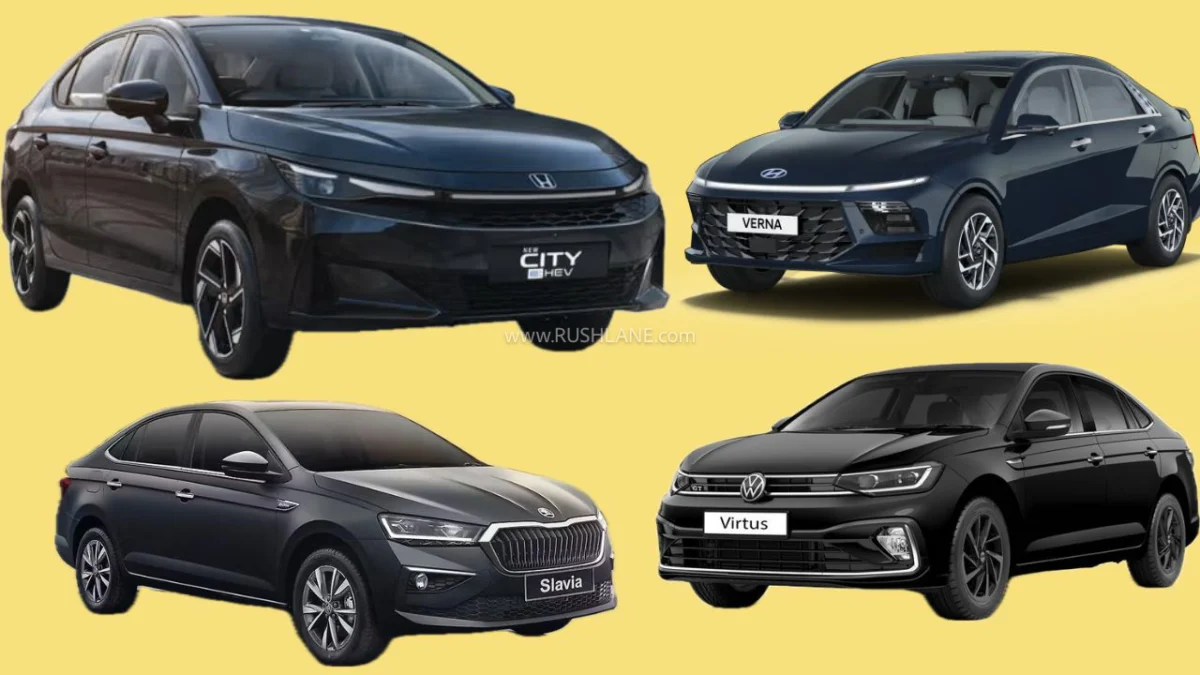
The Indian automotive landscape, long dominated by the relentless surge of Compact and Mid-size SUVs, is witnessing a sophisticated resurgence in the premium sedan segment. At the heart of this revival is the venerable Honda City, a nameplate that has defined the C-segment for over two decades. Honda Cars India Ltd. recently fortified its position by launching the Honda City facelift, a strategic move aimed at reclaiming market share from a formidable trio of rivals: the tech-heavy Hyundai Verna, and the performance-oriented European cousins, the Volkswagen Virtus and Skoda Slavia.
As the 2026 model year approaches, the competition has never been more cutthroat. With the Hyundai Verna recently undergoing a radical transformation and the Volkswagen Group’s "India 2.0" sedans preparing for their own mid-cycle refreshes, the Honda City finds itself in a high-stakes battle of dimensions, safety tech, and powertrain philosophy.
1. Main Facts: The New Competitive Order
The launch of the Honda City facelift introduces subtle yet significant cosmetic and functional updates. However, the sedan landscape has shifted since the fifth-generation City first arrived. The current market is defined by four distinct philosophies:
- Honda City: The balanced incumbent, focusing on reliability, cabin ergonomics, and the pioneering e:HEV strong-hybrid technology.
- Hyundai Verna: The futuristic disruptor, leading the pack in terms of sheer feature density, aggressive styling, and raw power.
- Volkswagen Virtus & Skoda Slavia: The enthusiast’s choices, built on the MQB-A0-IN platform, prioritizing structural integrity, ground clearance, and turbocharged driving dynamics.
While the City remains a household name, it faces a pricing disadvantage. Starting at Rs 12 lakh and stretching to Rs 21 lakh for the top-tier Hybrid variant, it is the most expensive entry point in the segment. Conversely, the Skoda Slavia holds the title of the most affordable starting price, while the Verna is increasingly viewed as the "Value for Money" (VFM) champion due to its extensive equipment list at a competitive price point.

2. Chronology: The Road to the 2026 Face-Off
To understand the current rivalry, one must look at the rapid sequence of events that reshaped the segment over the last few years:
- The European Entry (2022): Volkswagen and Skoda discontinued their aging Vento and Rapid models, replacing them with the larger, more powerful Virtus and Slavia. This forced a shift in the segment’s size and performance benchmarks.
- The Hybrid Gambit (2023): Honda introduced the City e:HEV, bringing strong-hybrid technology to the masses and offering a diesel-beating fuel efficiency of over 27 km/l.
- The Verna Revolution (2024-2025): Hyundai launched the all-new Verna with a polarizing "Sensuous Sportiness" design, a 5-star Global NCAP rating, and a segment-leading 158 bhp turbo-petrol engine.
- The 2026 Refresh Cycle: Honda responds with the current City facelift. Simultaneously, Hyundai prepares its 2026 model year updates, and the Volkswagen Group readies facelifts for the Virtus and Slavia to incorporate more technology and stay relevant against the Korean and Japanese onslaught.
3. Supporting Data: A Comprehensive Technical Comparison
Dimensions and Presence
In the mid-size sedan world, "bigger is better" remains the mantra for the Indian consumer. Despite the City’s facelift increasing its cosmetic length to 4,594 mm, it lags behind in the most critical metric for interior comfort: the wheelbase.
| Attribute | Honda City | Hyundai Verna | VW Virtus / Skoda Slavia |
|---|---|---|---|
| Length | 4,594 mm | 4,535 mm | 4,561 mm / 4,541 mm |
| Wheelbase | 2,600 mm | 2,670 mm | 2,651 mm |
| Width | 1,748 mm | 1,765 mm | 1,752 mm |
| Boot Space | 506L (Petrol) | 521L | 521L |
| Ground Clearance | Not Disclosed | Not Disclosed | 179 mm |
The Hyundai Verna dominates the wheelbase and width categories, translating to superior shoulder room and rear-seat legroom. Furthermore, the European duo offers a segment-best ground clearance of 179 mm, a vital feature for navigating Indian road conditions, whereas Honda and Hyundai remain tight-lipped about their official clearance figures.
Powertrain and Efficiency
The segment is currently split between three mechanical ideologies: Naturally Aspirated (NA) for reliability, Turbo-petrol for performance, and Hybrid for efficiency.

- The Performance King: The Hyundai Verna’s 1.5L Turbo Petrol engine produces a staggering 158 bhp and 253 Nm of torque, making it the most powerful vehicle in its class.
- The Enthusiast’s Choice: The Virtus and Slavia offer a 1.5L TSI engine with Active Cylinder Technology (ACT), delivering 148 bhp and a driving experience characterized by German precision.
- The Efficiency Leader: The Honda City e:HEV remains the gold standard for fuel economy, promising 27.13 km/l. However, its high price tag (Rs 21 lakh) makes the ROI a long-term calculation for buyers.
Interestingly, Honda continues to equip the City with 185-section tires, which many critics argue are "skinny" for a car of this stature. In contrast, all three major rivals offer 205-section tires, providing better grip and a more planted stance.
Safety and Technology
Safety has transitioned from an optional extra to a primary selling point.
- Hyundai Verna: Leads with a radar-based Level-2 ADAS system and a 5-star Global NCAP rating. It is the only car in the segment to offer all-four disc brakes across its higher trims.
- VW Virtus & Skoda Slavia: Both boast 5-star Global NCAP ratings for both adult and child occupants, emphasizing structural integrity over electronic aids, as they currently lack ADAS features.
- Honda City: Utilizes a camera-based Level-2 ADAS system (Honda Sensing). While effective, camera-only systems can sometimes struggle in heavy rain or low-visibility conditions compared to radar-based units. However, Honda’s "Lane Watch" camera remains a fan-favorite feature for navigating tight traffic.
4. Feature Wars: The Battle for the Cabin
Inside the cabin, the Hyundai Verna "trounces everything in its path," according to industry analysts. It introduces features previously reserved for the D-segment or luxury cars.
- The Tech Suite: While all contenders offer roughly 10-inch infotainment screens, the Verna is the only one providing a fully digital 10.2-inch TFT instrument cluster. It also features a built-in dashcam, a first-in-segment addition that caters to the growing demand for security and insurance documentation.
- Comfort and Ergonomics: All four sedans offer ventilated front seats—a necessity in the Indian climate. However, Honda sticks to manually adjustable seats for the City, whereas its rivals offer powered adjustments.
- The "Boss Mode": In a nod to the chauffeur-driven demographic, the Verna includes a "Boss Mode" feature, allowing the rear passenger to move the front passenger seat forward to maximize legroom.
- Visibility and Privacy: The City offers a manual rear windshield blind, but the Verna counters with rear window blinds (side), a feature often preferred by those seeking privacy and sun protection.
5. Official Responses and Industry Context
While Honda executives maintain that the City’s "legacy of trust" and "unmatched resale value" will keep it at the top, market analysts suggest a tougher road ahead.

A spokesperson for Honda Cars India noted during the launch that the City facelift aims to provide a "harmonious blend of advanced safety and elegant styling." However, the industry sentiment suggests that the "elegant" approach may be under threat from the "feature-rich" approach of Hyundai and the "performance-first" approach of the Volkswagen Group.
Industry experts point out that the mid-size sedan segment is no longer just about getting from point A to point B. "The 2026 buyer is tech-savvy," says a lead automotive consultant. "They want ADAS, they want connected car tech, and they want a car that feels like a gadget on wheels. Hyundai has tapped into this perfectly, while the Europeans have captured the hearts of the driving enthusiasts. Honda is playing the middle ground, which is a traditionally safe bet, but the middle ground is shrinking."
6. Implications: The Future of the C-Segment Sedan
The arrival of the Honda City facelift and the impending 2026 updates for its rivals signal a "do or die" moment for sedans in India.
For the Consumer: The competition is driving innovation. Buyers now have access to 5-star safety, autonomous driving features, and hybrid technology—all under the Rs 20 lakh mark. The variety of powertrains means there is a "perfect" car for every type of user, whether they are a high-mileage commuter (City Hybrid) or a weekend highway cruiser (Virtus/Verna Turbo).

For the Manufacturers: The pressure is on to localize advanced technology. Honda’s reliance on a camera-based ADAS versus Hyundai’s radar-based system will be a key test of consumer preference. Furthermore, the pricing strategy will be crucial. If Honda cannot justify the premium for the City, it risks losing its crown to the Verna, which currently offers more "bang for the buck."
The Verdict: The Honda City facelift is a refined evolution of a classic, but it is no longer the undisputed king. The Hyundai Verna has redefined the segment’s feature list, while the Virtus and Slavia have set new bars for driving dynamics. As we move into 2026, the City will have to rely on its reputation for reliability and the unique appeal of its Hybrid powertrain to withstand the most aggressive competitive environment it has faced in its 25-year history.
