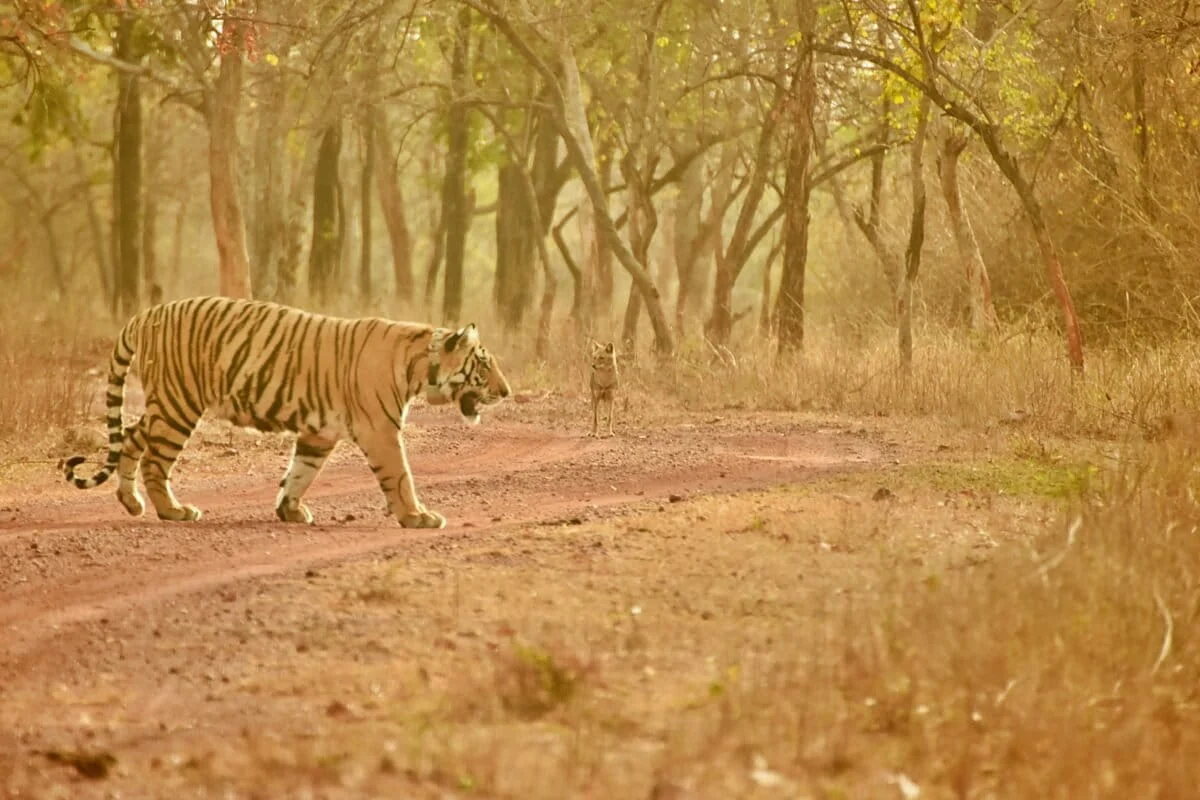
PANNA, MADHYA PRADESH – In the annals of global conservation, the Panna Tiger Reserve (PTR) stands as a beacon of hope and a cautionary tale. In 2009, the reserve faced a catastrophic milestone: it was officially declared to have lost its entire tiger population to rampant poaching. The silence in the dry deciduous forests of Madhya Pradesh was absolute, marking a nadir for India’s Project Tiger.
Yet, today, Panna is celebrated for a "miraculous" recovery. Following a rigorous reintroduction program that began shortly after the collapse, the reserve is once again home to a thriving population of Bengal tigers. However, a groundbreaking new study from the Wildlife Institute of India (WII) suggests that the success of this recovery was not merely a result of releasing apex predators into the wild. Instead, the study reveals that Panna’s resurgence was underwritten by an intact foundation of prey abundance and a resilient habitat—factors often overshadowed by the charismatic allure of the tiger.
Main Facts: The Hidden Architecture of Recovery
The study, authored by Supratim Dutta and his colleagues at WII, shifts the focus from the "top-down" approach of predator management to a "bottom-up" understanding of ecosystem dynamics. The research, titled "Interspecific Interaction among Mammals in Panna Tiger Reserve," posits that while carnivore reintroduction is a vital tool for ecological balance, it cannot succeed in a vacuum.
"Focusing exclusively on the apex predator for ecosystem recovery tells only a fraction of the story," explains Supratim Dutta. "The real question is not whether the tigers came back, but what environmental and biological infrastructure made that recovery possible. The answer lies in the broader mammalian community."
The findings suggest that Panna’s tigers did not simply "reclaim" the land; they integrated into a pre-existing, robust network of herbivores and secondary carnivores. The study identified that tiger presence is inextricably linked to the spatial distribution of specific prey, such as chital (spotted deer) and sambar. Furthermore, the research highlighted a phenomenon known as "trophic facilitation," where the presence of tigers actually benefited other scavengers, such as striped hyenas, through the provision of carrion.

Chronology: From Total Collapse to Ecological Resurgence
To understand the significance of the WII study, one must look at the timeline of Panna’s turbulent history:
- Pre-2009: Panna was a stronghold for tigers in Central India. However, a lack of stringent protection led to a steady decline due to organized poaching.
- 2009: The Forest Department and independent biologists confirmed that not a single tiger remained in the reserve. This sparked a national outcry and a total overhaul of the reserve’s management.
- 2009–2010: The Panna Tiger Reintroduction Project was launched. Two female tigers (T1 and T2) were brought from Bandhavgarh and Kanha, followed by a male (T3) from Pench.
- 2010–2015: The reintroduced tigers began breeding. The population grew steadily, supported by intensive monitoring and the relocation of several villages from the core area to reduce human-wildlife conflict.
- 2019: Researchers from WII conducted large-scale camera trap surveys to assess how the now-stabilized tiger population was interacting with the rest of the ecosystem.
- 2024: The publication of the WII study provides the first comprehensive look at the multi-layered interactions that define the "new" Panna.
Supporting Data: 40,000 Images of a Living Landscape
The WII study was a massive undertaking, utilizing 475 camera trap sites during the winter and 338 sites during the summer of 2019. The cameras, placed along animal trails, riverbeds, and forest roads, generated a staggering 40,308 images.
The Mammalian Census
The data identified 10 key species that define the Panna landscape. Interestingly, the most frequently photographed animal was not a wild herbivore, but cattle, reflecting the complex relationship between the reserve and the 30,000 people living in its buffer zone.
Following cattle, the most common sightings were:
- Chital (Spotted Deer): The primary prey for tigers.
- Sambar: A larger deer species preferred by tigers in denser forest patches.
- Leopards: The reserve’s secondary apex predator, which showed a distinct spatial niche compared to tigers.
- Striped Hyenas: The most frequently recorded carnivore after leopards, showing a surprising affinity for tiger-occupied areas.
The Modeling Approach
Researchers used a sophisticated modeling framework to test three hypotheses:

- Predator-Driven Model: Assumed that tigers and leopards dictate where other animals live.
- Prey-Driven Model: Assumed that the availability of food dictates the movement of all species.
- Combined Model: Included environmental factors like water, slope, and forest cover.
The "Combined Model" proved to be the most accurate. It revealed that tigers did not "suppress" their prey into a state of equilibrium. Instead, they "tracked" an already abundant and spatially organized prey community. This suggests that the prey was the engine of the recovery, and the tigers were the passengers who eventually took the wheel.
The Scavenger Guild and the "Water Backbone"
One of the most unexpected findings of the study was the relationship between tigers and hyenas. In many ecosystems, larger predators kill or drive away smaller competitors. However, in Panna, hyenas were more likely to be found in areas with high tiger activity.
"This is trophic facilitation," says Dutta. "Apex predators were functionally subsidizing the scavenger guild. By leaving behind carcasses, tigers and leopards provided a consistent food source for hyenas, allowing them to thrive in the same space."
Furthermore, the data underscored the absolute criticality of the Ken River. Panna is a landscape of extremes, with summer temperatures soaring to 45°C. The Ken River is the only perennial water source in the 1,574-square-kilometer reserve. The study found that for almost every species, the probability of detection dropped sharply as the distance from the river increased. The river acts as the "ecological backbone," concentrating life in a narrow corridor during the harsh dry season.
Official Responses and Expert Perspectives
The WII study has been met with praise from the broader conservation community, as it provides scientific backing for a "holistic" approach to rewilding.

Anish Andheria, President and CEO of the Wildlife Conservation Trust (WCT), who was not involved in the study, noted that Panna’s success was a "best-case scenario" because the habitat had not been destroyed along with the tigers.
"In Panna, tigers were lost to poaching, not because the prey had collapsed or the forest had been razed," Andheria said. "That is a crucial distinction. In many other landscapes where reintroduction is discussed, the prey base is already gone. You cannot simply drop a predator into a ‘dead’ forest and expect it to survive. Predator recovery depends on prey density, just as prey populations are shaped by predators."
Andheria further emphasized that Panna’s recovery was "catalysed" by what was already there. "The habitat was intact. The sambar and chital were there. The water was there. The tigers were the missing piece of the puzzle, but the puzzle board was ready."
Implications: A New Blueprint for Rewilding
The findings from Panna have significant implications for future conservation efforts across India and the world. As India embarks on ambitious projects like the Cheetah reintroduction in the nearby Kuno National Park, or discusses sending tigers to Cambodia, the lessons of Panna serve as a vital guide.
1. Prey First, Predators Second
The study suggests that the "success" of a reintroduction should not be measured by the birth of the first cubs, but by the stability of the prey base. Conservationists must ensure that herbivore populations are at a carrying capacity that can support a large carnivore before translocation begins.

2. Habitat Connectivity and Water Security
The reliance of Panna’s wildlife on the Ken River highlights the danger of habitat fragmentation. If water sources are diverted or if corridors between water and forest cover are broken, the entire mammalian community could collapse, regardless of how well the predators are protected.
3. The Role of the "Buffer Zone"
With 30,000 people and high numbers of cattle in the buffer zone, Panna is not a "pristine" wilderness but a shared landscape. The study’s finding that cattle are the most frequent species captured on camera highlights the need for management strategies that account for human presence and livestock as part of the ecosystem’s energy flow.
4. Redefining "Ecosystem Restoration"
Supratim Dutta’s conclusion offers a philosophical shift for the field: "A reintroduced predator population does not restore an ecosystem; it reveals whether a stable one already exists."
In the end, the Panna miracle was not just about bringing back the roar of the tiger. It was about a river that kept flowing, a forest that remained standing, and a community of deer and scavengers that waited for their king to return. The study serves as a reminder that in the complex web of nature, every thread—from the smallest hyena to the largest river—is essential to holding the tapestry together.