

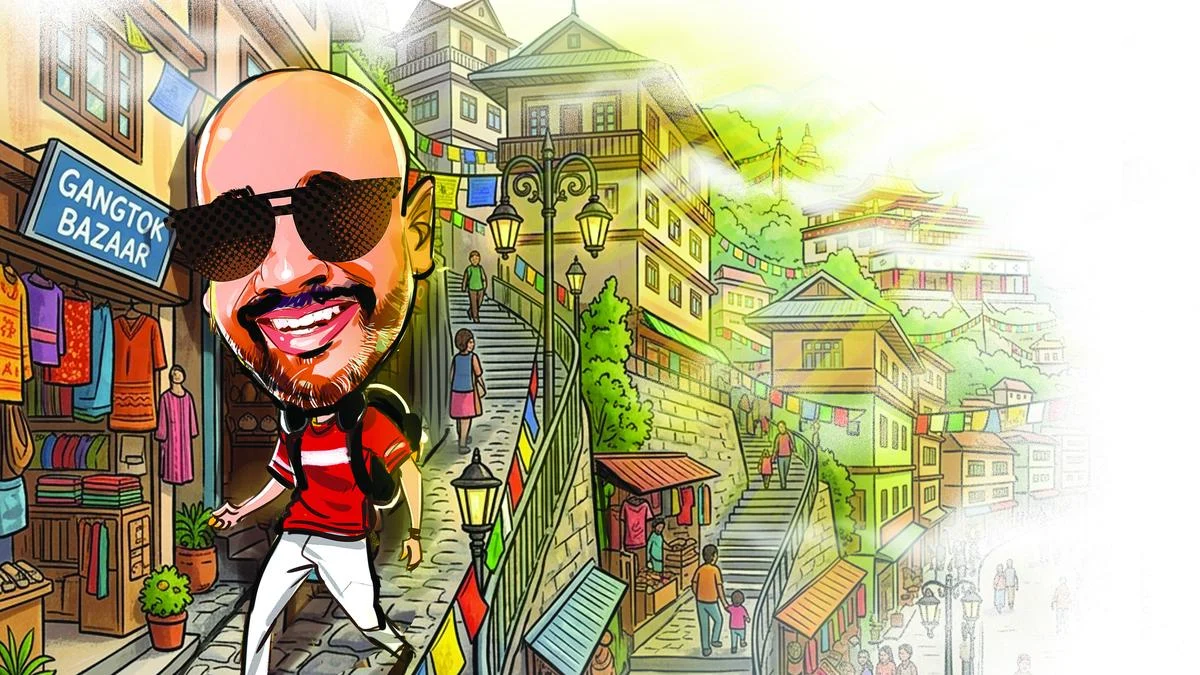
GANGTOK — In the landscape of Indian urban planning, where the car is often king and the pedestrian an afterthought, the capital of Sikkim stands as a defiant anomaly. While major metropolises like Delhi, Bengaluru, and Chennai struggle with crumbling sidewalks and suffocating traffic, Gangtok has quietly cultivated a culture of walkability that rivals international standards. From the pedestrianized sanctuary of MG Marg to a twelve-kilometer footpath that shadows the national highway, Gangtok offers a blueprint for what a "walker’s city" can look like in the 21st century.
Main Facts: A City Built for the Human Scale
Gangtok, a city of approximately 150,000 residents perched in the Himalayan foothills, has achieved what many larger, wealthier Indian cities have failed to do: create a continuous, safe, and pleasant environment for those on foot. The city’s infrastructure is defined not just by its roads, but by an intricate web of stairs, flyovers, and dedicated footpaths that allow residents to navigate the vertical terrain with efficiency.
The crown jewel of this urban design is MG Marg. In 2009, this central stretch of road was completely pedestrianized, transforming it into a vehicle-free zone that serves as the city’s social and commercial heart. Beyond the city center, the infrastructure extends into the suburbs. A remarkable 12-kilometer footpath runs along the highway, connecting the main town to the residential hubs of Tadong, 5th Mile, and 6th Mile, stretching nearly to the neighboring town of Ranipool.
Unlike the fragmented and often obstructed sidewalks found in other Indian cities, Gangtok’s footpaths are characterized by:
- Structural Integrity: Proper railings on both sides to ensure safety on steep inclines.
- Connectivity: Integration with stairs and flyovers that provide shortcuts between winding mountain roads.
- Civic Discipline: A strictly enforced culture of cleanliness, with bans on littering and public spitting that are noted by visitors and influencers alike.
Chronology: The Evolution of a Walking Culture
The transformation of Gangtok from a traditional hill station to a modern pedestrian hub did not happen overnight. It evolved through three distinct phases:
The Era of Necessity (Pre-2000s)
Historically, walkability was a matter of survival and geography. In the Himalayan foothills, the steep topography made walking the most logical—and often only—way to get around. Generations of Gangtokians grew up with "knee-obliterating" daily commutes, walking uphill to schools and tuition centers and downhill to stadiums and markets. Covering five kilometers a day on foot was the standard baseline for residents.
The 2009 Transformation: The MG Marg Experiment
The pivotal moment in Gangtok’s modern urban history occurred in 2009 with the pedestrianization of MG Marg. The proposal, spearheaded by local officials and architects like Prashant Pradhan, was initially met with significant skepticism. Shop owners feared that removing car access would stifle business, while residents worried about the logistics of transporting the elderly or the sick.

Despite these "murmurs of discontent," the government moved forward. The result was an immediate revitalization of the city center. MG Marg became a "living room" for the city, where people engaged with their environment rather than simply passing through it in a vehicle.
The Modern Expansion (2010–Present)
Following the success of MG Marg, the city expanded its pedestrian focus. The construction of the 12-kilometer highway footpath and the integration of pedestrian-only flyovers marked a shift from localized pedestrian zones to a city-wide network. This era also saw the introduction of stricter vehicular regulations aimed at preserving the city’s walkability.
Supporting Data: Infrastructure and Regulation
The success of Gangtok’s pedestrian-centric model is supported by specific data points and regulatory frameworks that distinguish it from the rest of the country.
The Highway Footpath
The 12-kilometer continuous footpath is a rarity in South Asia. In most Indian cities, highways are hostile environments for pedestrians. In Gangtok, the footpath serves as a primary artery for commuters. By providing a safe, railed path that parallels the main vehicular route, the city has successfully separated high-speed traffic from human movement, reducing the risk of accidents.
Vehicular Control Measures
To prevent the city from being overwhelmed by cars, the Sikkim government has implemented some of the strictest vehicle ownership laws in India. A key regulation requires any prospective automobile buyer to provide "proof of parking space" at their residence before a vehicle can be registered. This prevents the "street-side parking" crisis that plagues cities like Delhi and Mumbai.
Furthermore, the "odd-even" traffic rule has been utilized to manage congestion, though officials admit that rising wealth continues to put pressure on the city’s narrow roads.
Comparative Urbanism
When compared to other Indian metros, Gangtok’s infrastructure stands out:

- Chennai/Bengaluru: While these cities have parks, they lack a functional "errand-based" walking network. Pedestrians often have to compete with motorcycles on sidewalks.
- Chandigarh: Noted as one of the few other Indian cities with a consideration for walkers, though its flat, sprawling grid offers a very different experience than Gangtok’s vertical density.
- Shimla/Pondicherry: These towns have attempted pedestrian zones, but often struggle with the "last mile" connectivity that Gangtok has mastered.
Official Responses and Expert Insights
The architectural and governmental philosophy behind Gangtok’s success emphasizes the "human experience" over "vehicular flow."
Prashant Pradhan, one of the architects instrumental in the redesign of the city’s public spaces, notes that the shift was as much psychological as it was physical. "The city came alive with people walking, meeting, and engaging," Pradhan observes. He highlights that the initial resistance from business owners vanished once they realized that foot traffic is more conducive to retail than drive-by traffic.
Government officials have also pointed to the "civic sense" of the population as a critical component. The enforcement of no-smoking, no-spitting, and no-littering zones in the pedestrian areas has created a "premium" feel to the public space, which in turn encourages residents to respect and use the infrastructure.
However, officials also acknowledge a growing challenge: the "status" of the car. As the middle class grows, there is a cultural shift where walking is increasingly viewed as a sign of lower economic status—a "uniquely South Asian insecurity," as some social observers describe it. To combat this, the city continues to promote walking as a lifestyle choice for the "posh" and the healthy, rather than just a necessity for the car-less.
Implications: A Model for the Future of Indian Cities
The implications of Gangtok’s success extend far beyond the borders of Sikkim. As India grapples with rapid urbanization, the Gangtok model offers several vital lessons:
1. The Economic Value of Pedestrianization
MG Marg proves that car-free zones are not bad for business; they are transformative. By creating a space where people want to linger, the city has boosted its tourism and local retail sectors. This serves as a case study for cities like Delhi (Chandni Chowk) and Mumbai (Kala Ghoda) as they experiment with similar zones.
2. Environmental and Health Benefits
In a country facing a respiratory health crisis, Gangtok’s emphasis on walking provides a natural mitigation strategy. The physical demand of the city’s "up-down" geography contributes to a healthier population, while the reduction of short-distance car trips lowers the localized carbon footprint.

3. The "Last Mile" Solution
Gangtok’s network of stairs and footpaths solves the "last mile" connectivity problem that multi-billion dollar metro projects in other cities often ignore. By treating stairs and footpaths as primary infrastructure—equal in importance to roads—Gangtok ensures that public transport (like the ropeway or local taxis) is accessible to everyone.
4. Cultural Smugness vs. Urban Reality
There is a growing sense of "pedestrian pride" among Gangtokians. Residents who move to other Indian cities often report a sense of "smugness" about their hometown’s walkability when faced with the "no-walk zones" of the plains. This pride is a powerful tool for urban maintenance; when citizens value their sidewalks, they are more likely to protect them.
Conclusion: The Long Walk Ahead
Despite its successes, Gangtok is not immune to the pressures of modernity. Traffic jams remain a persistent issue, exacerbated by a culture that increasingly views walking as "un-posh." The challenge for the next decade will be maintaining the city’s pedestrian-centric identity in the face of rising car ownership.
However, for now, Gangtok remains the gold standard. It is a city where a resident can walk to the dentist, the tailor, and the bookstore without ever feeling like an intruder on the road. It is a city where a 60-kilometer walk along a highway is seen not as a feat of endurance, but as a "wonderfully provincial" way to spend a day.
As novelists and residents like Prajwal Parajuly note, the true value of Gangtok is only fully realized when one leaves it. In the heat and chaos of Chennai or the sprawl of New York, the memory of Gangtok’s railed footpaths and clean, cobbled squares serves as a reminder that Indian cities can be walkable—if they have the vision to prioritize the person over the piston.
