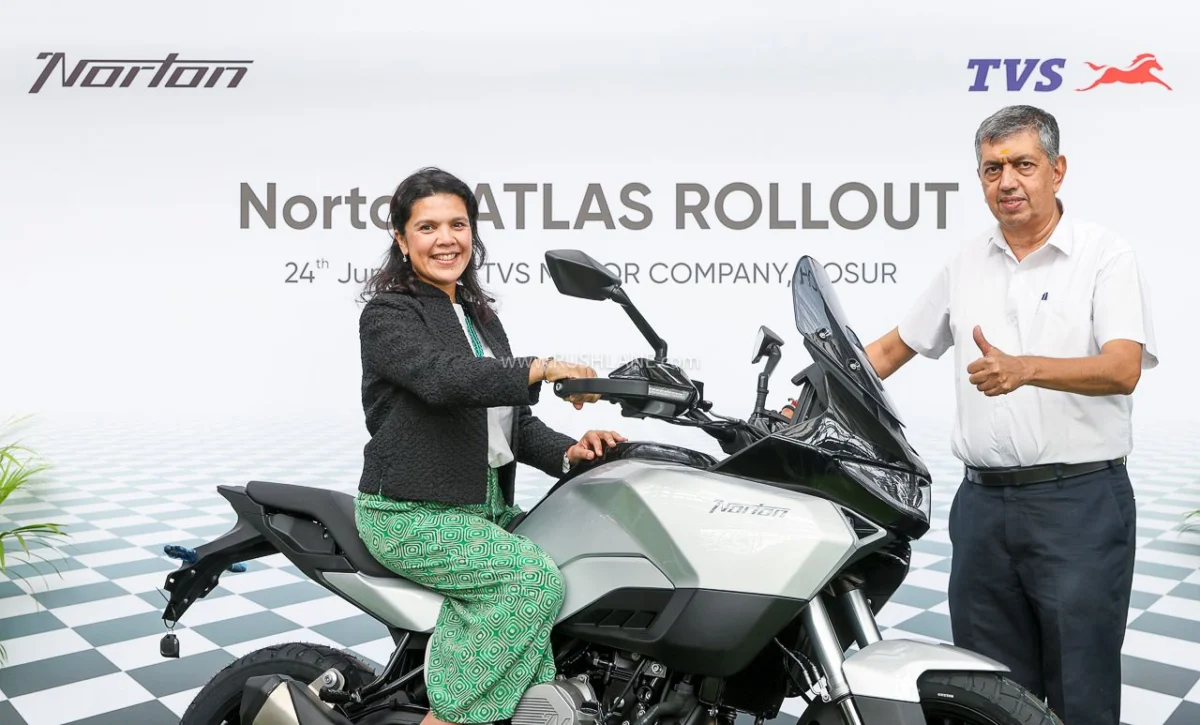
The global motorcycling landscape witnessed a pivotal moment on June 24, 2026, as the first production units of the Norton Atlas began rolling off the assembly lines at TVS Motor Company’s state-of-the-art manufacturing facility in Hosur, Tamil Nadu. This milestone marks a definitive chapter in the revival of Norton Motorcycles, the storied British marque that was acquired by the Indian two-wheeler giant, TVS Motor Company, in 2020.
The rollout ceremony was not merely a logistical achievement but a symbolic bridge between British heritage and Indian manufacturing prowess. Attended by high-ranking officials, including Dr. Sutapa Choudhury, the British Deputy High Commissioner for Tamil Nadu, Puducherry, and Kerala, the event signaled the commencement of a global strategy aimed at reclaiming Norton’s position in the premium motorcycling segment.
Main Facts: The New Era of the Norton Atlas
The Norton Atlas, a nameplate steeped in history, returns as a middleweight contender designed to compete in the increasingly crowded adventure and sport-touring markets. The motorcycle is the fruit of a collaborative effort: it was entirely designed and engineered at Norton’s global headquarters in Solihull, United Kingdom, while the heavy lifting of mass production has been entrusted to TVS’s Hosur plant.
Two Distinct Variants
Norton is launching the Atlas in two primary iterations to cater to different riding styles:
The Norton Atlas (Standard): An adventure-focused machine equipped with a 19-inch front wheel, designed for light off-roading and long-distance touring.
The Norton Atlas GT: A road-biased sport-tourer featuring 17-inch wheels at both ends, optimized for agility, high-speed stability, and spirited tarmac riding.
The Heart of the Machine
At the core of the Atlas range is an all-new 585cc liquid-cooled parallel-twin engine. Eschewing the traditional 180-degree crank, Norton has opted for a 270-degree firing order. This configuration is intentional, providing the engine with a characterful exhaust note and power delivery reminiscent of a V-twin, while maintaining the compact packaging of a parallel twin.
Technological Sophistication
The Atlas is positioned as a premium offering, featuring a suite of electronics that rivals flagship superbikes. This includes a Bosch six-axis Inertial Measurement Unit (IMU), which facilitates lean-sensitive traction control, cornering ABS, and "cornering cruise control"—a rare feature in the middleweight segment. Riders interact with the machine via a massive 8-inch high-definition TFT display, which integrates smartphone connectivity through the proprietary Norton Rider app.
Chronology: From Acquisition to Assembly
The journey of the new Norton Atlas is a timeline of strategic restructuring and engineering focus.
April 2020: TVS Motor Company acquires Norton Motorcycles in an all-cash deal worth approximately £16 million, rescuing the brand from administration.
2021–2023: TVS invests heavily in a new global headquarters in Solihull, UK. This period is dedicated to fixing quality issues of previous models (like the V4SS) and establishing a "Quality-First" engineering culture.
November 2025: Norton officially showcases the Atlas and Atlas GT prototypes at EICMA in Milan, Italy. The motorcycles receive critical acclaim for their design, which blends modern aesthetics with classic Norton cues.
June 24, 2026: The first production-spec Atlas rolls off the line in Hosur, India.
July 2026 (Upcoming): Official global debut and media launch events are scheduled to take place in Europe.
Q3 2026: Customer deliveries are slated to begin in the UK and European markets.
Late 2026: The official commercial launch in the Indian market.
FY2027: Full-scale operations of "TVS Paddock," the premium retail network, to support Norton and other high-end TVS products.
Supporting Data: Engineering and Specifications
The collaboration between Solihull and Hosur has resulted in a motorcycle that boasts impressive specifications on paper, aimed at dethroning established European and Japanese rivals.
Chassis and Suspension
The Atlas utilizes a steel trellis frame, chosen for its balance of rigidity and weight. To ensure top-tier handling, Norton has partnered with KYB for the suspension. Both the front USD forks and the rear monoshock are fully adjustable for preload, compression, and rebound damping. This level of adjustability is often reserved for higher-capacity machines, highlighting Norton’s "no-compromise" approach.
Braking and Safety
Braking duties are handled by twin discs at the front with radially mounted calipers, integrated with the aforementioned Bosch cornering ABS. The inclusion of five distinct rider modes (Rain, Road, Sport, Off-Road, and Custom) allows the rider to tailor the throttle map, engine braking, and electronic intervention levels to suit the environment.
Manufacturing Logistics
The Hosur facility has been upgraded with a dedicated "Clean Room" assembly line for Norton products. While the UK facility in Solihull remains the hub for low-volume, high-value flagship models like the Manx R superbike and the V4SV, the Hosur plant provides the scale necessary for the Atlas to be price-competitive in the global middleweight market. This "Designed in UK, Made in India" model mirrors the successful strategies of other Indo-British partnerships, such as Triumph-Bajaj and BSA-Mahindra.
Official Responses: A Shared Vision
The rollout event featured optimistic commentary from both diplomatic and corporate leaders, underscoring the importance of this project for Indo-British trade relations.
Dr. Sutapa Choudhury, British Deputy High Commissioner, remarked on the occasion:
"The rollout of the Norton Atlas from this facility is a testament to the strengthening ties between the UK’s design innovation and India’s manufacturing excellence. Norton is an iconic British brand, and seeing it thrive under the stewardship of TVS Motor Company is a proud moment for both nations."
Senior Executives from Norton Motorcycles emphasized the brand’s commitment to quality:
"The Atlas is not just a new model; it is the embodiment of the ‘New Norton.’ Every component has been scrutinized to ensure it meets the standards expected of a premium British marque. By leveraging TVS’s world-class manufacturing capabilities in Hosur, we can ensure that this quality is delivered consistently to riders across the globe."
TVS Motor Company Leadership added:
"Our goal with Norton has always been to restore it to its rightful place as a global leader in the premium segment. The start of production for the Atlas is a major milestone in that journey. We are creating a product that is globally competitive, technologically advanced, and deeply rooted in the heritage of Norton."
Implications: Market Impact and Strategic Shifts
The production of the Norton Atlas in India carries significant implications for the motorcycle industry, TVS Motor Company, and the Norton brand itself.
1. Disrupting the Middleweight Segment
The 500cc–800cc segment is currently the most contested space in motorcycling. By offering a 585cc twin with premium electronics and suspension, Norton is positioning the Atlas as a "boutique" alternative to mass-market twins like the Yamaha T7 or the Honda XL750 Transalp. Its success will depend on whether consumers perceive it as a true Norton or a "TVS-built" product—a perception Norton is fighting by keeping design and engineering firmly in the UK.
2. The "TVS Paddock" Retail Strategy
For years, TVS has been known primarily as a manufacturer of high-quality commuters and the Apache series of performance bikes. The launch of Norton necessitated a complete overhaul of their retail experience. The "TVS Paddock" initiative, set to debut in FY27, will be a premium dealership network designed to offer a luxury buying experience. This network will be crucial for the Atlas, as premium buyers demand a level of service and brand atmosphere that standard commuter showrooms cannot provide.
3. Economic and Geopolitical Synergy
The Norton-TVS partnership serves as a blueprint for future "Free Trade Agreement" (FTA) discussions between India and the UK. It showcases how Indian capital can save a legacy British brand while creating high-tech jobs in both Solihull and Tamil Nadu. The project benefits from India’s lower production costs without sacrificing the "Britishness" of the brand’s identity.
4. Reclaiming the Heritage
The original 1962 Norton Atlas was a powerhouse of its time, designed to compete with the best of the era’s twins. By reviving this name, Norton is tapping into the nostalgia of the "Cafe Racer" and "Scrambler" eras. However, the new Atlas is forward-looking. Its 8-inch TFT and IMU-based electronics suggest that Norton is no longer content living in the past; it wants to lead the future of middleweight touring.
Conclusion
The rollout of the first Norton Atlas from Hosur is more than just a production start; it is a declaration of intent. For TVS, it is proof that they can handle the complexities of a premium European brand. For Norton, it is a lifeline that provides the scale and stability needed to survive in the 21st century.
As the Atlas prepares for its global debut next month, the motorcycling world will be watching closely. If the bike can deliver on its promise of Solihull-engineered soul and Hosur-built reliability, it may well mark the beginning of a golden era for one of the oldest and most respected names in motorcycling history. With customer deliveries set for Q3 2026, the roar of the 270-degree parallel twin is about to become a familiar sound on roads from London to Chennai.