

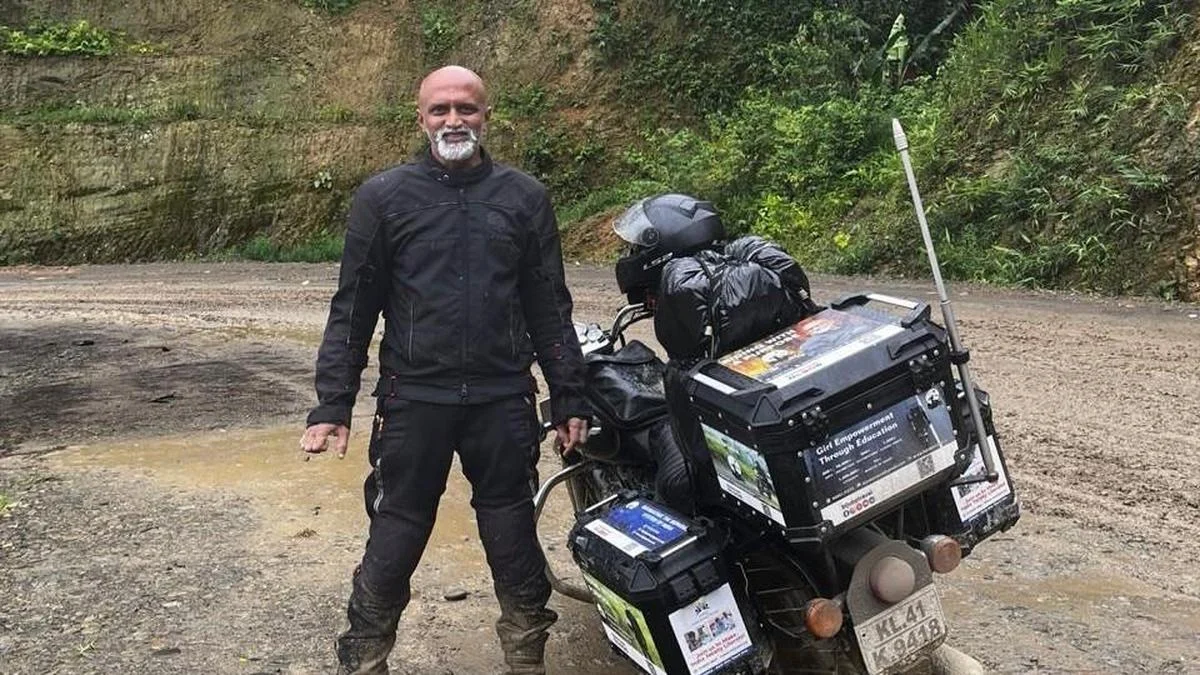
THIRUVANANTHAPURAM — “A lifetime is not enough to travel across India. You cannot imagine the diversity that is out there.” These words, spoken with the quiet conviction of a man who has seen more of the Indian subcontinent than most will in several lifetimes, serve as the modest summary of an extraordinary feat. Biju BP, a solo motorcyclist whose journey has captured the imagination of the nation, has officially been recognized by the World Records Union for completing the longest solo motorcycle ride across Indian states and Union Territories.
What distinguishes Biju’s journey from a mere feat of endurance is its core mission: the promotion of girl empowerment through education. Over a staggering period of 666 days, Biju traversed the length and breadth of India, turning his motorcycle into a mobile billboard for social change. While the ride concluded in October 2023, the rigorous verification process required by international record-keeping bodies culminated in May 2026, when he was formally awarded the world record.
Main Facts: A Journey of Numbers and Narratives
The scale of Biju BP’s achievement is difficult to overstate. Spanning nearly two years, his expedition covered all 28 Indian states and 8 Union Territories. While the primary goal was social advocacy, the physical and logistical requirements were gargantuan.
Key Statistics of the Expedition:
- Duration: 666 Days
- Scope: 28 States and 8 Union Territories
- Primary Objective: Advocacy for girl child education and empowerment.
- Official Recognition: World Records Union (May 2026).
- Evidence Submitted: Thousands of GPS logs, 15,000+ photographs, video testimonials, and over 100 newspaper clippings from various regional languages.
Biju did not set out to break records. "I didn’t undertake the journey keeping this record in mind," he explained during a recent press briefing. "I applied for it only when my friends and well-wishers insisted. Since I had already finished the journey, I had to submit the proof, which included recordings, photographs, and newspaper cuttings to the Records Union. It was a tedious process of retrospective documentation."
The Chronology of a Two-Year Odyssey
Biju’s journey began with a single kickstart, fueled by a passion for motorcycling and a deep-seated concern for the educational disparities facing girls in rural India.
The Departure and Initial Phase:
Starting from the southern tip of the peninsula, Biju spent the first three months navigating the coastal roads of Kerala, Tamil Nadu, and Karnataka. During this phase, he focused on rural school visits, coordinating with local NGOs to speak with parents about the long-term economic benefits of keeping daughters in school.
The Himalayan Challenge:
As he moved northward, the terrain and climate became his primary adversaries. Biju reached the high-altitude passes of Ladakh and Himachal Pradesh during the shoulder seasons. He navigated the treacherous Zojila and Khardung La passes, often riding in sub-zero temperatures. Here, his mission took on a different tone, as he witnessed the resilience of students in remote mountain villages who trek miles daily to reach the nearest schoolhouse.
The Heartland and the North-East:
The middle year of his journey was spent in the vast plains of Uttar Pradesh, Bihar, and the tribal belts of Jharkhand and Chhattisgarh. It was here that Biju encountered the most significant socio-economic barriers to education. He spent weeks engaging with community leaders, using his motorcycle—a symbol of freedom and mobility—as a conversation starter.
The final leg took him through the "Seven Sisters" of the North-East. Navigating the monsoon-drenched roads of Meghalaya and the rugged terrain of Arunachal Pradesh, Biju documented the unique matrilineal societies and educational structures of the region, adding a rich layer of cultural data to his mission.
The Conclusion:
By the time Biju returned to his starting point in October 2023, he had worn through multiple sets of tires, survived various mechanical failures, and, more importantly, collected thousands of signatures and pledges from citizens promising to support girl child education in their local districts.
Supporting Data and Logistical Rigor
To maintain the integrity of a world record claim, Biju had to operate with the precision of a surveyor. The World Records Union requires "unimpeachable proof of presence" in every administrative region claimed.
Logistical Documentation:
Biju utilized a combination of digital and analog tracking. Every 50 kilometers, he logged his GPS coordinates. In every major town or city, he sought out local authorities—often police stations or village panchayats—to sign a logbook verifying his arrival and departure. This logbook, now a thick, weathered volume, serves as a testament to the administrative diversity of the Indian state.

The Machine:
The motorcycle used was not a high-end imported superbike but a rugged, Indian-made machine modified for long-distance touring. Biju emphasized that using a locally serviceable bike was essential. "In the interiors of Odisha or the heights of Spiti, you don’t need a fast bike; you need a bike that a local mechanic can fix with a hammer and a wrench," he noted.
The Advocacy Impact:
Beyond the ride, Biju’s data includes interactions at over 400 schools. He distributed educational kits and pamphlets translated into 12 different regional languages, ensuring that his message of empowerment was accessible to the grassroots populations he encountered.
Official Responses: Recognition of a National Feat
The confirmation of the record in May 2026 brought forth a wave of commendations from both the government and the private sector.
The World Records Union issued a statement regarding the certification: "The verification of Mr. Biju BP’s journey required an extensive audit of nearly two years of travel data. His commitment to the cause of girl empowerment, combined with the sheer physical endurance required for a 666-day solo ride, sets a new benchmark for advocacy-based adventure."
State education departments have also taken note. A spokesperson for the Ministry of Education commented, "Individual initiatives like that of Biju BP complement national schemes like Beti Bachao, Beti Padhao. By taking the message to the most inaccessible parts of the country on a motorcycle, he has humanized the statistics of educational reform."
Motorcycling clubs across India have hailed Biju as a "modern-day dervish." The President of the All-India Riders Association stated, "Biju has shown that the motorcycle is not just a vehicle for thrill-seeking, but a potent tool for social mobilization. His record is a matter of pride for the entire Indian biking community."
Implications: The Legacy of the 666-Day Ride
Biju BP’s achievement carries implications that extend far beyond the record books. It highlights three critical areas of contemporary Indian life:
1. The Power of Solo Advocacy:
In an era of digital activism, Biju’s journey reaffirms the impact of "boots on the ground" (or tires on the road). The face-to-face interactions he had with rural families provided a level of engagement that social media campaigns cannot replicate. His journey suggests that for deep-seated social issues like gender bias in education, personal presence remains the most effective form of advocacy.
2. Tourism and Infrastructure:
Biju’s ability to navigate the entire country over 666 days serves as an informal audit of India’s growing road infrastructure. His successful transit through once-isolated regions in the North-East and the Himalayan belt underscores the improving connectivity that is vital for both economic growth and educational access.
3. Redefining Masculinity in Adventure:
The motorcycling subculture is often associated with rugged individualism. By dedicating his ride to "girl empowerment," Biju has helped pivot the narrative of the "lone rider" toward one of social responsibility. He has demonstrated that the spirit of adventure can—and perhaps should—be harnessed for the betterment of those who do not have the privilege of mobility.
Conclusion: A Lifetime in Two Years
As Biju BP settles back into a more stationary life, the dust of the Indian roads may have settled on his gear, but his mission continues. He is currently in the process of compiling his journals and photographs into a book aimed at inspiring young travelers to ride with a purpose.
"The record is just a piece of paper," Biju says, looking at the certificate from the World Records Union. "The real reward is the memory of a girl in a small village in Bihar telling me she wants to be a pilot, or a father in Arunachal Pradesh promising that his daughter will finish college. India is too big to understand in a day, but in 666 days, I learned that despite our different languages and landscapes, the hope for a better future for our children is the thread that binds us all."
Biju BP’s journey remains a landmark in the annals of Indian adventure—not just for the miles covered, but for the minds opened along the way. In the vast, diverse tapestry of India, his motorcycle tracks have left an indelible mark, proving that one man, one bike, and one message can indeed resonate across a billion hearts.
