

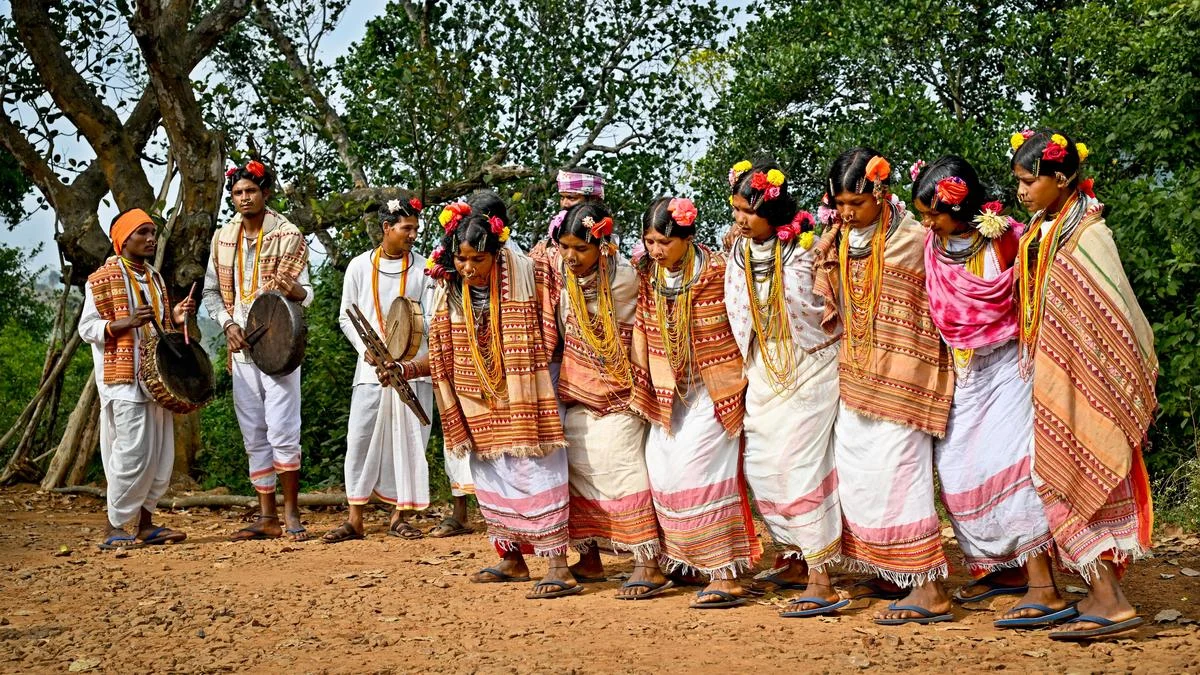
At the foothills of Odisha’s Niyamgiri mountain range, the air on a Monday morning is thick with the scent of sun-dried fruit and the low hum of competitive bargaining. In the small town of Kalyansingpur, the weekly santha (shandy) is more than just a marketplace; it is a vital economic artery and a cultural stage for the Dongria Kondh, one of India’s most reclusive and resilient Particularly Vulnerable Tribal Groups (PVTGs).
As a trader tips a handful of amber-colored dried mango slices onto a tarpaulin, the scene captures a delicate balance between an ancient way of life and the encroaching forces of modern commerce. Here, the value of a season’s labor is determined in a few frantic hours of negotiation, while the forested slopes of Niyamgiri—the "Mountain of Law"—loom in the distance, serving as a silent witness to a community that has successfully fought to keep its hills sovereign.

Main Facts: The Pulse of the Kalyansingpur Santha
The Monday market at Kalyansingpur serves as the primary interface between the Dongria Kondh and the outside world. By 10:00 AM, the market is a kaleidoscope of activity. Motorcycles navigate through crowds of buyers, and weighing scales swing rhythmically as sacks of forest produce are traded for cash or essential supplies.
The Dongria Kondh women are the most striking figures in this landscape. Their appearance is a curated display of tribal identity: strands of vibrant beads drape across their chests, multiple metal rings pierce the cartilage of their ears, and a signature small dagger (kapda gunda) is tucked discreetly into their tightly coiled hair buns. These daggers are not merely decorative; they are practical tools for forest life and symbols of a protective spirit that defines the tribe.

This season, the market is dominated by the wild mango harvest. Unlike the commercial varieties found in urban supermarkets, these native mangoes are harvested from the deep forests, sliced, and sun-dried on the slopes. However, the economics of the santha are volatile. This year, a bumper crop has led to a significant price drop. While dried mango sold for approximately ₹85 per kilogram last year, the current season has seen prices tumble to nearly ₹45. Despite the lower margins, the volume of trade remains high, with consignments destined for major hubs like Raipur, Mumbai, and various districts in Andhra Pradesh.
Chronology: From Ancestral Sovereignty to Legal Landmark
The history of the Dongria Kondh is inextricably linked to the Niyamgiri hills, a 250-square-kilometer massif spanning the Rayagada and Kalahandi districts. For centuries, the tribe has practiced a unique form of horticulture, transforming the steep slopes into "hanging gardens" of pineapples, bananas, and millets.

The Sacred Struggle (2003–2013)
The modern history of the region is defined by a decade-long David-vs-Goliath battle against industrial encroachment. In the early 2000s, the Odisha Mining Corporation (OMC) and the global mining giant Vedanta Resources proposed an open-cast bauxite mine on the Niyamgiri plateau. For the Dongria Kondh, this was not just an environmental threat; it was a religious sacrilege. They believe the mountain is the abode of their supreme deity, Niyam Raja, and that mining the hilltop would be equivalent to "decapitating their god."
The 2013 Supreme Court Verdict
The conflict culminated in a historic 2013 judgment by the Supreme Court of India. In a landmark decision for indigenous rights, the court ruled that the tribal communities’ religious and cultural rights must be considered under the Forest Rights Act (FRA). The court mandated that local Gram Sabhas (village councils) must decide whether mining should be permitted.

The "Niyamgiri Referendum"
In July and August of 2013, 12 Gram Sabhas were held across the hills. In an unprecedented show of unity, the tribal residents unanimously rejected the mining proposal. This was the first time in Indian history that a "referendum" was used to grant indigenous people the power to veto a major industrial project on their ancestral lands.
Supporting Data: The Ecology and Economy of the Hills
The resilience of the Dongria Kondh is rooted in their diversified ecological economy. Unlike monoculture farmers, the tribe relies on a "forest-farm" continuum that provides food security throughout the year.

Agricultural Diversity
A typical Dongria Kondh meal, often served on hand-stitched leaf plates, reflects this diversity. A single lunch may include:
- Native Millets: Ragi (finger millet) porridge, a staple that provides high calcium and iron.
- Legumes: Native varieties of tur dal (pigeon pea) and black gram.
- Wild Fruits: Jackfruit, tamarind, wild berries (kala jamun), and pineapples.
- Forest Vegetables: Wild brinjals and plantains.
Economic Reach
While the tribe lives in relative isolation, their products have a wide geographic footprint. The wild mango season is brief—peaking in June—but the volume of dried produce flowing out of Kalyansingpur is substantial. Traders note that the unique tartness and organic nature of Niyamgiri’s wild mangoes make them highly sought after in the food processing industries of neighboring states.

Demographics and Development
As a PVTG, the Dongria Kondh population is small, estimated at around 10,000 to 15,000 individuals living in approximately 120 villages. While tradition remains the bedrock of their society, the hills are not immune to change. Solar panels now glint from the roofs of concrete houses provided under government schemes, and mobile phones are increasingly used to track market prices in Kalyansingpur before the long trek down the mountain.
Official Responses and Legal Frameworks
The status of the Dongria Kondh is protected under several layers of Indian law, though the implementation of these protections remains a point of contention between activists and the state.

The Forest Rights Act (2006): This legislation was the cornerstone of the 2013 court victory. It recognizes the "community forest rights" of tribes, allowing them to manage and protect their traditional lands. Officials from the Odisha tribal welfare department state that efforts are ongoing to provide individual land titles, though many Dongria leaders argue that the collective "community" title is more vital for the preservation of the hills.
The PESA Act (1996): The Provisions of the Panchayats (Extension to Scheduled Areas) Act grants special powers to Gram Sabhas in tribal areas. In Niyamgiri, the PESA Act is viewed as the "shield" that prevents the alienation of tribal land.

Government Initiatives: The Dongria Kondh Development Agency (DKDA), headquartered in Chatikona and Parsali, is tasked with providing education and healthcare. However, local residents like Babula of Phakeri village emphasize a preference for self-reliance. "Our fields and streams give us everything," he says. "We earn from what we grow. Why would we exchange that for something that could damage the hills?"
Implications: The Future of Indigenous Sovereignty
The story of the Dongria Kondh at the Kalyansingpur market is a microcosm of a larger global struggle: the tension between industrial development and indigenous conservation.

Environmental Stewardship
The Niyamgiri hills are a vital watershed, feeding two major rivers—the Vamsadhara and the Nagavali. The Dongria Kondh’s refusal to allow mining has effectively preserved a critical carbon sink and a biodiversity hotspot. Their traditional farming practices, which eschew chemical fertilizers in favor of forest mulch, serve as a model for sustainable agriculture in an era of climate change.
Cultural Continuity vs. Modernity
The presence of solar panels and cricket-playing children in villages like Phakeri suggests that the Dongria Kondh are not "frozen in time." They are selective adopters of technology. The challenge for the coming decade will be ensuring that "development" does not come at the cost of the very identity that has sustained them. The younger generation, while more connected to the digital world, still participates in the traditional festivals and the santha trade, indicating a strong cultural glue.

A Model for Rights-Based Conservation
Niyamgiri remains a beacon for other indigenous groups across India and the world. It proved that legal frameworks, when backed by grassroots mobilization and judicial independence, can protect vulnerable groups from displacement. However, the drop in mango prices this year highlights their vulnerability to market fluctuations. There is an urgent need for better cooperative structures that could help the tribe process their produce locally—such as making mango pulp or leather—to ensure they capture more value from their labor.
As the afternoon light softens over Kalyansingpur, the santha begins to wind down. The sacks of mangoes are loaded onto trucks bound for the cities, and the Dongria Kondh families begin the steep climb back to their mountain hamlets. They return to a landscape they have fought for, carrying with them the supplies for the week and the enduring spirit of Niyam Raja. In the quiet of the hills, life continues in an unhurried rhythm—a testament to the fact that for some, the land is not a resource to be extracted, but a heritage to be lived.
