

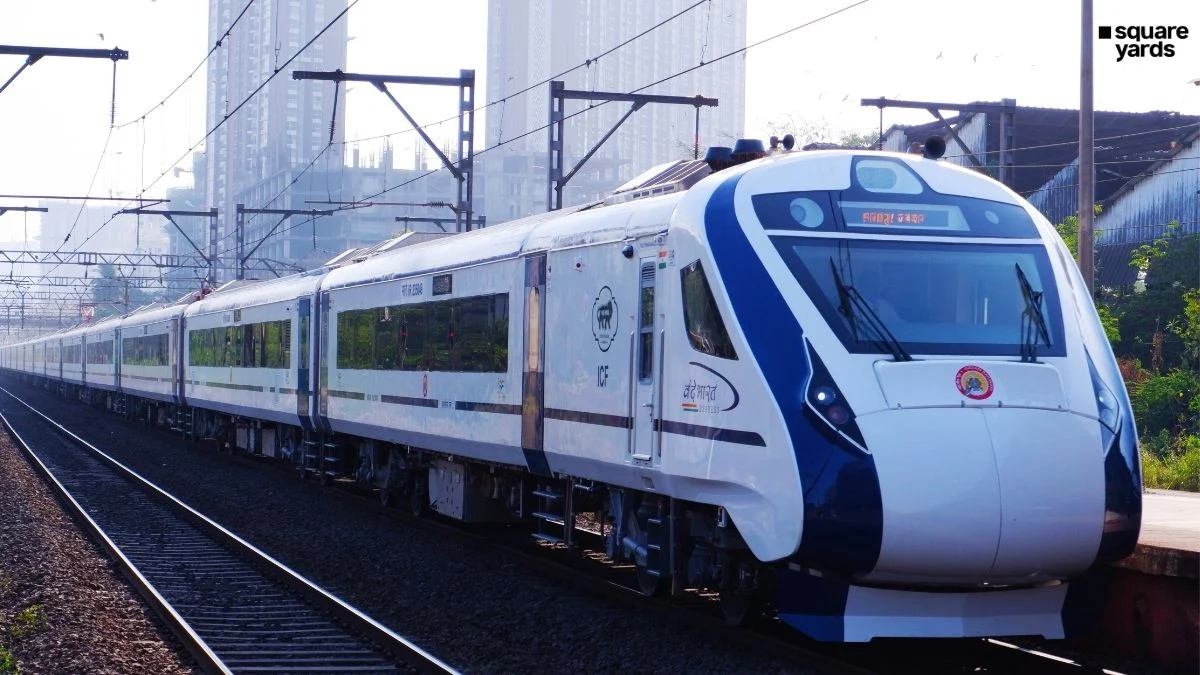
In the traditional lexicon of Indian real estate, "location" has always been the primary determinant of value. However, as India stands on the precipice of a high-speed infrastructure revolution, a new metric is emerging: time. The proposed Bengaluru-Hyderabad High-Speed Rail (HSR) corridor is not merely a transport project; it is a catalyst for a socio-economic paradigm shift that could redefine the geography of Southern India.
By slashing travel time between two of the nation’s most powerful economic engines from nearly twelve hours to just under two, the project promises to create an "Integrated Economic Region." For investors, developers, and homebuyers, this shift represents a generational opportunity, provided they can distinguish between speculative hype and long-term execution.
I. Main Facts: The Blueprint of a High-Speed Corridor
The Bengaluru-Hyderabad Bullet Train project is envisioned as a high-capacity, high-speed link connecting the capital of Karnataka with the capital of Telangana. While the project is currently in the advanced planning and approval stages, several technical and geographical specifications have been established.
Technical Specifications and Speed
The corridor is designed to accommodate speeds of up to 350 kmph, with an expected operational speed of approximately 320 kmph. At these velocities, the roughly 600-kilometer distance between the two cities—currently a grueling 8 to 12-hour journey by conventional rail or a 9-hour drive—will be covered in approximately 120 to 150 minutes.
Proposed Route and Key Stations
The alignment is expected to serve as a spine connecting major industrial and residential hubs. Key nodes identified in preliminary surveys include:
- Bengaluru Hubs: Kodihalli (Bengaluru Rural), Devanahalli (near Kempegowda International Airport), and Alipura (Gauribidanur).
- Transit Towns: Hindupur, Anantapur, Kurnool, and Mahbubnagar.
- Hyderabad Hub: Shamshabad (near Rajiv Gandhi International Airport), leading into the city’s core.
The "Two-Hour Economic Region" Concept
The primary objective is the creation of a seamless business zone. Bengaluru’s dominance in aerospace, R&D, and the startup ecosystem, paired with Hyderabad’s leadership in pharmaceuticals, life sciences, and data centers, creates a synergistic corridor. The HSR allows for "day-tripping" for executives, researchers, and specialized talent, effectively merging the labor markets of both cities.
II. Chronology: From Vision to Preliminary Execution
The trajectory of the Bengaluru-Hyderabad HSR has gained significant momentum over the last 24 months, moving from a conceptual proposal to a project with institutional backing.
- Initial Proposal & National High-Speed Rail Corporation (NHSRCL) Inclusion: The route was identified as one of the seven high-speed corridors planned by the Government of India to expand the HSR network beyond the Mumbai-Ahmedabad line.
- Survey and Alignment (2023-2024): RITES Limited, a leading engineering consultancy, was commissioned to conduct preliminary alignment studies and LiDAR surveys. These surveys are crucial for determining the path of least resistance, minimizing environmental impact, and identifying land acquisition requirements.
- State-Level In-Principle Approval (Recent Milestone): The Karnataka Cabinet recently granted in-principle approval for the corridor. This is a critical step, as state cooperation is essential for land acquisition and the development of multimodal integration at station points.
- DPR Preparation (Current Stage): The project is currently in the Detailed Project Report (DPR) phase. This report will finalize the financial model, exact station locations, and environmental clearances.
- Future Outlook (2026 and Beyond): Following the submission and approval of the DPR, the project will move into the land acquisition and tendering phases. While a "bullet train" is a long-gestation project, the planning phase alone has already begun to influence land prices in the proposed influence zones.
III. Supporting Data: Real Estate Momentum in Key Influence Zones
Data provided by Square Yards highlights a clear trend: even before a single track has been laid, the "announcement effect" is driving price appreciation in areas identified as potential HSR hubs.
1. Devanahalli (North Bengaluru)
Devanahalli is perhaps the most significant beneficiary on the Karnataka side. Already a powerhouse due to the Kempegowda International Airport and the Aerospace Park, the HSR station adds a layer of inter-city connectivity that transforms it into a regional gateway.
- Price Trends: Average apartment asking prices have climbed from ₹8,550 per sq. ft. in June 2025 to ₹9,250 per sq. ft. by March 2026.
- Yields: The area currently offers a rental yield of 3.37%, supported by the influx of professionals working in the nearby tech and aerospace sectors.
- Market Sentiment: With government registration prices hovering around ₹8,600 per sq. ft., the market remains robust, driven by the prospect of becoming a multimodal transport hub.
2. Shamshabad (South Hyderabad)
On the Telangana side, Shamshabad mirrors Devanahalli’s potential. Its proximity to the Rajiv Gandhi International Airport makes it the logical terminus or major stop for the HSR.
- Price Trends: Asking prices moved from ₹7,850 per sq. ft. to ₹8,850 per sq. ft. over the same nine-month period.
- Commercial Potential: Square Yards data indicates commercial office space pricing in Shamshabad at approximately ₹27,850 per sq. ft., signaling that the market is preparing for high-value business activity rather than just residential sprawl.
3. Hoskote (The Eastern Junction)
While not directly on the Hyderabad line, Hoskote is a critical "watch" market. As Bengaluru plans for both the Hyderabad and Chennai HSR links, Hoskote emerges as a potential eastern anchor.
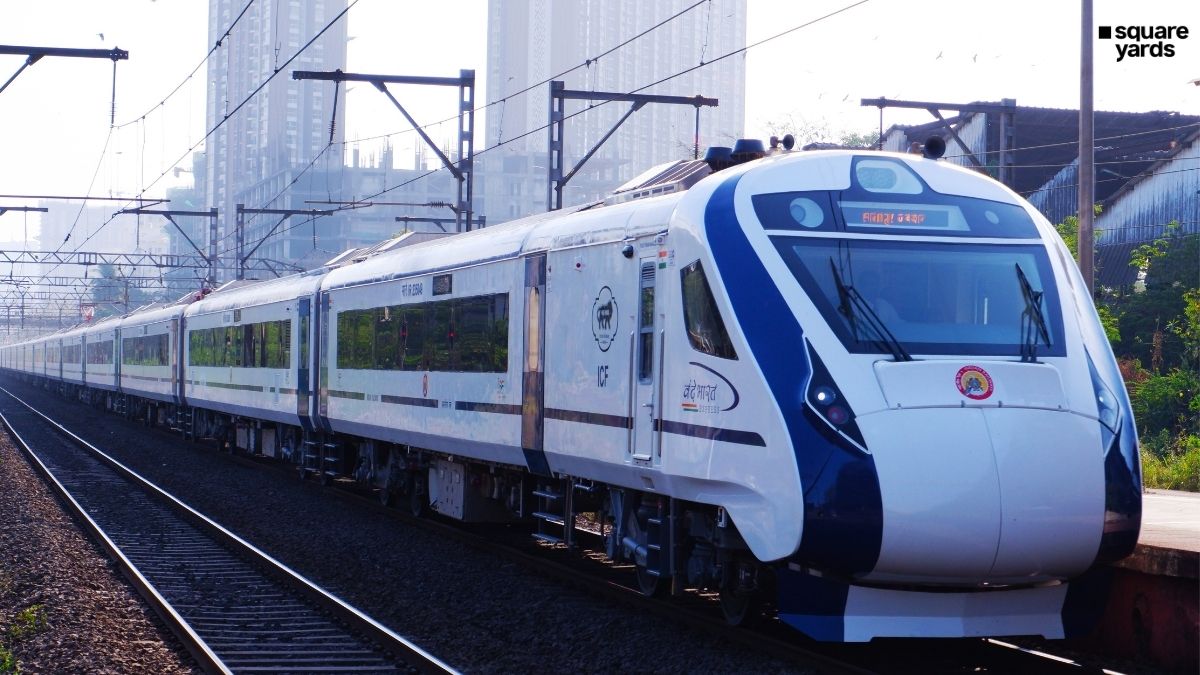
- Growth Statistics: Hoskote has seen a staggering 34.38% growth in apartment prices, rising from ₹6,000 per sq. ft. to ₹7,250 per sq. ft. in less than a year.
- Industrial Synergy: The overlap of the Bengaluru-Chennai Expressway and the proposed rail links makes Hoskote an emerging logistics and industrial powerhouse.
IV. Official Responses and Technical Challenges
While the enthusiasm for the project is high, government officials and infrastructure experts maintain a tone of "cautious optimism."
Land Acquisition: The Primary Hurdle
Official sources within the Karnataka and Telangana governments acknowledge that land acquisition remains the most complex variable. High-speed rail requires a relatively straight alignment with minimal gradients, often necessitating the acquisition of expensive private land or the navigation of sensitive environmental zones.
Funding and Execution Models
The project is expected to follow a joint-venture model between the Central Government and the respective State Governments, potentially involving international funding agencies (similar to the JICA funding for the Mumbai-Ahmedabad corridor). Technical experts emphasize that "execution will create the market." Without seamless "last-mile" connectivity—linking HSR stations to Metro lines and bus rapid transit—the utility of the 350 kmph speed is diminished.
RITES and Technical Oversight
RITES Limited has emphasized that the technical feasibility of the Bengaluru-Hyderabad route is high due to the relatively flat terrain of the Deccan Plateau compared to the mountainous regions of the North. However, the integration of stations into existing urban fabrics remains a significant engineering challenge.
V. Implications: The Economic and Real Estate Ripple Effect
The completion of the Bengaluru-Hyderabad HSR will have far-reaching consequences that extend beyond simple commuting.
1. Decentralization of the Tech Workforce
Currently, the "tech talent" is concentrated in the core areas of Whitefield, Electronic City (Bengaluru), and HITEC City (Hyderabad). The HSR allows for the development of "Satellite Tech Cities." A professional could live in Anantapur or Kurnool—where the cost of living and real estate is significantly lower—and commute to Bengaluru or Hyderabad in under an hour.
2. The Rise of Transit-Oriented Development (TOD)
We are likely to see a surge in Mixed-Use Developments around station points. These "Station Cities" will feature a blend of:
- Grade-A Commercial Spaces: For companies wanting a presence in both cities.
- Serviced Apartments & Hotels: Catering to the "day-tripper" business demographic.
- Premium Plotted Developments: For investors looking to capitalize on the long-term appreciation of land near infrastructure nodes.
3. Logistics and Hospitality
The speed of the HSR isn’t just for people; it can also facilitate the rapid movement of high-value, low-volume freight (like pharmaceuticals or electronics). Furthermore, the hospitality sector in cities like Anantapur and Kurnool could see a boom as they become "halfway points" for business and tourism.
4. Risks for Investors: Speculation vs. Reality
The "Infrastructure Trap" is a real risk. Investors often flock to areas based on "proposed" lines on a map. However, real estate value is only realized when the project moves into the construction phase.
- Advice for Homebuyers: Focus on locations that have an existing economic base (like Devanahalli or Shamshabad). Do not buy solely on the promise of the bullet train.
- Advice for Investors: Track the "Influence Zones"—areas within a 5-10 km radius of confirmed stations. Proximity to the track itself is often a disadvantage due to noise; proximity to the station is where the value lies.
Conclusion: Redrawing the Map of South India
The Bengaluru-Hyderabad High-Speed Rail is more than a train; it is a blueprint for a new Indian urbanism. By bridging the gap between two of the world’s fastest-growing cities, the corridor will effectively create a mega-metropolis of nearly 30 million people, connected by a two-hour thread.
As the project moves from the drawing board of RITES to the construction sites of the NHSRCL, the real estate landscape will continue to shift. The "winners" of this transformation will not be those who merely follow the tracks, but those who understand that in the next decade of Indian real estate, the most valuable commodity is no longer square footage—it is time.
