

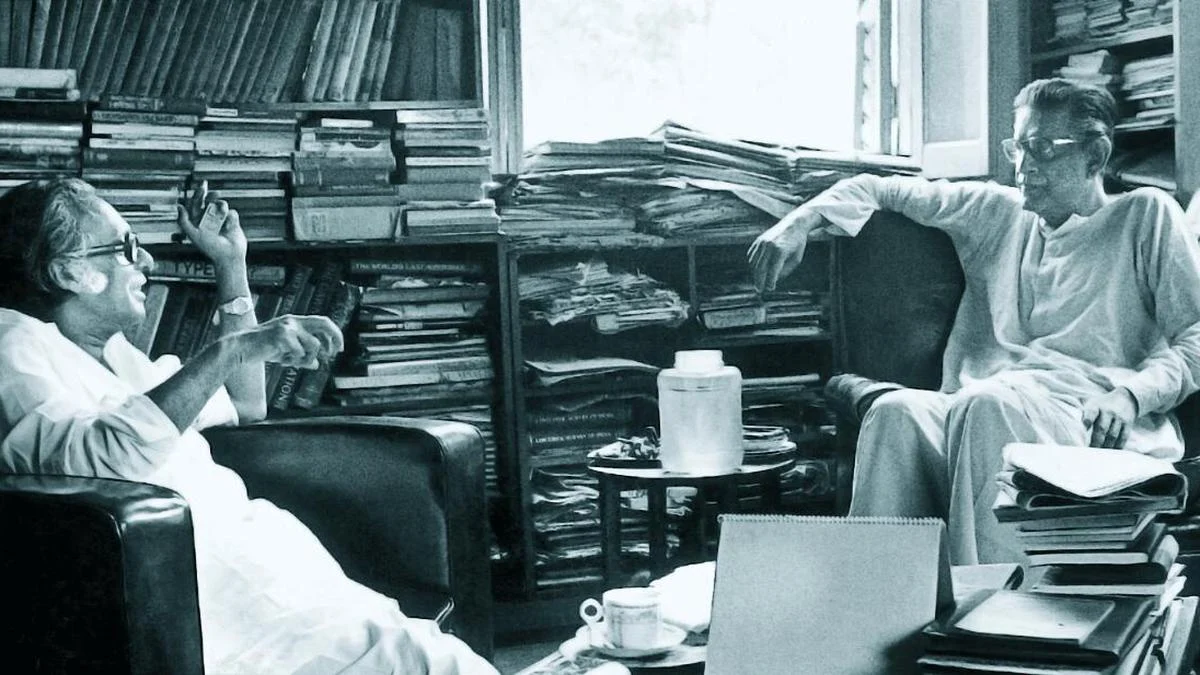
Beyond the celebrated canvases, the silver screen’s enduring magic, and the resonant verses that defined an era, lie the quieter, yet equally potent, forces that shaped Bengal’s rich cultural tapestry: profound friendships. These bonds, forged in shared dreams, intellectual sparring, and unwavering support, often served as the silent engines driving artistic innovation and societal progress. This exploration, drawing from the insights of Professor Sanjoy Mukhopadhyay, delves into the remarkable connections that not only defined the lives of luminaries but also indelibly marked the landscape of Indian cinema, literature, and art.
The Art of Collaboration: Satyajit Ray and Bansi Chandragupta
The genius of Satyajit Ray, a filmmaker whose name resonates globally, was often accompanied by moments of quiet introspection and even trepidation. Before the iconic "Action!" or "Cut!" echoed on the sets of his groundbreaking films, the maestro would often find himself wrestling with uncertainty. It was in these silences that the strength of his friendship with Bansi Chandragupta, his art director and closest confidant, truly shone.

Chandragupta, with an almost telepathic understanding, would step in to provide the crucial cues, easing Ray through the creative process. This camaraderie transcended the technicalities of filmmaking. The image of Chandragupta casually lighting Ray’s cigarette on the sets of Apur Sansar (1959) is more than a mere anecdote; it serves as a poignant metaphor for a friendship that literally and figuratively kept the flame alive, illuminating one of the most illustrious bodies of work in Indian cinema. Professor Mukhopadhyay, who inherited these stories through his own deep connections with Ray’s collaborators like film editor Dulal Dutta and cinematographer Soumendu Roy, emphasizes this symbiotic relationship. These were not just professional acquaintances; they were individuals who understood the unspoken nuances of genius and offered steadfast support.
"Khistology" and Scotch: The Unlikely Alliance of Jyoti Basu and Snehangshu Acharya
The political landscape of West Bengal, particularly the Left movement, was profoundly shaped by figures like Jyoti Basu, the former Chief Minister, and Snehangshu Acharya, a distinguished barrister and former Advocate General. While their public lives were intertwined with decades of political struggle and governance, their friendship, which began in their youth, was a testament to the power of shared experiences and intellectual kinship.

Their bond, forged during their student days at Presidency College in the early 1930s, was characterized by irreverent humor and spirited "adda" (informal gatherings). It was during these afternoons on the lawns of Hedua, opposite Scottish Church College, that Acharya conducted his unique, self-invented lessons in "Khistology" – a playful exploration of Bengali slang, delivered with remarkable wit and creativity. Basu and the noted writer Samar Sen were among Acharya’s most enthusiastic students, highlighting a shared appreciation for linguistic dexterity and unconventional learning.
This intellectual camaraderie evolved over the years, extending to a shared appreciation for Scotch whisky during their time in England. Acharya imparted his refined taste to Basu, teaching him the art of savoring the spirit, allowing it to linger and unfold its complex notes. This friendship, rooted in youthful intellectual curiosity and later deepened by shared tastes and mutual respect, endured as a cornerstone of their lives, proving that even amidst the gravest political responsibilities, personal connections could flourish and sustain.

The Crucible of Dreams: Paradise Cafe and the Genesis of Indian Cinema
In the bustling heart of Kolkata, on Hazra Road, stood a modest establishment that belied its immense influence: Paradise Cafe. This humble eatery served as an informal sanctuary for the burgeoning talents who would later define Indian cinema. During the 1940s, it was a meeting point for members of the Indian People’s Theatre Association (IPTA), a vibrant hub where luminaries like Prithviraj Kapoor, Kaifi Azmi, Balraj Sahni, Hrishikesh Mukherjee, Mrinal Sen, Ritwik Ghatak, and Salil Chowdhury would gather, often with pockets lighter than their aspirations.
The cafe, though small, was rich in the company it hosted. Here, amidst the aroma of tea, conversations flowed about cinema, politics, literature, and the audacious dreams they harbored. Hrishikesh Mukherjee, who was earning a modest income, often took on the responsibility of footing the bill, a gesture of quiet generosity that underscored the camaraderie. Ritwik Ghatak, on the other hand, was known for his perpetual borrowing, a trait that became a running joke among his friends.

These gatherings were more than just social soirees; they were incubators of artistic thought and nascent movements. The members of Paradise Cafe were united by a shared belief that art should resonate with the common person and carry a potent political message. Their conversations often revolved around the unfinished nature of their work, the vast creative territories yet to be explored. The release of Satyajit Ray’s Pather Panchali in 1955 was a momentous occasion for this group. Mrinal Sen and Ritwik Ghatak, walking the short distance from Paradise Cafe to Basusree Cinema to witness the film, underscored the collective spirit and shared ambition that permeated these informal meetings. Long before they achieved legendary status, they were simply friends, bound by shared cups of tea, borrowed funds, and the audacious pursuit of cinematic excellence.
Beyond the Canvas: Ramkinkar Baij and Benode Behari Mukherjee’s Artistic Dialogue
At Visva Bharati University in Shantiniketan, a place synonymous with Rabindranath Tagore’s vision, the artistic landscape was being reshaped by the independent spirits of sculptor and painter Ramkinkar Baij and artist Benode Behari Mukherjee. Invited by Tagore himself, these two original thinkers found themselves drawn to European artistic traditions at a time when Kala Bhavan, the university’s art school, remained deeply entrenched in the Oriental school of art.

This divergence in artistic approach did not sit well with Nandalal Bose, the Principal of Kala Bhavan. He frequently voiced his concerns to Tagore, citing the perceived excessive borrowing from Western styles by Baij and Mukherjee. However, Tagore, whose own artistic journey had embraced European influences, saw things differently. He recognized the burgeoning modernity in their work and urged Nandalal not to stifle their creative exploration, famously remarking, "They are young. Let them paint the way they wish."
This paternalistic encouragement fostered a unique intellectual bond between Baij and Mukherjee. Their evenings were often filled with animated discussions, fueled by a bottle of alcohol that Baij would frequently bring to Mukherjee’s home. Though Mukherjee was not a heavy drinker, he never objected, allowing their conversations to drift from the profound harmonies of Beethoven and Mozart to the intriguing aesthetics of Japanese art and European Surrealism. These dialogues, conducted outside the mainstream artistic currents of Shantiniketan, opened up new avenues of artistic expression. Their friendship, deepened by shared intellectual curiosity and a mutual appreciation for diverse artistic traditions, laid the groundwork for their recognition as pioneering figures of Indian modernism.

The Unlikely Union: Michael Madhusudan Dutt and Ishwarchandra Vidyasagar
At first glance, the flamboyant, English-writing poet Michael Madhusudan Dutt and the disciplined, reformist scholar Ishwarchandra Vidyasagar appeared to be worlds apart. Vidyasagar, a towering figure of the Bengal Renaissance, was known for his austere demeanor and deep commitment to tradition, while Dutt was a maverick, an alcoholic, and a writer who primarily expressed himself in English.
Despite these apparent contrasts, their friendship was a remarkable testament to mutual respect and intellectual recognition. Every letter from Dutt to Vidyasagar began with the affectionate salutation, "My dear Vid." Their bond, however, was met with disapproval from some quarters, with many urging Vidyasagar to distance himself from Dutt, deeming him disreputable. Vidyasagar steadfastly refused.

When Dutt sought admission to the Calcutta Bar, a petition was lodged with the Chief Justice, arguing against his character. The Chief Justice, seeking counsel from Bengal’s most respected public figures, received Vidyasagar’s endorsement first. Vidyasagar, with unwavering conviction, declared Dutt fully competent, recognizing the genius that others overlooked. This act of solidarity speaks volumes about Vidyasagar’s foresight and his belief in Dutt’s inherent capabilities.
Dutt, in turn, understood that beneath Vidyasagar’s traditional exterior lay a revolutionary mind reshaping education and social reform. Their friendship challenged conventional definitions of compatibility. One indulged in drink, the other abstained; one embraced Western attire and habits, the other remained rooted in Bengali tradition. Yet, their affection never wavered. Vidyasagar deeply admired Dutt’s literary prowess, and Dutt stood firmly beside Vidyasagar in his advocacy for women’s rights. When financial ruin threatened Dutt, Vidyasagar generously offered him financial assistance, a gesture of trust that few others were willing to extend. Both men were pushing the boundaries of their respective fields, challenging feudal traditions and ushering in a new era for Bengal. Dutt’s radical reimagining of epic narratives in his Bengali works, such as Meghnad Badh Kavya, questioned established moral hierarchies, further solidifying their shared commitment to breaking free from societal constraints.

The Harmonious Resonance: Hemanta Mukhopadhyay and Uttam Kumar
The golden age of Bengali cinema and music owes an immeasurable debt to the profound friendship and creative synergy between singer and music director Hemanta Mukhopadhyay and the beloved actor Uttam Kumar. Their voices and presence intertwined seamlessly, creating a captivating narrative that continues to resonate with audiences.
Their bond was more than professional; it was deeply personal. In a rare interview, Hemanta Mukhopadhyay described Uttam Kumar as his "own," his "younger brother," emphasizing their near-identical identities during their prime: "In those days, Uttam Kumar meant me, and I meant Uttam, as if we were two sons of the same mother." This profound connection meant that their artistic outputs became almost indistinguishable. Hemanta recounted how, after watching films featuring Uttam Kumar lip-syncing his songs, audiences could no longer discern whether the emotive renditions were sung by Hemanta or by Uttam himself. This blurring of artistic identities, where one’s voice became intrinsically linked to another’s presence, stands as a powerful testament to a friendship that transcended individual expression and forged a shared artistic legacy.

Revolutionary Rhythms: Salil Chowdhury and Ritwik Ghatak
The spirit of revolution, both artistic and political, found a potent expression in the friendship between music composer Salil Chowdhury and filmmaker Ritwik Ghatak. Contemporaries and inseparable friends, their bond was nurtured through a shared belief that art should serve as a voice for the common people and carry the weight of political conviction.
Their collaborations, including films like Komal Gandhar (1961) and Bari Theke Paliye (1958), were marked by a deep understanding of each other’s artistic vision. Even when a song composed by Chowdhury for Komal Gandhar was ultimately omitted from the final cut, their artistic dialogues continued unabated, extending beyond the confines of the screen. Their shared dedication to social commentary and their ability to infuse their work with political consciousness made them formidable forces in Bengali cinema and culture. Their friendship was a testament to the power of shared ideals and the enduring impact of collaborative artistic endeavors.

Beyond Ideology: Buddhadeb Bhattacharjee and Biman Bose
In the realm of politics, where ideological divides often define relationships, the friendship between former Chief Minister of West Bengal Buddhadeb Bhattacharjee and Biman Bose, the former State Secretary of the Communist Party of India (Marxist), stands out. Their bond transcended the strictures of political discourse, flourishing in the private spaces of "adda," shared jokes, and conversations that belonged solely to the realm of friendship, distinct from their public roles. This personal connection, nurtured away from the public eye and ideological debates, highlights how genuine human relationships can persist even within the most structured and often contentious environments.
The Enduring Legacy
The stories of these friendships, as recounted and preserved by Professor Sanjoy Mukhopadhyay, reveal a profound truth: the most impactful artistic and intellectual revolutions are often fueled by the quiet strength of human connection. These were not merely acquaintances or professional colleagues; they were individuals who offered each other unwavering support, intellectual stimulation, and a deep wellspring of understanding. Whether it was Bansi Chandragupta steadying Satyajit Ray’s hand, Snehangshu Acharya sharing a glass of Scotch with Jyoti Basu, Hrishikesh Mukherjee paying for tea at Paradise Cafe, or Hemanta Mukhopadhyay and Uttam Kumar becoming one artistic identity, these friendships played an indispensable role in shaping the cultural and intellectual landscape of Bengal and, by extension, India. History remembers the masterpieces, the speeches, and the sculptures, but it is time that truly remembers the friends who stood just outside the frame, ensuring that their companions could shine, forever weaving their own indelible threads into the grand tapestry of human achievement.
